
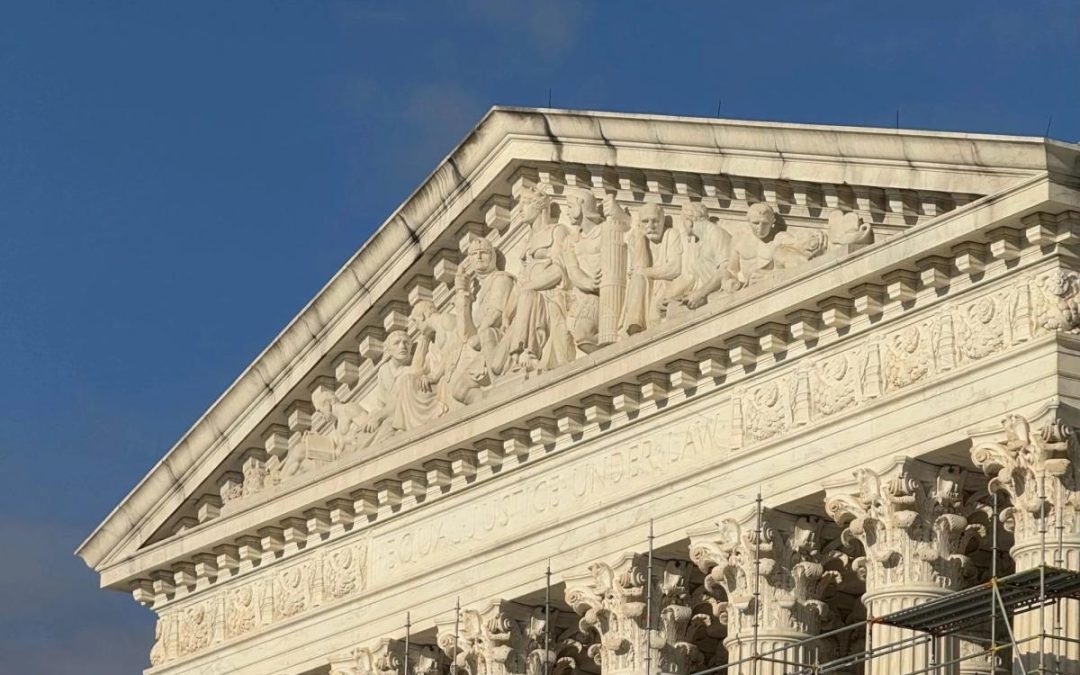
Justice James Wilson died on this day in 1798. This summer, Jesse Wegman published a biography of Wilson, highlighting, among other things, his time in debtors’ prison.
At the Court
Last Friday, the Trump administration urged the Supreme Court to pause a lower-court ruling that would halt construction of a new White House ballroom. The National Trust for Historic Preservation, the private nonprofit challenging the construction project, responded to this request on Tuesday, asking the court to leave the ruling in place. The matter is now fully briefed, so the court’s response could come at any time.
On July 27, the Trump administration asked the Supreme Court on its emergency docket to clear the way for the implementation of President Donald Trump’s executive order on mail-in voting. Twelve states later echoed this request in their own application. One week later, the group of 23 states and the District of Columbia challenging the order asked the court to deny these requests. The matter has been fully briefed for more than two weeks; last week, the Trump administration urged the court to “promptly” issue its decision.
Morning Reads
Supreme Court justices just can’t move about like they did in the good ol' days
Mark Walsh, ABA Journal (paywalled)
In the not-too-distant past, Supreme Court justices navigated the Washington, D.C. area like a typical resident, driving themselves to work and sometimes going for a midday stroll. But today, amid rising security threats, they almost always travel in “armored SUVs” alongside personal security details, according to ABA Journal. Justices Elena Kagan and Amy Coney Barrett highlighted these shifts during their recent appearance before Congress, where they explained “the high court’s request for an increase in security funding,” some of which would go toward adding members to each justice’s detail. “Now, the threats are constant, and they’re always there,” Barrett told a House panel. “It’s necessary now, for protection and daily activities, to have a security detail.”
Oyez, Oyez and Ahoy! Paddlers Protest John Roberts' Private Island
Alex Seitz-Wald, Midcoast Villager
Last weekend, protesters “arrived by kayak, canoe and rowboat” to protest near Chief Justice John Roberts’ vacation home in Maine. “Twenty-one people – and one dog – used small paddle craft to hold a one-hour ‘floating vigil’ in the waters between Port Clyde and Hupper Island, where Roberts has a home, while another 20 people lined the edge of the public landing,” according to the Midcoast Villager. “Organizers said the purpose of the ‘By Land and By Sea Vigil’ was ‘to bring attention to Chief Justice John Roberts’ transformation of the Supreme Court into a rubber stamp for authoritarianism.’”
DHS Lawyer Faces Ethics Complaint Over ‘Worst’ Judges Posts
Suzanne Monyak, Bloomberg Law
DHS general counsel James Percival often takes to social media to post “about the so-called ‘worst of the worst’ judges who’ve ruled against the Trump administration.” Now, his posts are the subject of an “ethics complaint filed with the Florida Bar” by 128 retired judges who believe Percival is “violating professional conduct rules,” according to Bloomberg Law. “The retired judges cited Florida Bar conduct rules that bar attorneys from ‘impugning qualifications and integrity of judges or other officers,’ and asked the Florida Bar to investigate Percival’s conduct and ‘take appropriate disciplinary action as soon as possible.’” Bloomberg Law noted that Percival is one of many members of the Trump administration who has “publicly blasted federal judges” after setbacks in court. “Attorney General Todd Blanche described a ‘war’ against the federal judiciary during a conference last year, though he later claimed that his remarks ‘were not directed at judges.’ Trump also called the Supreme Court justices who ruled against his signature tariffs ‘fools’ and ‘lapdogs.’”
A Few Expert Lawyers Dominate Supreme Court Arguments, a New Study Finds
Adam Liptak, The New York Times (paywalled)
In his newsletter for The New York Times, Adam Liptak highlighted new research confirming what many court watchers likely already assumed to be true: “These days, [Supreme Court] arguments are dominated by a small number of polished lawyers who specialize in Supreme Court advocacy.” The study, focused on oral arguments that took place from October 2005 to April 2026, found that approximately 1,300 lawyers appeared before the court during that time period. However, “[j]ust 20 of them accounted for more than a quarter of the words spoken by lawyers.” The group of 20 includes “Paul Clement, who served as solicitor general in the George W. Bush administration before going into private practice,” and who “argued 101 cases over those years, a figure that far outpaces other lawyers.”
On Site
Court News
Trump asks Supreme Court to hear his defamation case against CNN
President Donald Trump has asked the Supreme Court to weigh in on his defamation case against cable news giant CNN. In a filing submitted on Aug. 14 but docketed on Thursday, Trump told the justices that “CNN falsely and maliciously portrayed” him “as a knowing liar who fabricated objections to the 2020 election, lacked supporting evidence, and deliberately deceived the American people.”
Contributor Corner
What the public thinks about the emergency docket
In her In the Interim column, Taraleigh Davis explored public views on the emergency, or interim, docket, sharing the results of her survey of 1,455 U.S. adults. Among other findings, Davis’ survey showed that only 36% of respondents had heard of this docket, but 62% said they believe emergency decisions are necessary.
Contributor Corner
Slaughter’s vice
In his Major Questions column, Chad Squitieri revisited Trump v. Slaughter, in which the court held that the “Federal Trade Commission’s for-cause removal provision is contrary to the separation of powers enshrined in the Constitution.” In Squitieri’s view, that description is “incomplete” and “indicative of a vice exhibited throughout many of the court’s recent separation of powers decisions.” “The problem,” according to Squitieri, “is that the relevant constitutional provisions [have not been] clearly analyzed by the court.”
Podcasts
Advisory Opinions
Let’s Pretend We’re Justices | Interview: Chris Scalia
David French and Sarah Isgur steelman Justice John Paul Stevens and Justice Stephen Breyer’s dissents in the Heller case through a one-act play produced by ChatGPT. The two also invite Chris Scalia to play the majority opinion writer (and his late father) Justice Antonin Scalia.
A Closer Look
Justice Alfred Moore
By several measures, Justice Alfred Moore drew the short end of the stick. He lost a U.S. Senate seat by a single vote, wrote exactly one opinion during his fewer than four years as a justice, and was too ill to hear arguments in the most famous case of his tenure, Marbury v. Madison. However, the 12th justice left behind “moore” than that ledger suggests (sorry).
Moore was born in May 1755 in Brunswick County, North Carolina, into a family that had built much of the Lower Cape Fear. His grandfather founded Brunswick, while his granduncle owned the Orton plantation and, with 250 enslaved people, was the “largest slaveholder … in colonial North Carolina.” Moore’s father was a colonial judge whose widely read essay denying Parliament’s power to tax unrepresented colonists through the Stamp Act cost him his judgeship. Sent to Boston for school at age nine after his mother’s death, Alfred returned to North Carolina to read law with his father and joined the bar in 1775 at age 20.
His timing coincided with the Revolutionary War. Five months after joining the bar, Moore took a captain’s commission in the First North Carolina Continental Regiment, commanded by his uncle, James Moore. The war would take the lives of his brother, father, and uncle: Moore’s brother was killed at Brunswick Town in early 1776, and in January 1777 his father and uncle died of illness at the same place on the same day. Moore then resigned to take over the family’s holdings but kept fighting as a militia colonel, causing enough difficulties for the British around Wilmington that a British major retaliated by looting the family plantation. The major promised amnesty (and the return of everything he had taken) if Moore quit his efforts for the colonies, but Moore refused.
Following this, Moore led a relatively long public career, rising to state senator from Brunswick County in 1782 and, once James Iredell stepped aside, attorney general. The work was mostly political prosecution (the assemblies of the 1780s treated punishing former loyalists as a security matter) and it ran into a practical wall given that juries were reluctant to convict their neighbors of anything serious. Moore adapted to this by charging these individuals for lesser offenses. He resigned in January 1791 after the legislature created a solicitor general’s office matching his in authority and pay, which Moore considered to be an infringement on his own role.
Moore joined the North Carolina legislature in 1792, having earlier pushed to ratify the Constitution following North Carolina’s initial refusal to do so. He also served as one of the University of North Carolina’s original founders (he gave the new university $200 and a pair of globes, its first teaching equipment). Shortly after, he lost a Senate race to Timothy Bloodworth by one vote and then lost a second Senate race four years later. He subsequently took a superior court judgeship in 1798.
When Iredell died, Adams appointed Moore to the Supreme Court, and the Senate confirmed him by voice vote in December 1799. Moore took the judicial oath the following April.
Moore’s lone opinion of five paragraphs came in the 1800 case of Bas v. Tingy, which asked whether France qualified as an “enemy” under a salvage statute after an American vessel taken by the French was won back (an act of 1798 gave those who recaptured an American ship one-eighth of its value, while an act of 1799 gave them one-half if the ship had been retaken “from the enemy” after more than 96 hours in hostile hands). Moore concluded that “the honor and dignity of both nations” required “that they should be called enemies, for it is by that description alone that either could justify or excuse the … confiscation which has unhappily occurred.” (The Federalists approved of this, while the Republicans did not). Roughly three years later Moore missed the arguments in Marbury v. Madison due to illness (the reason given by most, but not all sources), and took no part in the decision. Some criticized Marshall for not postponing the arguments in Marbury, since Justice William Cushing was also absent. (Moore, too, might have had interesting arguments to add since as attorney general he had argued the losing side of Bayard v. Singleton, an early test of judicial review.)
Ill health forced Moore to resign from the court in January 1804, and William Johnson took his seat. Moore died at 55 on Oct. 15, 1810, at his son-in-law’s plantation in Bladen County, and he was buried with military honors. He was later moved to St. Philips churchyard at Brunswick Town. Moore County is named after the justice, and more than 200 years later, he is still the last North Carolinian to sit on the court.
Presenting Moore’s portrait to the North Carolina Supreme Court in 1899, Junius Davis put him at “scarce five feet four inches in height, neat in dress, graceful in manner, but frail of body,” with a “keen sense of humor, a brilliant wit, a biting tongue, a masterful logic [that] made him an adversary at the bar to be feared.”
SCOTUS Quote
MR. DOUGLAS: “Here's – here's a line that apparently somebody thought was obscenely, ‘leave the light on is just more cozy.’”
(Laughter.)
MR. WHICHELLO: “I think that would be debatable, Your Honor, in that case.”
— Alberts v. California (1957)
Recent Comments