
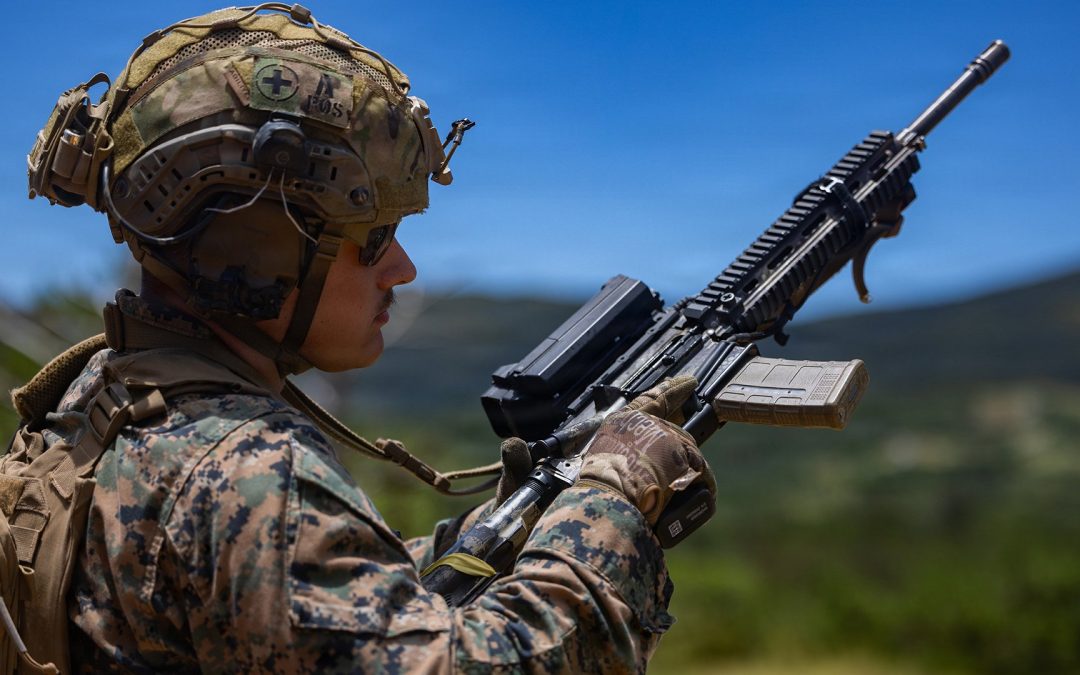
The Marine Corps plans to push more air defenses “down to the squad level” as part of a major retooling of how its ground units and infantry troops are trained and equipped for future conflicts.
On Wednesday, the Marines released Ground Combat Element 2040, a blueprint for transforming the land force component of the Marine Air Ground Task Force or MAGTF, the central formation that the Corps organizes around for a battle. A MAGTF moves and fights with its owns ground, aviation, and logistics units under a single commander.
As the heart of the 40 page document, which includes many pictures of Marines in various combat roles, is a vision for how the basic elements of infantry squads and platoons will be equipped on battlefields swarming with drones.
“The widespread use of drones underscores the need for effective organic protective measures across the [Ground Combat Element], down to the squad level,” the planning document says.”The evolving drone threat presents the most significant risk to ground maneuver, requiring layered active and passive counter-[unmanned aircraft systems] capabilities to retain the initiative.”
Top Stories This Week
The Marine Corps is already in the process of fielding defenses against “inexpensive, lethal one-way attack drones” to small units, said Lt. Gen. Jay M. Bargeron, deputy commandant for plans, policies, and operations.
“The ability for our lowest echelon units – squad, platoon, company – to defend themselves against these one-way attack systems is really maybe one of the biggest holes in our swing,” Bargeron told reporters on Wednesday. “So we’re working hard on that.”
So far this year, the Marine Corps has fielded more than 80 sets of what it calls the “organic counter small UAS system,” which allows squads to jam and destroy small drones, Corps officials said.
Bargeron mentioned that the Marine Corps has also purchased 400,000 anti-drone rounds for Marines’ M4 carbine and M27 Infantry Automatic Rifles. Designed specifically to be used against small drones, the ammunition separates into five distinct projectiles after being fired.
“I think that will change how we do counter small [unmanned aircraft systems] at the small unit level,” Bargeron said.
When a rifle squad can strike at artillery range
He also said that he had recently visited the Marine Corps Air Ground Combat Center at Twentynine Palms, California, which is developing a course on the best tactics, techniques, and procedures for rifle squads to defend against small drones.
In addition to these defenses, the Marine Corps is also fielding the “Home Alone” countermeasure to detect drones from several kilometers away, Bargeron said.
No further information about the “Home Alone” system was immediately available.
The Marines are also going on offense in the small drones fight. Bargeron said the Corps is in the process of fielding loitering munitions to squads that will give them the ability to strike targets up to 20 kilometers away.
“That’s something that that Marines rifle squad, platoon, company would have had to depend on artillery somewhere else, mortars somewhere else, aircraft somewhere else to talk onto the target,” Bargeron said. “I think that will be dramatic.”
Marine anti-tank missile gunners will be responsible for the loitering munitions, and there are no current plans to create a new military occupational specialty for that purpose, Corps officials said.
The post Marine Corps releases roadmap for infantry in drone-covered world appeared first on Task & Purpose.
Recent Comments