

The first half of 2026 saw a notable increase in private market activity, with investor interest increasingly concentrated in a handful of sectors. Nasdaq Private Market’s Secondary Scene: Private Markets at the Midpoint of 2026 report provides a comprehensive review of trends, including data on issuances, secondary activity, and liquidity programs. As has been widely reported, the U.S. IPO market posted its strongest first half since 2021, with 65 IPOs raising over $114 billion. The SPAC market has also recovered. After collapsing from a 2021 peak of roughly $145 billion, SPAC issuance rebounded to $26 billion raised in 138 deals in 2025—nearly three times the $8.7 billion raised in 2024. That momentum carried into 2026, with 118 SPAC IPOs raising approximately $20.9 billion in the first half of 2026. A robust IPO market provides liquidity for private shareholders, many of whom reinvest their capital back into the private markets.
Secondary market data illustrates where buyer and seller interest is concentrated. Demand is heaviest in the industrials sector, where buy-side orders account for 94% of activity. The defense tech sector and AI and machine learning sector follow with buy-side orders accounting for 92% and 79% of all orders, respectively. Conversely, sellers dominate in the commerce & marketplaces (85% sell-side), consumer (80%), cybersecurity (79%), and enterprise software (73%) sectors.
The tender market continues to provide liquidity for companies that are not yet ready to go public, and the pace of activity has increased. The median secondary program now launches just four months after the last primary round, suggesting that many tenders are being structured as “companion” liquidity events for investors who missed their allocation in the primary. The time between a company’s successive tender programs has also compressed sharply, falling from 290 days (for 2018 and 2022) to just 108 days in 2025. The technology sector, including AI, has been the dominant industry, accounting for 47% of all company liquidity programs, followed by the financial sector (17%) and industrials (11%).
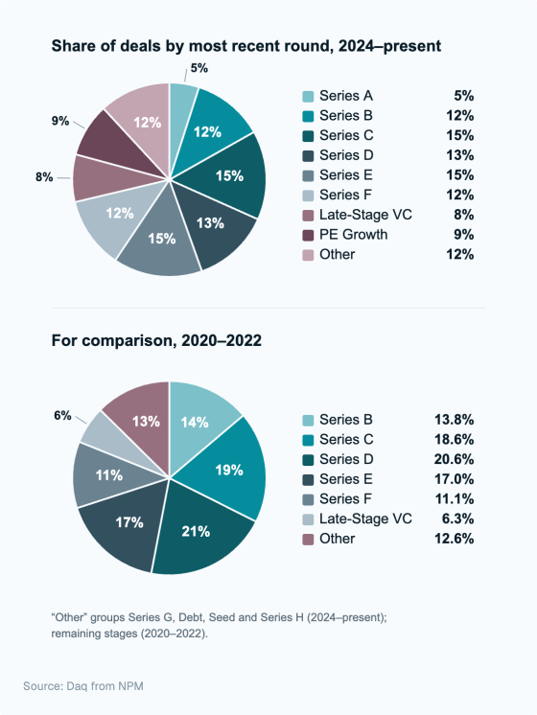
Nasdaq also notes that company-sponsored deals are diversifying across all company stages with debt financing rounds among private companies experiencing the biggest increase. As companies remain private longer, they draw on an increasingly diverse set of liquidity tools, with debt taking on a more intentional and strategic role in their capital structures. This trend is especially evident among fintech firms, where taking on debt is often a fundamental component of the business model. Nasdaq’s comparison chart below shows the broader mix of deals by stage in recent years versus 2020-2022. The data points in a consistent direction: capital is flowing toward AI, defense, and robotics, while established software and consumer categories are seeing more supply than demand. With the IPO market functioning again, tender programs expanding, and private market pricing adjusting actively, 2026 is offering stakeholders a broader array of liquidity options than the market has seen in recent years.
Recent Comments