

The cyclosporiasis season that CDC defines, May 1 through August 31, closed yesterday, August 31, 2026. It closes with 17,180 laboratory-confirmed cases of cyclosporiasis acquired in the United States, 922 hospitalizations and two deaths across forty-eight states and the District of Columbia, against 1,180 for the entire 2025 season. It closes with 11,458 of those illnesses in twenty states tied by CDC and FDA to recalled Taylor Farms de Mexico iceberg lettuce, with at least 495 hospitalizations and both deaths inside that outbreak. And it closes with a fifty-state count, built from what each state health department has been willing to publish, of 32,857 as of this morning, September 1. Cyclosporiasis is the intestinal illness caused by Cyclospora cayetanensis, a parasite that reaches produce when human waste reaches a field or the water that runs through it. The calendar closed on Monday. Nothing about the parasite did.
The federal record closes the season at roughly fifteen times last year, and it is still counting July.
CDC posted the last weekly update of the season on August 25, with data through August 24: 17,180 laboratory-confirmed domestic cases, 922 hospitalizations, two deaths, cases in forty-eight states plus the District of Columbia, and at least 11,844 more that are not laboratory confirmed or still need work to decide whether they were acquired here. Another 1,805 confirmed cases are travel-associated and sit on top of that. The median onset date is July 7 and the range runs from May 1 to August 19. On June 18 the same surveillance pageshowed 145 domestic cases in seventeen states. That is more than a hundredfold in ten weeks.
The outbreak pages moved last on Thursday, August 27, as I wrote that night: 11,458 illnesses from twenty states, illness onsets from June 14 through August 15, at least 495 hospitalizations and the two Michigan deaths, with Georgia, Tennessee and Texas added that week. CDC says genotyping shows the parasites from sick people in this outbreak are genetically related, which ties the patients to each other and not yet to the lettuce, and FDA says its inspections and sampling at iceberg lettuce growers and the processing facility in Mexico are ongoing and its status is still Ongoing. Neither agency has said what the end of the season means for this investigation, and neither page mentions it.
Most people with cyclosporiasis never get a stool test, because the parasite is missed by the routine ova and parasite exam and has to be asked for by name. The standard estimate of that gap comes from Scallan and colleagues in Emerging Infectious Diseases in 2011, which puts the underdiagnosis multiplier for Cyclospora at 83.1. Applied to the 17,180 confirmed cases, that puts the real number near 1,428,000.
Seven state rows moved in the last week of the season, and one of them is a correction I owe the reader.
Michigan reported 14,510 cases and 356 hospitalizations as of August 27, up 233 cases and 21 hospitalizations from the week before, its second-smallest week of the outbreak. Indiana stands at 2,090 as of August 26, up 21, with Allen County at 508. Kansas is at 829 as of August 26, up 22, with 36 hospitalizations; the state counted 687 cases in July and 66 in August. West Virginia is at 315 as of August 28, up two, with 21 hospitalized. Washington is at 76 as of August 28, up five, and it still publishes the breakdown nobody else does: of 25 cases with no international travel, twelve traveled to an outbreak state, three of them are counted in the Taco Bell outbreak, and nine never left Washington. New Hampshire stood at 94 as of August 25, up 25 from the 69 my chart had carried since August 4, and the hospital at the center of its cluster declared that cluster over the next day.
The correction is Florida. My chart has carried Florida at 407 through August 8 for two weeks, while the report it links to said 450 through August 15. The number was in my own source and I did not read it. Florida moves to 450, a plus of 43, and its calendar-year count stood at 486 through August 22. North Carolina holds at 940 but its as-of date is corrected to August 25, which is when the state posted it. The net of all seven rows is 351, and the floor moves from 32,506 to 32,857.
Three states have already stopped counting out loud, and the season gave them permission.
Virginia now says at the top of its page that the season runs May 1 to September 1, that its cases have been decreasing, and that starting September 1 it will resume normal case reporting. Its last weekly table is dated August 24, at 234, and the Monday table that would have carried August 31 did not appear. New York said it would update every Wednesday through the end of August. The page still reads last updated August 19, at 939 cases from May 1 through August 17, and the August 26 update never posted. New York City, on its own page, counts 643 cases since May 1 through August 24. Indiana updated its dashboard every weekday afternoon in July. It now says the data is updated every Wednesday. Ohio has published no statewide figure since August 13, when it stood at 5,452, and that is nineteen days of silence from the second-largest state in this outbreak.
None of that is a scandal. Every one of those departments spent the summer doing work it was never staffed for. But a season end is a permission slip, and the pattern is what I said it would be when the count crossed thirty thousand: the number you get depends on who is still willing to print one. The forty-one counted rows in the table below have as-of dates ranging from July 11 to August 28. Every one is a floor, and the older ones are further below the truth than they were a week ago.
August 31 is a line on a web page. The parasite did not read it.
CDC says on its own surveillance page that the season is May 1 through August 31 and, in the next sentence, that clusters of cyclosporiasis have been detected outside that range in some years. The last onset date in the outbreak is August 15. The latest domestic onset on the national page is August 19. CDC says it takes about six weeks from the first symptom for a case to reach Atlanta, which means the September updates will still be filling in July and August. The season definition is what makes 17,180 comparable to last year’s 1,180, because both were counted in the same window. It is not a statement that anybody stopped getting sick.
What to watch this week, as I set out over the weekend: CDC’s Case Data page has moved on Tuesdays, and today is one; the outbreak pages have moved on Thursdays, which puts the next one on September 3; Michigan reports Thursday; West Virginia posts Friday; Missouri publishes on Sundays and its August 30 figure had not reached anyone I can find by this morning. The thing to watch is not which of those numbers moves. It is which of the pages stops.
Two of every three confirmed cases are tied to the lettuce. Nobody has named a product for the rest.
Set the two federal series side by side. CDC has attributed 11,458 illnesses to the recalled Taylor Farms de Mexico lettuce, as of August 27. It has confirmed 17,180 domestically acquired cases, as of August 24. The pull dates are three days apart, so I will say roughly two in three rather than print a percentage. Against the 29,024 cases CDC has either confirmed or is still working through, the outbreak is about four in ten. Against the 32,857 the states themselves publish it is about a third. The remainder is 5,722 confirmed illnesses with no attributed source, and 427 of the country’s 922 hospitalizations sit in that pile. The attribution is not by laboratory. No product sample has ever tested positive, and CDC’s genotyping ties the parasites from sick people to each other, not to a head of lettuce. It rests on interviews and on FDA’s traceback to a single supplier.
No state publishes its own split, and CDC’s first state-level table, published August 27, shows how far the two series sit apart: 4,846 Michigan illnesses attributed against the 14,510 the state reports, 2,679 in Ohio against 5,452, twenty in Texas against 315, two in North Carolina against 940. For the rest, the record is a list of things health departments have said out loud. North Carolina says its cases do not appear tied to the multistate outbreak and that parsley and cilantro were reported more often than expected. Alabama named two clusters at Mexican-style restaurants that it says plainly are not Taco Bell. New York has 939 cases and no named source at all. Hawaii is investigating a case with no travel in a state that never received the lettuce. FDA’s investigation table carries at least six other Cyclospora clusters whose sources are not confirmed. Not one of them has produced a second recall. The Taylor Farms lettuce is the only product recalled for Cyclospora in this country this year.
Taylor Farms de Mexico recalled all iceberg lettuce sourced from central Mexico on July 17, 2026. FDA puts the foodservice distribution at June 29 through July 16 to thirty-one states, and the retail product at Walmart stores in fifteen states under the Marketside label, with best-by dates through August 3. CDC publishes the epidemic curve for this outbreak on its timeline page, and I rebuilt it from CDC’s own data table on August 27 with the recall date marked. It is built on the 9,256 people, of 11,458, who have an onset date on file. Of those, 8,959, which is 96.8 percent, got sick before the recall. The week of July 6 through July 12 alone holds 5,287 people. The single worst day, July 10, holds 1,001.
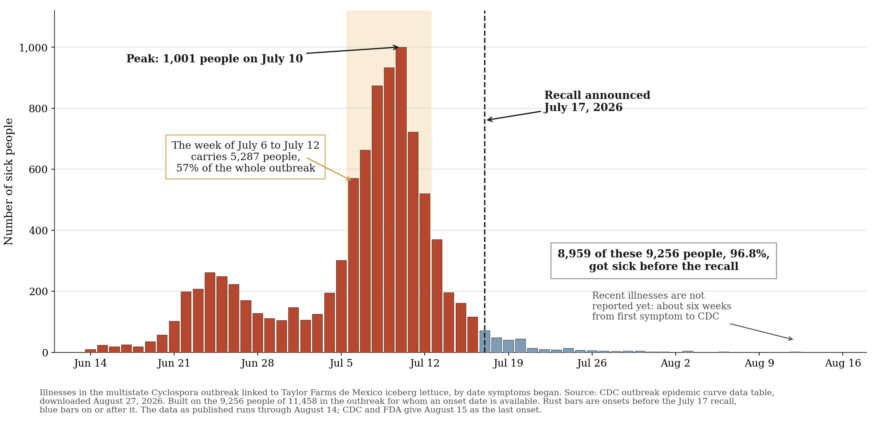
Illnesses in the multistate Cyclospora outbreak by the date symptoms began. Source: CDC outbreak epidemic curve data table, downloaded August 27, 2026, built on the 9,256 people of 11,458 for whom an onset date is available. Rust bars are onsets before the July 17 recall; blue bars are on or after it. The bars sum to 9,256.
Are people still getting sick since the recall? By onset date, barely. The 297 people whose illness began on or after July 17 are 3.2 percent of the curve, and because the incubation period runs up to two weeks, an onset in the last days of July can still be lettuce eaten before the recall, and product dated through August 3 could lawfully have been in a kitchen until then. The fifteen August onsets are the ones that need explaining, and the last of them is August 15. CDC’s national page shows domestic onsets as late as August 19 and does not say whether any of them belong to this outbreak. What is rising is the count, not the illness. Every number that moved this week was a July illness reaching a database. A falling curve and a rising count are not a contradiction. They are what a six-week reporting lag looks like from the outside.
Here is where all fifty states stand this morning. The Lettuce column is whether FDA has confirmed that recalled Taylor Farms de Mexico lettuce reached that state. The last column is whether anybody has tied that state’s illnesses to Taylor Farms at all; it now reads Linked for twenty states, because CDC added Georgia, Tennessee and Texas on August 27.
| State | 2026 cases | As of | All of 2025 | Lettuce | Taylor Farms |
| Michigan | 14,510 | Aug 27 | 50 | Yes | Linked |
| Ohio | 5,452 | Aug 13 | 76 | Yes | Linked |
| Missouri | 2,152 | Aug 23 | none reported | Yes | Linked |
| Indiana | 2,090 | Aug 26 | 27 | Yes | Linked |
| Illinois | 1,437 | Aug 18 | 301 | Yes | Linked |
| North Carolina | 940 | Aug 25 | 300 | Yes | Linked |
| New York | 939 | Aug 17 | 694 | Yes | Unknown |
| Kansas | 829 | Aug 26 | 29 | Yes | Linked |
| Kentucky | 620 | Jul 29 | 45 | Yes | Linked |
| Oklahoma | 544 | Aug 18 | 41 | Yes | Linked |
| Florida | 450 | Aug 15 | 210 | Yes | Unknown |
| Iowa | 327 | Aug 20 | 64 | Yes | Linked |
| Texas | 315 | Aug 11 | 512 | Yes | Linked |
| West Virginia | 315 | Aug 28 | 8 | Yes | Linked |
| Arkansas | 287 | Aug 24 | 13 | Yes | Linked |
| Virginia | 234 | Aug 24 | 115 | Yes | Unknown |
| Nebraska | 218 | Aug 6 | 51 | Yes | Linked |
| Wisconsin | 216 | Aug 5 | 65 | Yes | Unknown |
| Colorado | 150 | Jul 17 | 205 | No | Unknown |
| Massachusetts | 145 | Aug 5 | 74 | Yes | Linked |
| New Hampshire | 94 | Aug 25 | 7 | Yes | Linked |
| Alabama | 85 | Aug 3 | 19 | Yes | Unknown |
| Pennsylvania | 82 | Jul 29 | not notifiable | Yes | Linked |
| Washington | 76 | Aug 28 | not available | May have | Travel link |
| Maryland | 69 | Jul 17 | 123 | Yes | No link found |
| New Jersey | 46 | Jul 11 | 180 | Yes | Unknown |
| California | 41 | Jul 14 | not available | May have | Unknown |
| Minnesota | 41 | Jul 17 | none reported | No | Unknown |
| Connecticut | 35 | Jul 17 | 41 | Yes | Unknown |
| Maine | 27 | Aug 7 | 4 | Yes | Linked |
| Oregon | 23 | Jul 24 | not available | No | Travel link |
| Arizona | 19 | Jul 17 | 49 | No | Unknown |
| Georgia | 11 | Jul 17 | 116 | Yes | Linked |
| Tennessee | 11 | Jul 17 | 38 | Yes | Linked |
| Mississippi | 7 | Jul 22 | not notifiable | Yes | Unknown |
| Hawaii | 6 | Aug 26 | not available | No | No link found |
| Alaska | 5 | Jul 16 | 6 | No | Unknown |
| Rhode Island | 4 | Jul 17 | 6 | May have | No link found |
| South Dakota | 3 | Jul 16 | 3 | May have | Unknown |
| Louisiana | 1 | Jul 17 | 99 | Yes | Unknown |
| Utah | 1 | Jul 17 | 37 | No | No link found |
| Delaware | no count published | — | 1 | May have | Unknown |
| Idaho | no count published | — | not notifiable | No | Unknown |
| Montana | no count published | — | 8 | No | Unknown |
| Nevada | no count published | — | not notifiable | No | Unknown |
| New Mexico | no count published | — | 9 | No | No link found |
| North Dakota | no count published | — | 4 | May have | Unknown |
| South Carolina | no count published | — | 45 | Yes | Unknown |
| Vermont | no count published | — | 3 | May have | Unknown |
| Wyoming | no count published | — | 0 | No | Unknown |
| All fifty states | 32,857 | 31 | 20 |
Counts as published by each state health department, compiled from the linked sources on September 1, 2026. Forty-one states publish a 2026 count and those forty-one sum to 32,857, which is 351 above the 32,506 published August 26; the seven moves are Michigan, Indiana, Kansas, West Virginia, Washington, New Hampshire and the Florida correction. Nine states publish no count at all. Florida is shown on its May 1 series; its calendar-year count is higher. Every figure is a floor.
The questions I am getting this week.
How many of the cases are linked to Taylor Farms? CDC has tied 11,458 illnesses to the recalled lettuce, against 17,180 laboratory-confirmed domestic cases, so roughly two in three confirmed cases and about a third of the 32,857 the states publish. The remaining 5,722 confirmed illnesses have no attributed source. The link rests on interviews and traceback; no product sample has tested positive.
Are any of the Taylor Farms cases outside Taco Bell, and if so, where? Yes. Since August 5, CDC’s definition has included anyone who reported exposure to the recalled lettuce served or purchased at various locations, not only Taco Bell, and the outbreak count went from 1,947 to 6,358 in the twelve days after that change. CDC has never published the split. The named places on the public record are few. New Hampshirehas tied 43 of its 94 cases to a recalled product, and 39 of those to Taylor Farms lettuce served at the Cheshire Medical Center cafeteria salad bar in Keene between early June and July 20. The hospital counts 34 cases on its own laboratory, 21 of them employees, and declared its cluster over on August 26 after two weeks without a new case. It is the only location in New Hampshire tied to an outbreak, and the only named non-Taco Bell establishment in the country. Maine tied ten of its 27 cases directly to the recalled lettuce without naming where it was served, in a state that is not on the distribution list at all. Missouri’s federal description includes people who handled the lettuce at work, not just people who ate it. Washington’s three outbreak cases all ate at Taco Bell. The other customers on the recall record, Subway, Sysco, US Foods, Jack in the Box and Walmart’s Marketside bags, have had no illness publicly tied to them by any agency.
Are the other cases linked to any other product? No product has been named. North Carolina points to parsley and cilantro, Alabama to two restaurant clusters that are not Taco Bell, and FDA lists at least six other clusters with sources not confirmed. The Taylor Farms lettuce is the only product recalled for Cyclospora in the United States this year.
When was the recall, and what did it cover? July 17, 2026. Taylor Farms de Mexico recalled all iceberg lettuce sourced from central Mexico. Foodservice product went to thirty-one states between June 29 and July 16, and Marketside-brand bags reached Walmart stores in fifteen states, with best-by dates through August 3.
Are people still getting sick since the recall? By onset date, almost none. Of the 9,256 outbreak cases with an onset date, 8,959 got sick before July 17. Fifteen have an August onset and the last is August 15. The count keeps rising because it takes about six weeks for a case to reach CDC, not because the lettuce is still out there.
Is the outbreak over now that the season is? The exposure appears to have ended in mid-July. The season is a counting window, not a finding. CDC and FDA both still call the investigation ongoing, and the counting will run into the fall.
Do I still need to worry about lettuce? The recalled product is long past its dates and FDA says it is confident it is off the market; Taco Bell stopped using that supplier on July 17. No other lettuce has been recalled in this outbreak. Wash produce, cook what you can, and know that washing does not reliably remove this parasite.
I got sick in August and never got tested. Am I too late to count? No. Call your doctor and ask specifically for Cyclospora testing; a routine stool panel does not look for it, symptoms relapse for a month or more, and it is treatable. A case confirmed in September is still a 2026 case, whatever the season calendar says.
A season is a bookkeeping convention. It tells CDC when to start a comparison and when to stop one, and it lets a state health department decide the extra work is finished. It does not tell a parasite anything. Two people are dead, 922 have been hospitalized, and the state health departments that were willing to print a number this summer printed 32,857 of them. Some of them stopped printing this week. I will keep adding them up for as long as any of them keeps publishing, and I will say so when they stop.
Recent Comments