
For a brief moment, noncompete law was headed toward a single national rule. Then the Federal Trade Commission’s (FTC) rule was set aside, the agency abandoned its appeals, and the map splintered. While the federal rule is gone, the policy fight is not—it has simply relocated to state capitols and courtrooms.
The FTC proceedings gave state lawmakers a policy record and a menu of competing priorities: worker mobility and wage growth on one side; freedom of contract, confidential information, and business investment on the other. States have gone in divergent directions.
States are answering five distinct questions differently: Who may be restrained? What interests justify restraint? Which economic devices count as noncompetes? What procedures must precede execution or enforcement? And who bears the risk of error once litigation begins?
For multistate employers, a national form paired with a choice-of-law clause is not enough. Employers need a system that identifies when a noncompete is lawful, when a narrower device will work better, and when merely presenting—or threatening to enforce—a covenant may create liability.
The Federal Rule Died, but Its Policy Framework Survived
The FTC’s rule would have replaced much of the state-law patchwork with a nationwide prohibition of employee noncompetes. In Ryan LLC v. FTC, however, the U.S. District Court for the Northern District of Texas ruled that the FTC lacked statutory authority to promulgate the rule and that the rule was arbitrary and capricious. The court set it aside nationwide, and the FTC later ended the appellate litigation.
The rulemaking thrusted both sides’ arguments into public view. Opponents of noncompetes emphasized wage suppression, reduced mobility, and inhibited entrepreneurship. Supporters emphasized the need to protect confidential information, customer relationships, specialized training, and investments in employees and teams.
The federal retreat removed the prospect of uniformity without ending reform. Employers that once prepared for one compliance date now face a moving collection of effective dates, compensation thresholds, notice rules, professional carve-outs, choice-of-law limits, and remedies.
Four State Models Have Emerged
1. Mobility-First Bans
California, North Dakota, and Oklahoma are the traditional examples of states that generally refuse to enforce employee noncompetes. Minnesota joined them in 2023, voiding employment noncompetes while preserving nondisclosure agreements, nonsolicitation agreements, and sale-of-business restraints.
The post-FTC period has added new variations on that model.
Wyoming’s 2025 statute declares void covenants that restrain a person’s right to receive compensation for labor, for contracts entered into on or after July 1, 2025. It has notable exceptions, though: the law preserves sale-of-business restraints, trade-secret protections, specified education and training repayment provisions, and covenants for executive and management personnel and their professional staff. It separately invalidates physician noncompetes.
Washington’s 2026 legislation goes further. Effective June 30, 2027, all noncompetition covenants will be void regardless of when signed. The law prohibits entering into, attempting to enforce, threatening to enforce, or representing that a worker is subject to such a covenant. It also reaches provisions requiring an individual to repay or forfeit compensation or benefits because they engage in lawful work.
The drafting label is becoming less important than the economic effect. Calling a clause a “bonus condition,” “forfeiture provision,” or “repayment obligation” will not save it if state law treats the clause as a penalty for taking another job.
2. Eligibility Thresholds and Procedural Guardrails
A second group permits noncompetes only for workers who meet certain compensation thresholds. The implicit bargain is that restraints may be defensible for employees with meaningful bargaining power and access to competitively sensitive information, but not for workers with little ability to negotiate and limited capacity to cause competitive harm.
The Illinois Freedom to Work Act is illustrative: a noncompete may not be entered into unless the employee’s actual or expected annualized earnings exceed $75,000; that threshold rises to $80,000 on January 1, 2027. The statute also requires written advice to consult counsel and at least 14 days to review the covenant.
Compensation threshold regimes require employers to monitor change. A form that was valid when rolled out may become obsolete when a statutory threshold rises, an employee moves, or the state redefines which compensation counts.
3. Industry-Specific Rules, with Health Care at the Center
Health care has become the testing ground for targeted reform. These laws are driven by patient access, continuity of care, provider shortages, and the geographic reach of consolidated health systems. That policy mix has produced restrictions even in states that otherwise enforce commercial contracts.
Pennsylvania’s Fair Contracting for Health Care Practitioners Act, effective January 1, 2025, generally voids new practitioner noncompetes lasting more than one year and bars enforcement of even a one-year covenant when the practitioner was dismissed. The statute also imposes patient-notification obligations.
Texas took a different route in 2025: new or renewed covenants for physicians, dentists, nurses, and physician assistants generally must be limited to one year and a five-mile radius, be conspicuous, and include a capped buyout; physician covenants are void after an involuntary discharge without good cause.
Virginia now prohibits noncompetes for health care professionals and makes covenants unenforceable against employees discharged without cause unless disclosed severance or other monetary payment is provided.
The emerging policy judgment is that an employer’s legitimate investment does not automatically justify restricting where patients may obtain care—or where scarce providers may deliver it.
4. Pro-Enforcement Regimes
Florida has moved in the opposite direction. The 2025 CHOICE Act declares that strong contractual protections encourage information sharing, training, development, and investment, and states that nondisclosure, fixed-term, and nonsolicitation agreements are inadequate substitutes for covered employers. For covered employees who meet the compensation test, it validates qualifying garden-leave and noncompete agreements lasting up to four years.
If a covered employer seeks enforcement, the court must preliminarily enjoin the employee and may dissolve or modify the injunction only if the employee proves a specified defense by clear and convincing evidence based on nonconfidential information. The law authorizes similar relief against the new employer and presumes access to confidential information or customer relationships when the employee acknowledged that access in writing.
Why the Divergence?
A. Economic Policy
States restricting noncompetes increasingly cast mobility as an engine of wage growth and entrepreneurship. Washington’s 2026 legislation finds that noncompetes hinder innovation, suppress wages, reduce mobility, and harm consumers. Yet Florida’s CHOICE Act identifies the mirror-image concern: predictable enforcement encourages investment and protects the information sharing and development that businesses might otherwise withhold.
Compensation-thresholds appear to use compensation as a rough proxy for bargaining power, access to sensitive information, and whether the employee received meaningful value in exchange for limiting mobility.
B. In Health Care, the Patient is the Protected Party
Traditional restrictive-covenant doctrine balances employer interests against employee hardship and the public interest. Health care statutes put the patient at the center. Legislatures focus on rural access, travel distances, practitioner shortages, continuity of care, and patient choice. Once the issue is framed as access to care rather than employee mobility, targeted restrictions can attract support—even where other commercial covenants remain enforceable.
C. Politics Are a Clue, Not a Compass
Political control can help predict whether a legislature will emphasize worker mobility or freedom of contract, but it does not explain the map by itself. Wyoming paired a broad prohibition with executive exceptions. Texas tightened health care covenants while continuing to enforce reasonable restrictions elsewhere. Florida adopted a notably strong enforcement regime.
D. Courts Move The Boundary
Legislation isn’t the fully story. Courts still decide whether an overbroad covenant will be reformed, partially enforced, or rejected. Delaware’s Court of Chancery has warned that equity will not automatically rescue an employer from overreaching language, including in Kodiak Building Partners, LLC v. Adams and Sunder Energy, LLC v. Jackson.Yet in Cantor Fitzgerald, L.P. v. Ainslie, the Delaware Supreme Court enforced a sophisticated partnership agreement’s forfeiture-for-competition provision without ordinary noncompete reasonableness review, emphasizing freedom of contract under Delaware partnership law.
“Functional” Noncompetes
As direct noncompetes narrow, employers are starting to turn to forfeiture clauses, training-repayment agreements, customer restrictions, and what are now commonly referred to as “stay-or-pay” agreements. Legislatures are asking a functional question: does the clause protect a legitimate investment, or does it make leaving economically difficult, if not impossible?
Economic restraints are being pulled into the noncompete rulebook even when they do not say “you can’t compete.”
New York’s Trapped at Work Act, effective December 19, 2026, generally voids employment promissory notes that require repayment if employment ends before a stated period. It preserves certain arrangements, including prorated repayment for voluntary, transferable credentials and repayment of certain financial bonuses, relocation assistance, or other non-performance-based incentives, subject to protections for employees terminated without misconduct or whose jobs were misrepresented.
California’s 2026 “stay-or-pay” law also takes a functional approach. For contracts entered into on or after January 1, 2026, it generally prohibits terms that require payment of a debt, revive collection, or impose a penalty, fee, or cost when a work relationship ends. It has a number of exceptions, such as: transferable-credential costs must be separately documented and prorated, while certain up-front discretionary payments require a separate agreement, notice, at least five business days for review, proration over no more than two years, and an option to defer payment until the retention period is complete.
Practical Considerations for Multistate Employers
Here are some basic steps multistate employers should consider in view of the risks attendant to the patchwork quilt of state laws and court decisions that change the landscape.
First, identify where each employee actually works, the employee’s compensation and profession, the agreement date, and the expected enforcement forum. Then test the covenant against that jurisdiction’s eligibility rules, notice requirements, choice-of-law restrictions, termination rules, and available remedies.
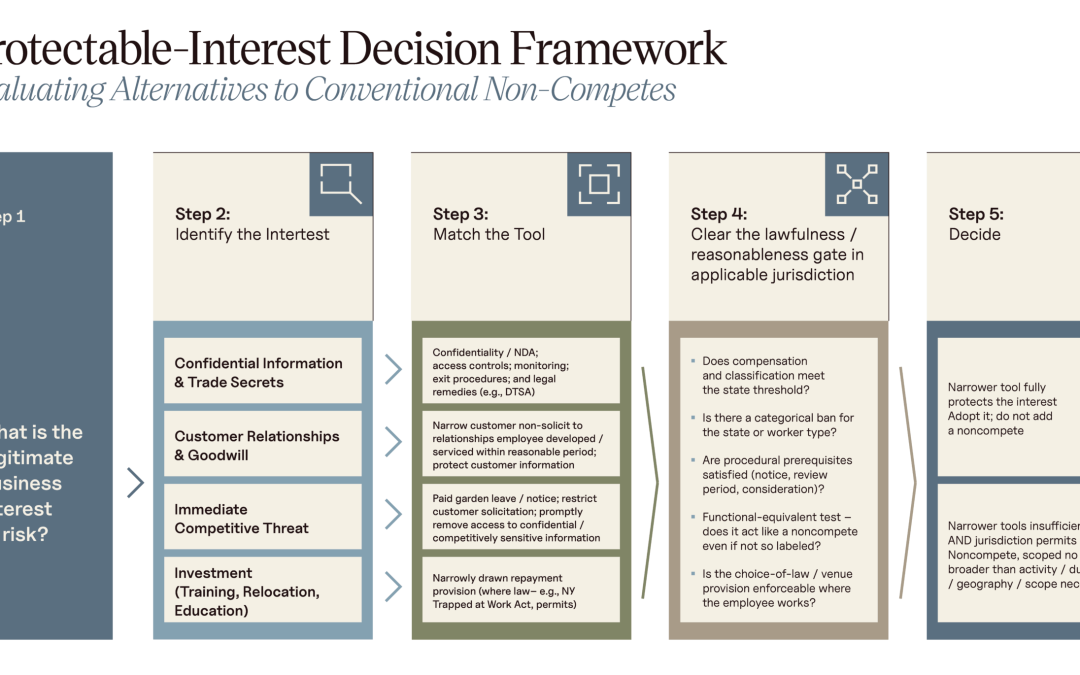
Second, match the tool to the interest. If the concern is trade-secret use, begin with confidentiality obligations, access controls, monitoring, and trade-secret remedies. If the concern is customer diversion, use a narrowly drawn nonsolicitation covenant tied to relationships the employee actually developed, where lawful. If the concern is an immediate transfer of strategy, consider paid garden leave. If the concern is recovery of a bona fide investment, use a measured repayment provision only where the governing law permits it.
Third, create an enforcement gate. Before sending a demand letter or filing suit, re-check the employee’s current location, compensation, termination circumstances, and the law in effect on that date. Some states impose liability not only for enforcing a void covenant, but for threatening to enforce it or representing that the worker remains bound.
Here is an illustation of a framework employers may wish to consider with an eye towards minimizing risks arising from conventional noncompetes:
Figure: Protectable-interest decision framework — identify the interest at risk, match it to the narrowest adequate tool, then clear the jurisdiction-specific lawfulness gate before drafting or enforcing.
Conclusion
The emerging map of state noncompete laws contains categorical bans, compensation thresholds, procedural guardrails, profession-specific restrictions, functional definitions, and statutory penalties. The lines do not divide neatly by region or party, and are likely to keep moving.
Employers should consider using narrower tools and reassess agreements as employees and laws change. That will make them best positioned to protect legitimate interests without stepping on the next statutory tripwire.
Recent Comments