
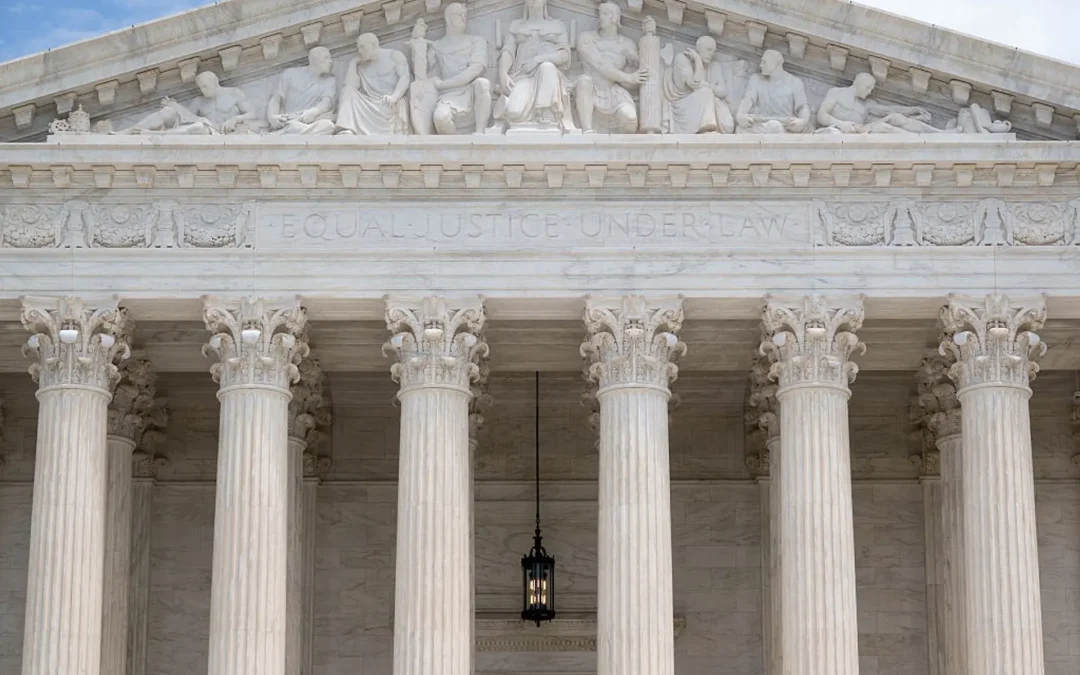
This is the second part in a series for SCOTUSblog recounting two decades of constitutional change through the five editions of our casebook, the first published in 2008 and the latest to be published this December.
In 2005, the Supreme Court’s 14th Amendment jurisprudence seemed at equipoise. The equal protection clause permitted the use of race to promote diversity in classrooms. The due process clause protected a right to abortion as a form of liberty, and sexual privacy under the rubric of dignity. And any challenge to constitutional birthright citizenship seemed unthinkable. Yet, that status quo would soon be turned upside down, as the next two decades brought a revolution to each facet of 14th Amendment law.
Equal protection altered
For a generation, equal protection doctrine seemed stable. Indeed, in our constitutional law casebook, the chapters on the equal protection clause remained virtually unchanged from the first edition in 2008 to the fourth edition in 2022. During this span, the trilogy of affirmative action cases remained the same. The fractured decision in 1978’s Regents of the University of California v. Bakke signaled that affirmative action could be used in certain narrowly tailored contexts – that is, to help promote the educational benefits that flow from diverse student bodies. A quarter century later, the Supreme Court decided Grutter v. Bollinger and Gratz v. Bollinger. In those cases, the justices rejected mechanical formulas for determining racial preferences but allowed race as a “plus” factor in admissions. The third and fourth editions of our book added two cases from Texas. Fisher v. University of Texas I seemed to signal that Justice Anthony Kennedy was willing to revisit Grutter, a case he had dissented in. But the sequel, Fisher v. University of Texas II, retreated and allowed Grutter to survive.
There was also stasis in cases involving gender-based classifications. The trilogy of sex discrimination cases remained unchanged across four editions of our casebook. Frontiero v. Richardson and Craig v. Boren were brought by the American Civil Liberties Union during the 1970s. Then-attorney Ruth Bader Ginsburg challenged laws that treated men worse than women. The court ultimately reviewed these laws with heightened, intermediate scrutiny. Two decades later, Justice Ruth Bader Ginsburg ruled in United States v. Virginia that a state military academy could not exclude female cadets.
The first four editions also included a pair of cases concerning “heightened” rational basis scrutiny: City of Cleburne v. Cleburne Living Center, Inc. and Romer v. Evans. These two cases didn’t fit the conventional accounting of equal protection doctrine, but they remained relevant to how Kennedy reviewed laws he viewed as denying dignity to minority groups. Cleburne concerned zoning laws that prohibited homes for “mentally retarded” individuals, and Romer involved a restriction on providing greater protection for gays and lesbians. “Rational basis with teeth (or bite)” scrutiny remains a category students need to know.
With the ascent of the Roberts court, the fifth edition reports a sea change in equal protection clause doctrine. On affirmative action, Bakke remains the seminal case as the court’s first foray into the matter, but Grutter, Gratz, and the Fisher pair are gone (along with Justices Sandra Day O’Connor and Kennedy). Instead, Students for Fair Admissions v. President and Fellows of Harvard College is now the court’s decisive precedent. The Supreme Court there ruled that schools can use race only in extremely narrow contexts, such as to demonstrate how a person’s race presented hardships that they overcame. (Although there is some evidence that institutions continue to test the boundaries of the ruling).
With sex discrimination, we added two new cases concerning transgender rights. United States v. Skrmetti upheld a state prohibition on certain sex-related medical procedures for minors. West Virginia v. B.P.J. ruled that states can exclude “biological[ly] males athletes who identify as female” from participating in women’s sports. The laws at issue in these cases would have been unthinkable in 2008, but societal movements changed quickly.
From “emanations and penumbras” to “history and tradition”
The first edition of our casebook presented what seemed to be a stable equipoise for the doctrine of substantive due process as well. The Warren court had decided Griswold v. Connecticut. This ruling declared unconstitutional a state prohibition on contraception for married couples. The precise basis of the decision was unclear, as Justice William O. Douglas’s majority opinion relied on “emanations” and “penumbras” from the 14th Amendment (whatever that means). But the court stressed the intimate sacredness of the marital relation to establish a constitutional right of privacy. The Burger court added Roe v. Wade, which enforced a constitutional right to abortion under the due process clause of the 14th Amendment. A decade later, the Burger court somewhat countered Roe with Bowers v. Hardwick, which emphatically rejected a purported substantive due process right to homosexual “sodomy.”
Nevertheless, the Rehnquist court reaffirmed a right to abortion in Planned Parenthood v. Casey. This landmark ruling reaffirmed the “core” holding of Roe v. Wade, even as it replaced the “trimester” framework with the undue burden test. Still, the court only went so far, declining to recognize a right to assisted suicide in Washington v. Glucksberg. Things changed again when Lawrence v. Texas recognized a substantive due process liberty protecting homosexual “sodomy,” thus overruling Bowers. The third edition ushered in two new gay-rights opinions. United States v. Windsor ruled that the Defense of Marriage Act violated the due process clause of the Fifth Amendment. And Obergefell v. Hodges recognized a right to same-sex marriage under the due process clause of the 14th Amendment. By 2015, Kennedy’s gloss on substantive due process would reach its apex. In the fourth edition was Whole Woman’s Health v. Hellerstedt, an abortion case, which refused to scale back Roe and Casey.
The fifth edition, however, would witness a revolution in substantive due process, and in how it is taught. Dobbs v. Jackson Women’s Health Organization overruled Roe v. Wade, holding that the due process clause of the 14th Amendment does not protect a right to abortion. But we decided it was not enough to simply add Dobbs as the final case. We trimmed down Griswold v. Connecticut and, for the first time, added Eisenstadt v. Baird, which ruled that unmarried couples also had a right to contraception. Once that right had been established, the marital relations rationale for it quickly dropped away, like a booster rocket that takes a satellite into orbit falls into the sea having done its job.
These older substantive due process cases, once foundational, are nonetheless now vestiges. This is certainly true of abortion, but Kennedy’s landmark cases here may also end up withering away. The Obergefell dissents may then prove the most relevant, as a possible signpost for the future. Neither of us could have fathomed in 2008 how this chapter would evolve over 18 years.
Defining birthright citizenship
Perhaps the most unexpected addition to the fifth edition was a topic that we could not have fathomed back in 2008: birthright citizenship. Indeed, in the absence of much serious scholarly attention, we had both accepted the conventional account of birthright citizenship. But once again, the times and the scholarship would change. Starting in 2025, we both took a closer look at birthright citizenship – a term that does not appear in the 14th Amendment – and realized the issue was much closer than we thought.
The constitutional arguments advanced by the Trump administration were ridiculed by both the professoriate and lower court judges but came within one vote of prevailing at the Supreme Court in Trump v. Barbara. (Justice Brett Kavanaugh accepted the revisionist account but would have found against the administration on statutory grounds.)
Due to the complexity of the issues, we spent considerable time figuring out where and how to teach this case. The issues were relatively simple: What was the original meaning of “subject to the jurisdiction” of the United States; and what was the holding of the Supreme Court’s decision in 1898’s United States v. Wong Kim Ark? But the evidence marshalled by both sides on the question of original meaning was extraordinarily complex, implicating the English common law, the Congressional debates over the Civil Rights Act of 1866 and the citizenship clause, subsequent executive branch practice, learned treatises, and case law.
That left the question of where this seemingly isolated doctrine would fit into the casebook (and case law in general). Because the opinions primarily concerned the original meaning of the 14th Amendment, and discussed executive branch practice in its immediate wake, we thought it was best suited as discussed as part of the Reconstruction Amendments.
***
The next installment in this series considers the changes to the religion clauses and the Second Amendment over the past two decades.
Recent Comments