
Yesterday was publication day for Justice Samuel Alito, who drew on his past speeches to write a book – So Ordered: An Originalist’s View of the Constitution, the Court, and Our Country – on his judicial philosophy.
At the Court
On Tuesday, the justices heard oral argument in Anderson v. Intel Corporation Investment Policy Committee, a dispute under the Employee Retirement Income Security Act on how to handle claims that employers have invested employees’ retirement funds imprudently.
Today, the justices will hear argument in Department of the Air Force v. Prutehi Guåhan, a case on the interaction between two federal environmental laws that arose when the U.S. Air Force applied to renew its permit to dispose of munitions on a beach in northern Guam.
On Sept. 28, the Trump administration brought a dispute over the Federal Bureau of Prison’s policy on healthcare and accommodations for transgender inmates to the interim docket. The court has asked the challengers to respond to this request by 4 p.m. EDT on Thursday.
Morning Reads
Supreme Court’s Alito Says a Democratic Senate Win Won’t Prompt Quick Retirement
Greg Stohr, Bloomberg (paywalled)
In an interview with Bloomberg about his new book, Justice Samuel Alito “said he plans to remain on the Supreme Court even if Democrats capture the Senate in next month’s midterms, dismissing speculation that he might quickly retire to ensure Donald Trump can get a successor confirmed.” “I intend to stick around through this term,” Alito said. “I made that decision many months ago.” Although Alito acknowledged that he’s thought about retirement in general, he added that he doesn’t “feel mentally or physically decrepit.”
Alito says Supreme Court can’t stem emergency appeals and voices concern over Trump’s rhetoric
Lindsay Whitehurst, Associated Press
In yet another interview, Justice Samuel Alito addressed the recent surge in activity on the Supreme Court’s interim docket, telling the Associated Press that “the escalating volume of emergency appeals before the court isn’t a good thing,” but that “there’s little the court can do to change the trajectory.” “I’m afraid this is going to continue,” he said. “An application is something that I think we have to rule on.” Alito also spoke with the AP about his last-minute recusal in Suncor Energy Inc. v. County Commissioners of Boulder County, a significant dispute related to climate change. “He initially stayed on the case because he doesn’t have stock in the companies involved, he said, adding that the court’s legal office agreed that he could hear the case.” “But as he delved deeper into the substance of the case,” he determined he should not take part. “This particular decision was a judgment call,” Alito said. “I gave it very, very serious consideration.”
Peter Navarro seeks Supreme Court review as Trump allies brace for Democratic subpoenas
Kaelan Deese, Washington Examiner
In a petition for review filed on Tuesday, “White House trade adviser Peter Navarro asked the Supreme Court … to review his conviction for contempt of Congress in a challenge that holds the potential to strengthen the defenses available to Trump administration officials facing subpoenas if Democrats retake the House in November,” according to the Washington Examiner. Navarro contends “that he should have been allowed to present evidence that he believed executive privilege prevented him from cooperating with the House Jan. 6 committee, even if that belief was mistaken.” The Washington Examiner noted that “[a] ruling adopting Navarro’s position would raise the government’s burden in criminal contempt cases and allow defendants to contest whether they knowingly broke the law.”
Christa Pike conscious and speaking after botched execution: Attorneys
Meredith Deliso, ABC News
Attorneys for Christa Pike said on Tuesday that “Pike is conscious and speaking nearly a week after a botched execution left her critically injured and temporarily on a ventilator,” according to ABC News. “Her prognosis remains unclear but, at a minimum, we expect a long recovery,” the attorneys said in a statement. Pike has been hospitalized since Sept. 30, when the Supreme Court cleared the way for her to be executed and “she survived being administered two lethal doses of pentobarbital.” Her attorneys said “[s]he has ‘severe damage’ to her arms and remains handcuffed to her bed.”
How Colorado Became a Springboard for Culture-War Clashes at the Supreme Court
James Romoser, The Wall Street Journal (paywalled)
Colorado is “known for its ski slopes and craft breweries.” But increasingly, it’s also associated with “politically charged Supreme Court showdowns,” according to The Wall Street Journal. Two of this term’s most closely watched cases – disputes on a Colorado city’s effort to hold energy companies financially liable for climate change and religious schools’ ability to participate in the state’s universal preschool program – originated in Colorado, as did several other recent Supreme Court cases on such issues as LGBTQ rights and religious freedom. The Journal noted that, “[a]t first glance, Colorado isn’t an obvious backdrop for culture-war clashes. Deeper-blue bastions like California and Massachusetts are more often associated with the sorts of boundary-pushing liberal policies that draw backlash from the Supreme Court’s conservative majority. But longtime Colorado residents and legal experts say they aren’t surprised” by the development, because Colorado’s “politics have shifted leftward amid rapid growth, as newcomers flock to Denver and its suburbs.”
Virginia should not make students choose between faith and financial aid
Steve Fitschen, The Hill
In a column for The Hill, Steve Fitschen, lead counsel for Bethany Hall in Hall v. Fleming, outlined why he believes the Supreme Court should take up Hall’s First Amendment challenge to the Virginia Tuition Assistance Grant, which enables eligible students to “receive thousands of dollars toward their education” so long as they are not pursuing “certain religious majors.” Hall lost her grant when she changed her major from Music Education: Choral to Youth Ministries. She has since changed her major again to Music and Worship but is still ineligible to receive the grant. “Had Bethany continued to pursue a degree in music education, she would be eligible” for the grant. “But because she is pursuing a degree in worship music, she is not,” Fitschen wrote, contending that “[t]hat is precisely the kind of choice the First Amendment prevents.”
On Site
Argument Analysis
Justices debate which courts may hear constitutional challenges to laws on veterans’ benefits
The Supreme Court on Monday considered whether federal district courts have the authority to hear certain constitutional challenges to laws affecting veterans’ benefits and, if they do, what types of constitutional challenges fall into this category. After just over an hour of oral argument in Johnson v. United States Congress, it was clear that several justices saw flaws on each side.
Contributor Corner
The Supreme Court’s blessing of third-country removals
In his Courtly Observations column, Erwin Chemerinsky reflected on the Supreme Court’s recent decision to allow, at least for now, the Trump administration “to send immigrants to countries where they have no prior contact, where they do not speak the language, and where they could face torture and death,” even as it agreed to hear argument in December on the issue of third-country removals.
Contributor Corner
Justice Scalia’s originalist gambit
In his Born Free and Equal column, Steven Calabresi told the story of how he “personally saw Justice Scalia actually set out to revive originalism … by giving what was at the time a risky lunch keynote address” on the topic in June 1986, days before he was nominated to the Supreme Court.
SCOTUS Outside Opinions
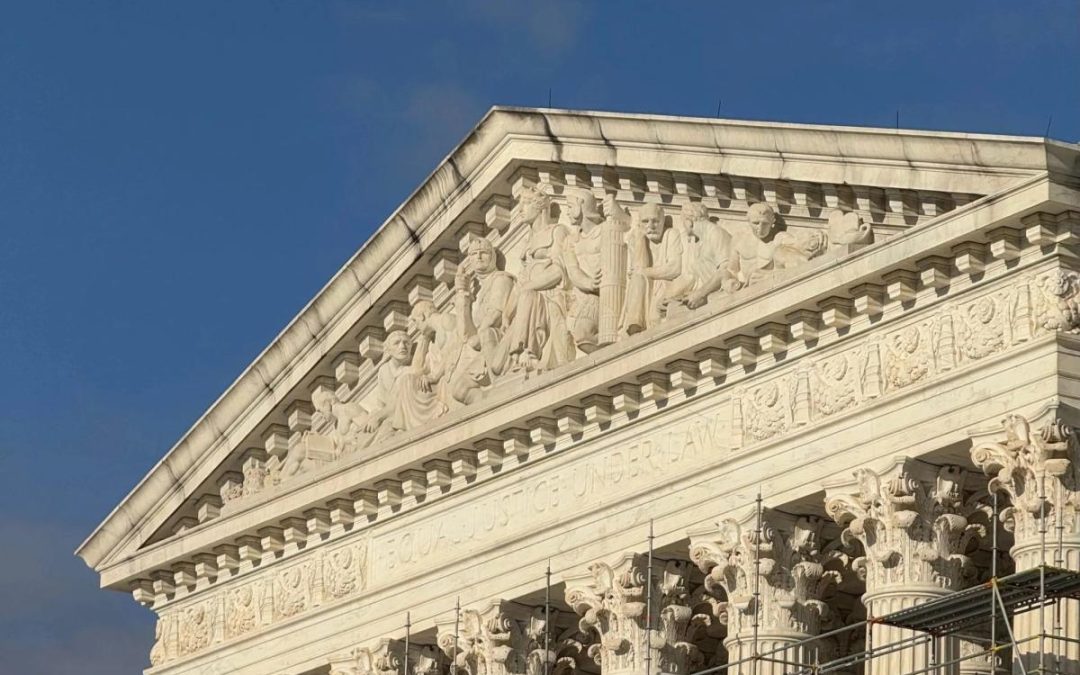
“Equal Justice Under Law” – except for Guam and the U.S. territories?
In a column for SCOTUSblog, Neil Weare and Adi Martínez Román described the broader context for the people of Guam of Department of the Air Force v. Prutehi Guåhan, which will be argued on Wednesday and explores whether federal law allows the U.S. Air Force to conduct less environmental review and community consultation when it disposes of hazardous munitions by exploding them on sensitive shorelines in Guam than when it builds roads or other military facilities.
Podcasts
Advisory Opinions
What Is Originalism? | Interview: Sherif Girgis
The new Supreme Court term has officially started, Sarah Isgur has returned from Down Under, and Sherif Girgis is taking a job at Harvard Law School. The vibes are immaculate as Sarah and David French discuss the long conference and then Girgis joins them to reflect on Justice Samuel Alito’s new book and his recusal from the biggest case of the term.
A Closer Look
The 2026 Red Mass
The 74th annual Red Mass was held on Sunday morning at the Cathedral of St. Matthew the Apostle in Washington, D.C.
In attendance were Chief Justice John Roberts, Justice Brett Kavanaugh, Justice Amy Coney Barrett, and retired Justice Anthony Kennedy. Vice President JD Vance, along with second lady Usha Vance and their four children (including their 11-week-old), sat three rows behind the justices. All were escorted by security personnel and attendees were required to undergo a security screening before entering the church.
Held the Sunday before the first Monday in October to coincide with the new Supreme Court term, the Mass is sponsored by the John Carroll Society and serves to “invoke God’s blessings on those responsible for the administration of justice as well as on all public officials,” according to the society. Other than the justices and the vice president, more than 1,000 lawyers, law students and professors, deans of local law schools, government officials, and members of the public were in attendance.
Named after red vestments used to symbolize the Holy Spirit, the Red Mass tradition began in 13th-century Europe to bless judges for the judicial year and was carried to D.C. by the John Carroll Society in 1953. The society is a Catholic professional organization that provides “spiritual, intellectual, charitable and social opportunities … in service to the Archbishop of Washington,” according to the Archdiocese of Washington, and is named for Archbishop John Carroll, the first U.S. Catholic bishop.
This year’s Mass – like last year’s – was led by Cardinal Robert McElroy, the Archbishop of Washington. Archbishop Timothy Broglio of the Archdiocese for the Military Services, USA, gave the homily, in which he welcomed members of the legal profession and spoke on “caritas,” a Latin word that means “charity or love.” “In his first encyclical, Pope Leo wrote that the way a society treats migrants, refugees, and those forced to move reveals whether its sense of justice is driven by fear or by the spirit of fraternity,” Broglio said. “Caritas certainly has a place in the law school just as it has a place in every angle of society. If we come to beg this morning the Father to send the Holy Spirit upon the members of the legal profession, we do so with confidence in his care and in the fervent hope that caritas will be a part of the gift.”
McElroy concluded the Mass with some final remarks, thanking the concelebrating bishops, archbishops, and priests along with members of the legal profession. “I want to thank the members of the Supreme Court, Chief Justice Roberts, Justice Kavanaugh, Justice Coney Barr[ett], and Justice Kennedy, who is happily here with us today, for all that you do in the foundational, burdensome, and glorious mission that you have in our nation and in our society.”
Supreme Court justices have typically attended the Mass since its inception in 1953, although none of the nine sitting justices attended last year due to a pre-dawn security incident involving homemade explosive devices.
SCOTUS Quote
JUSTICE KAGAN: “But I think one reason why this is becoming a little bit more complicated is because you keep switching back and forth between your two theories. You know, one theory is a theory, really, about air and water regulation and who gets to do that. And another theory is not about that and really goes much further and sets out broad principles of, you know, who can do what extraterritorially with respect to any subject. And as you're pressed on the extraterritorial aspect, you go back to your environmental theory. So is it really that your extraterritorial theory cannot stand alone?”
MR. SHANMUGAM: “Like my children, I love both of our theories equally, Justice Kagan.”
— Suncor Energy Inc. v. County Commissioners of Boulder County (2026)
Recent Comments