
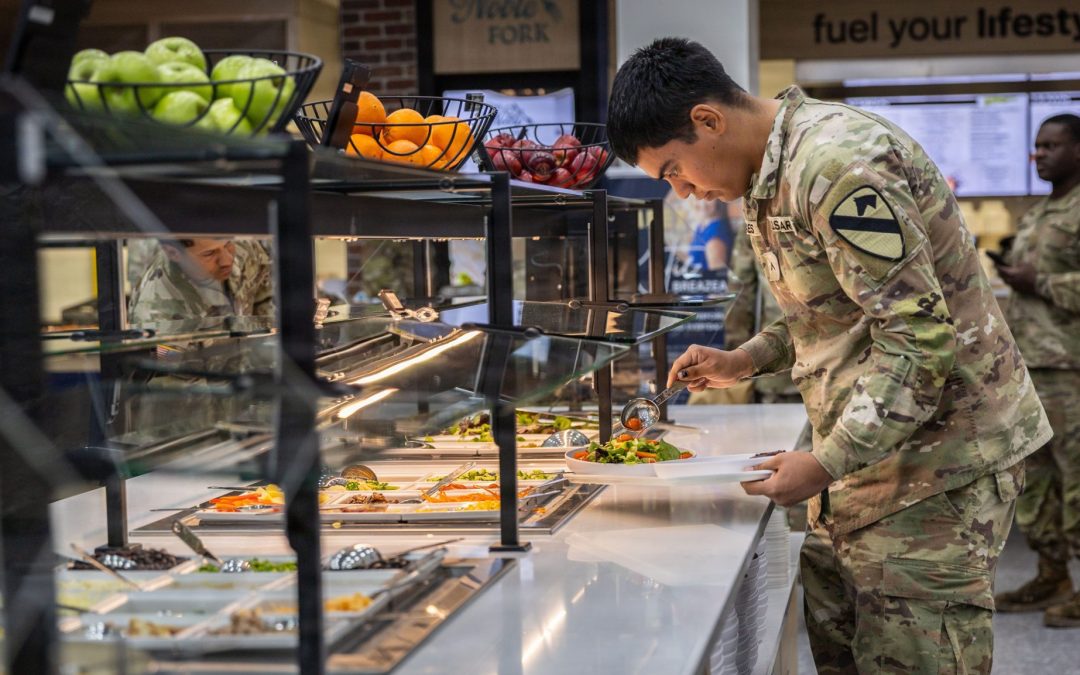
Army officials said more soldiers are eating at new college-inspired dining halls. In some cases, the average number of meals served is three to four times higher than at the same time last year, according to data provided by the service.
The numbers are reflective of the Army’s new campus-style dining halls, which were designed to be more like the cafeterias on college campuses. The service is less than a year out from opening four of its new dining facilities, and Army officials said they’re expanding takeout options and looking at more ways to add flexibility to meal card plans for soldiers.
In January 2025, the service put out a bid to private contractors, and later that year, the Army chose Compass Group USA Inc. to run the first set of new dining halls. In the last eight months, four new dining spaces have opened: 42 Bistro at Fort Hood, Texas; Stack House Bistro at Fort Carson, Colorado; Belvedere Bistro at Fort Drum, New York; and Rally Point Bistro at Fort Bragg, North Carolina. A fifth dining hall is scheduled to open at Fort Stewart, Georgia, in 2027.
Ken Hicks, a senior analyst involved in the Army’s efforts to overhaul its dining facilities, said they’ve seen usage rates go up “exponentially.” He said they’re tracking meals served and comparing it down to the quarter, month and week.
At 42 Bistro at Fort Hood, meal rates have increased three times what they were last year. Between February and mid-October, the new Texas dining hall served an average of 3,004 meals compared to 973 meals during the same time last year at the old facility. There’s also been a 130% increase in soldiers served, or about 5,500 more soldiers eating there compared to last year, according to data provided by the Army.
“The throughput through those facilities is literally tripling the traffic area,” said Stephanie Barton, head of the Army Food Program at Army Materiel Command. “That’s huge, and that’s really kind of where we want it to be.”
At Fort Carson, the new dining hall served an average of 3,324 meals from April to October, compared to 878 meals during the same time last year. At Fort Drum, an average of over 2,577 meals were served, compared to only 441 meals last year at the old dining hall, according to the Army.
To give soldiers more ways to use their meal plans, the Army has expanded a takeout dining option that first launched at Fort Hood with a few hiccups. Army officials said that as of Oct. 1, soldiers at all new dining halls have access to On Demand — where they can order food by phone app and have it delivered to drop zones on base.
“It’s less than a week old, so we’re just working through some kinks,” Barton said in early October. “I think it’s going to be really good for the soldiers.”
In other firsts, over the summer, 42 Bistro at Fort Hood was also the first dining hall allowed to sell alcohol. Hicks said sales have been pretty low.
“That’s out of [soldiers’] pocket if they want that,” he said. “That’s not included in their [meal plan] dollars.”
As the Army set out to transform its dining program, officials said they were aiming to increase the number of soldiers who eat on base.
In 2024, Army officials had cited statistics of dining hall utilization rates falling below 65%. That number is crucial, according to the Government Accountability Office, which reported in 2022 that Army standards dictate that dining facilities with utilization rates below 65% should be considered for closure. The GAO also found that the data being tracked by the military services did not “fully assess the extent” to which troops are using their meal entitlement.
However, Hicks argued that the 65% threshold is not useful, adding, “If that was the case, we’d have blown that a long time ago.” Instead, he said meal card holder utilization is the best indicator of whether soldiers are using the dining hall.
According to the Army, 20% to 30% of soldiers with meal cards on bases that have the new dining halls are choosing to eat at them.
So far, food planners have noticed that some aspects of the new contractor-run dining halls are consistent with old dining facility norms: the majority of customers are enlisted meal plan holders who often opt to eat there for breakfast and lunch. And with the new meal plan, officials said they’ve noticed that soldiers are choosing a different way to use it.
At the campus-style halls run by Compass Group USA Inc., soldiers get $39 worth of “freedom dollars” a day to spend any way they want on their food. For instance, soldiers could go for a heavy breakfast, skip lunch, come back for dinner, or opt for no breakfast and one big meal in the afternoon. According to Army officials, roughly 1 to 2% of soldiers eating at the dining halls are opting to spend their money in a single visit.
“They don’t physically have to go to the facility the way it’s designed now,” Barton said. “They can get their meals and they can enjoy their weekends better than having to report to an old legacy facility.”
Army officials said soldiers are doing this throughout the week — loading up on multiple meals before a busy work day — or spending it on the Friday ahead of the weekend.
Hicks said a handful of soldiers at each base are using their meal plan money this way, but he expects this trend to increase as they learn about the new options. He said food program officials are working to offer this kind of flexibility to more soldiers so they “can pick up two to three days’ worth of rations over a four-day weekend.”
“We’re just not there just yet,” he added. “We’ve got to make sure that our policies are aligned from a funding standpoint.”
The post Soldiers are using the Army’s new dining halls ‘exponentially’ more, official says appeared first on Task & Purpose.
Recent Comments