
What would it take for every soldier to eat and live the way guardsmen in Washington do now? A year ago, nobody would have asked for that.
In August 2025, guardsmen on the D.C. mission started sending me photos of their meals. One photo was of a lunch that held a chocolate banana loaf cake, a granola bar, a single apple and a bottle of juice. At the time, the official statement from leadership stated that local vendors were providing three daily meals, all ensuring access to nutritious food. The photos said otherwise.
Guardsmen continued to post about the deployment — the food, the housing — and by the end of August, Task & Purpose reported the breakfasts were drawing scrutiny. Publicly, the D.C. Guard held its ground, saying the more than 75,000 meals it has served since Aug. 12, 2025, met the Army food program calories and dietary requirements.
The turning point came when the D.C. National Guard owned the situation and changed how it handled one of the most basic parts of military life: troop welfare.
The fix did not start with a budget. It started with a problem that was surfaced from within the ranks and a command that took the criticism seriously. The Guard changed vendors, wrote the standard down and enforced it, and they did that in about a year on a mission with posts scattered across the city and a national audience. When leaders treat feedback from the bottom of the formation as a signal instead of a complaint, and hold contractors to a written standard, quality of life improves fast. Big Army has been hearing the same complaints about its dining facilities and barracks for years. The D.C. Guard is proof the problem is fixable.
There is an asterisk. The high-visibility mission in the nation’s capital has the kind of flexibility that a dining facility on a small installation or post may not have. This kind of assignment also brings with it a budget for apartment rentals, room contractors, gives command the ability to switch caterers, and generally buys leadership more freedom to act. Still, there are lessons to be learned from the D.C. Guard that don’t depend on the spotlight or the purse strings it can loosen.
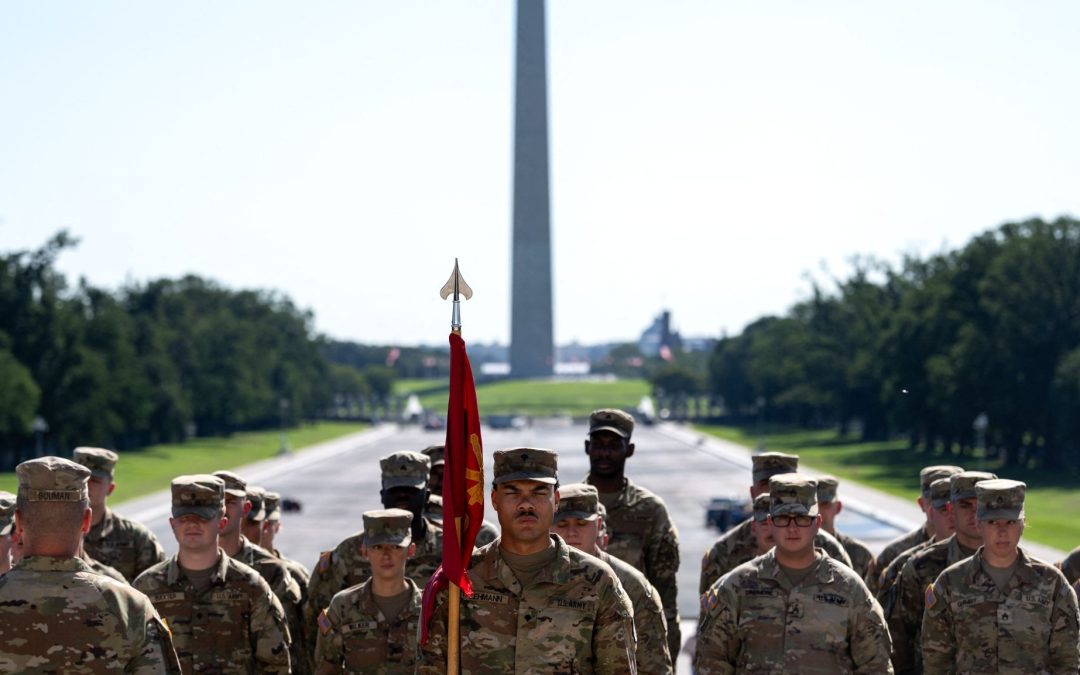
On Oct. 14, 2026, more than a year later, I had the opportunity to see firsthand what had changed. Maj. Gen. Leland D. Blanchard II, commanding general of the D.C. National Guard, and his staff walked me through how guardsmen live when deployed to the mission, now at the start of its second year.
Feeding soldiers at scale
The D.C. National Guard meals are still contracted as they were in 2025, but from a different vendor. The task force now serves roughly 8,000 most days and close to 10,000 meals on peak days, according to Air Force Col. Thomas Conley, commander of Joint Task Force-Support for the Air Force.
For comparison, the Army’s first campus-style dining venue, 42 Bistro at Fort Hood, averaged nearly 2,100 meals a day in its first two months, according to Army Materiel Command. Even at that volume, demand outran the Army’s projections so quickly after its February opening that officials paused online ordering. A typical Army dining facility serves roughly 800 to 1,000 meals a day, according to 2023 and 2024 headcount records the Army attached to a solicitation for its campus-style dining program. The task force serves about eight times that.
When the Guard went back to market in September 2025, a notice to vendors mandated a complete hot breakfast be served alongside varied midday options, while also guaranteeing tailored menus for vegan, vegetarian, halal, kosher, and gluten-free dietary requirements. The vegetarian and vegan options I saw on the chow line this October were from that list.
This level of accountability is rare across the active duty Army, where soldiers frequently report issues like undercooked chicken or inadequate food service. When change does happen, it’s usually after the threat, or follow-through, of repercussions on vendors.
The D.C. dining operations run from two sites: a drill hall floor at the D.C. Armory and a collection of tents at Joint Base Anacostia-Bolling. Neither is a real kitchen. The task force hopes to move into an unused dining facility at JBAB, but for now it feeds thousands of guardsmen a day from spaces built for something else. While some guardsmen may be walking into the building for food, most are getting it dropped off at their posts, wherever that may be around the city. But getting it to them, at the right temperature and in a safe condition to eat, can often mean sending it out by truck, metro, and even by shopping cart; all of which can be upended or delayed by any number of recurring city-specific issues.
“You can do a lot of things to soldiers and airmen,” Blanchard said. “You [have] got to make sure you’re getting their food to them.”
Conley’s staff tracks food consumption as closely as orders. Under-order, and you risk the death spiral familiar to active duty dining facilities: quality slips, hours shrink, soldiers stop coming, and low turnout justifies more cuts until the facility closes, consolidating into another existing facility, which can cause problems of its own. On an installation, that means a longer walk to a meal, creating a severe barrier to feeding our soldiers. On the D.C. Guard’s current mission, there is no other dining facility to fall back on. Failure here means a guardsman goes without food.
“Food, shelter, clothing, water,” Conley said. “If we nail that, we’ll take care of the rest of the mission.”
From cots to apartments
When the mission began in August 2025, many guardsmen arrived with cots and sleeping bags, expecting a deployment. They were right to come prepared. Blanchard still calls the D.C. mission a deployment and expects guardsmen to be in that mindset. However, it’s recognizably different these days, and Conley has told them to send the gear home.
Everyone started in hotels for housing. This has slowly transitioned to guardsmen living in traditional apartments, with better access to amenities. Today, about 800 remain in hotels, with apartments closing in on 2,000.
The apartments they occupy follow the military’s space standards by grade. The units set aside for E-6 and E-8 pay grades — staff sergeants, sergeants first class, first sergeants and master sergeants in the Army — I saw were one-bedrooms with a kitchen and a full-size washer and dryer. An E-4, either a specialist or corporal depending on the field, shared a two-bedroom apartment with a kitchen and a full-size washer and dryer as well. All apartments have free, accessible Wi-Fi. The square footage changes with rank. Nothing else does. An E-4 gets the same amenities, the same cleanliness, and the same standards as an E-8. That standard is not cheap. The Guard is paying $292 million over three years for 2,000 apartment-style units from corporate lodging company Placemakr, Task & Purpose reported. Most installations couldn’t do this if they wanted to. Spreading guardsmen across complexes and hotels also makes unit integrity harder to hold, a problem active duty units combat regularly.
The standards seen in the Guards’ apartments mirror the Army’s recently released barracks guidebook, though the task force started using these standards before it officially came out. Every room gets inspected every week. Active duty units are only now starting to do the same, after the Army’s new barracks guidebook called for it. The task force was already doing it. A monthly visit from a cleaning service for fresh linens and a simple wipe-down, and a contracted maintenance company that takes work orders via QR code, phone or text. The guardsmen I spoke with had used all three and said their work orders were handled quickly and without issues. They also have the opportunity to rate their satisfaction with the maintenance work after it is completed.
After each job, guardsmen rate the work, and that rating isn’t just a formality. It holds the contractor accountable, and it gives the most junior people in the formation a voice in decisions leadership makes about that contractor.
That’s not the experience of many service members. When active duty soldiers tell Hots&Cots about their experience with the Army’s Directorate of Public Works, it’s rarely a positive one. They describe work orders going unanswered, or either partially or wholly unresolved. This causes a vicious cycle of mistrust, but it’s something the Guard has been able to get ahead of.
Don’t pass down hardship
For two decades after 9/11, the Guard’s playbook was built for war. Guardsmen deployed overseas more than 1 million times, according to the National Guard Bureau, moving through a mobilization site on to wherever the mission put them: Bagram Airfield, Forward Operating Base Falcon or a small outpost with a General Purpose Medium Tent (GP-Medium Tent) and a cot. A domestic mission in the nation’s capital asks something different of these guardsmen. Blanchard said it pushes Joint Force Headquarters across the 30 states and territories to operate almost like combatant commands, moving people in and out and employing them day to day. “It’s been more complex because we aren’t really configured that way.”
Blanchard spent months during a 2005 deployment without running water, power, or air conditioning, but when I raised the common thought of “I had it bad, so you suffer too,” mindset, he rejected it. “The good old days weren’t always that good,” he said. “No experience is better or worse than someone else’s. It’s just different.”
That stuck with me, and that, more than anything, may be the difference between how the National Guard addressed this problem and how the rest of the Army has struggled to do the same: We need to stop treating hardship as tradition.
The D.C. National Guard heard the complaints from their guardsmen, owned them and fixed them within a year. The Army has been hearing the same complaints about its barracks and dining facilities for far longer — years, in fact — and we have yet to see improvement in the same manner as the Guard.
It leaves a question worth asking at every installation: If a temporary mission in the nation’s capital can do this, what’s stopping the permanent ones?
The post Could the DC National Guard mission become the Army’s standard for quality of life? appeared first on Task & Purpose.
Recent Comments