
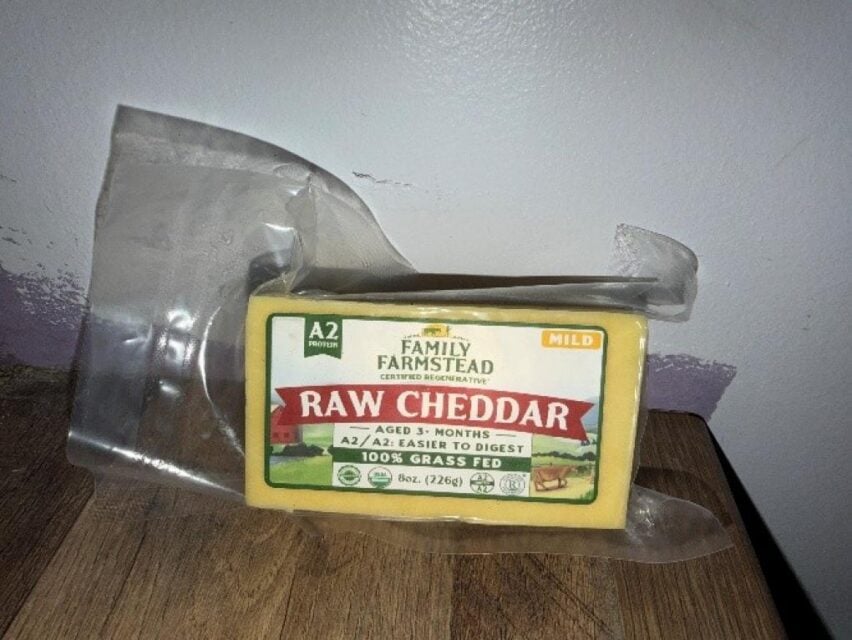
Family Farmstead Dairy of Worcester, New York is recalling all of its raw mild and raw sharp cheddar because the cheese may be contaminated with Listeria monocytogenes. FDA posted the company’s announcement on November 10, 2026. The recall covers every lot code dated 10/16/27 and earlier, sold through retail stores in twelve states. It comes 26 days after the same dairy recalled one lot of the same cheese for Shiga toxin-producing E. coli.
What is recalled
Family Farmstead Raw Mild Cheddar, 8 oz, plastic wrapped: all lot codes dated 10/16/27 and prior.
Family Farmstead Raw Sharp Cheddar, 8 oz, plastic wrapped: all lot codes dated 10/16/27 and prior.
The lot code on this cheese is its best-by date, printed on the back label. The company says the cheese went to retail stores in New York, New Jersey, Vermont, New Hampshire, Massachusetts, Pennsylvania, Rhode Island, Connecticut, Delaware, Virginia, West Virginia and Tennessee. No other Family Farmstead Dairy products are included, the notice says, “unless specifically identified by the company.”
What to do if you have it
Do not eat it. The company says the cheese can be returned to the place of purchase, or consumers can contact Family Farmstead Dairy at (607) 397-4044, Monday through Friday, 8:00 to 5:00, or at customerservice@familyfarmsteaddairy.com.
Check the refrigerator carefully. Aged cheddar keeps, and the best-by dates in this recall run to October 2027, which means recalled blocks could sit in home refrigerators for most of a year. Listeria survives and grows at refrigerator temperatures, so wash the drawer or shelf where the cheese was stored, along with any knives and cutting boards that touched it.
The October recall
On October 15, Family Farmstead Dairy recalled a single lot of Raw Mild Cheddar, lot code and best-by date 7/22/27. The company said the problem was found when “a LFFM sample in Maryland” isolated two strains of Shiga toxin-producing E. coli in two samples of its A2 Raw Cheddar. LFFM is FDA’s Laboratory Flexible Funding Model, which pays for state laboratories to test food.
The first version of that notice named E. coli O157:H7 and said the cheese went to grocers in New York and New Jersey. A corrected notice changed the strains to O26:H11 and O45:H2 and the distribution to seven states: New York, Pennsylvania, New Jersey, Connecticut, Maryland, Virginia and Massachusetts. Both versions said no illnesses had been reported and that no other products were involved.
What the new notice does not say
Whether anyone is sick. The October notice said no illnesses had been reported. The November notice says nothing about illnesses either way.
How the Listeria was found. The notice does not say whether a finished cheese or the plant environment tested positive, or whether the company, a state or FDA did the testing.
Why the map changed. Maryland was on the October list and is not among the twelve states now. Vermont, New Hampshire, Rhode Island, Delaware, West Virginia and Tennessee are new. Sharp cheddar was not part of the October recall at all.
What went wrong. In October the company said it was “committed to identifying the cause of this issue.” The November notice reports no cause for either pathogen.
This is not the Graziers outbreak
The E. coli O26 outbreak CDC announced in September was linked to Graziers raw milk cheese from Sierra Nevada Cheese Company of Willows, California, with 13 people sick in nine states as of CDC’s September 25 update. Family Farmstead Dairy is a different company in a different state. Both matters involve E. coliO26:H11, but a shared serotype does not connect two products, and no agency has said the two are related.
Three questions
Which Family Farmstead cheese is recalled? All Raw Mild Cheddar and Raw Sharp Cheddar in 8 oz packages with a lot code or best-by date of 10/16/27 or earlier, sold in twelve eastern states.
Has anyone gotten sick? No illnesses have been publicly reported in connection with either Family Farmstead recall. The November notice is silent on the question.
What are the symptoms of Listeria infection? Fever, muscle aches, headache, stiff neck, confusion and loss of balance, sometimes after diarrhea. Symptoms usually begin within two weeks but can take as long as 70 days. Pregnant women, newborns, adults over 65 and people with weakened immune systems are at highest risk, and infection during pregnancy can cause miscarriage or stillbirth. Anyone who ate the recalled cheese and develops symptoms should call a doctor and mention the exposure.
About Marler Clark
Marler Clark, The Food Safety Law Firm, has represented people sickened by Listeria and E. coli for more than 30 years, including the families of all 33 people who died in the 2011 Jensen Farms cantaloupe Listeriaoutbreak. For more information see About Listeria and the firm’s Listeria page, or call 1-800-884-9840.
Recent Comments