
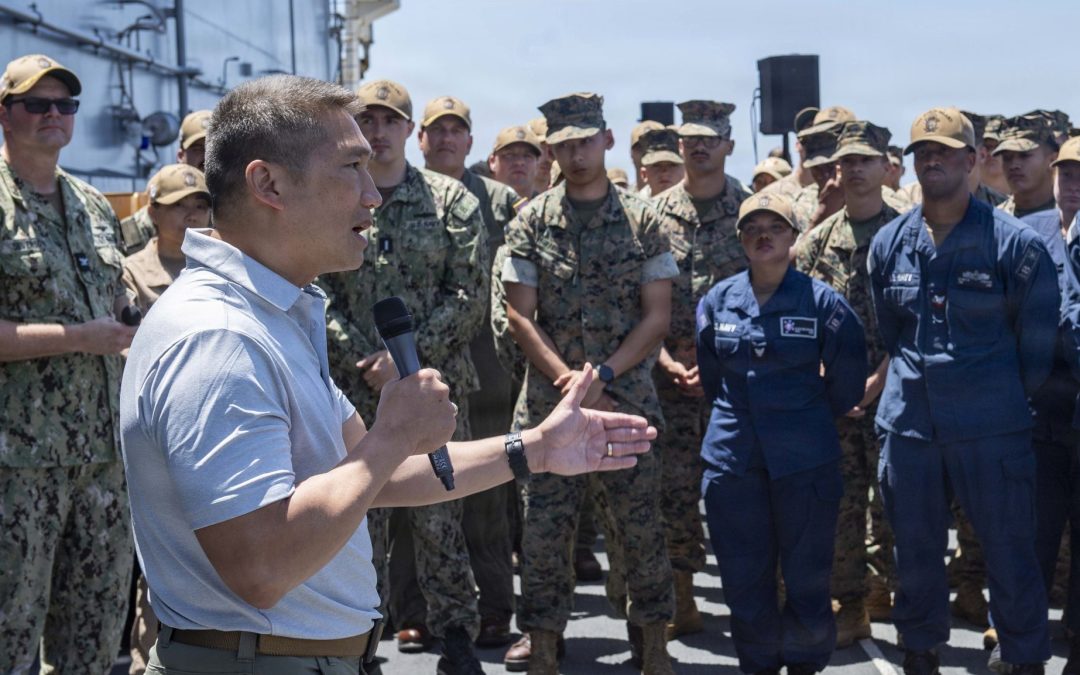
Acting Navy Secretary Hung Cao says sailors are facing longer deployments at sea “because” the service doesn’t have enough ships.
Cao’s comments came during his nomination hearing before the Senate Armed Services Committee Tuesday morning. Cao was nominated to the position in September but still needs to be confirmed by the Senate.
The acting secretary came into the role amid growing concerns from military families and media reports about mounting quality-of-life issues and mental health concerns facing sailors aboard Navy ships deployed to support the Iran war. On Tuesday, Senators pressed Cao for his perspective on issues raised over the last few months, including how the Navy’s ship deployments have averaged closer to a year at sea instead of the Navy’s goal for seven-month deployments.
“The reason why we had to have these extended deployments is really because we only have 286 ships today,” Cao said. “As of today, there’s only 286 ships in the battle force. We need 355, and we’re doing the best we can to get these ships out there as quickly as we can so that sailors are not extended on deployment for a long time away from their families. It causes a lot of maintenance issues for our ships as well.”
The hearing comes a week after Cao reportedly told family members of the USS George H.W. Bush carrier strike group that their sailors would not be coming home before the holidays, and that the deployment might stretch a year. A senior Navy official could not confirm the deployment extension for Task & Purpose, citing operational security.
One naval historian said the problem of not having enough ships to meet demand has been brewing for decades. Steven Wills, a former Navy officer and expert for the Center for Maritime Strategy, pointed to a 1993 report that said the Navy would need 15 aircraft carriers to sustain a constant carrier presence in Europe, the Middle East, and the western Pacific.
But the fleet size has hovered around 11 carriers since the 1990s, and today several of those are currently in long-term overhaul. The problems snowball, Wills said. First, the Navy sets out scheduled ship maintenance periods, and when those periods get skipped due to extended deployments, it saddles them with longer and more expensive maintenance sessions.
“In your car there’s a little sticker in the upper left-hand driver’s side window that says ‘bring me back to your dealer at X number of miles,’” Wills said. “You might be able to drive a lot longer [than that]. But when you come back to your car dealer, then they’re probably going to find more things wrong with your car than what the maintenance plan said.”
Top Stories This Week
Cao also told Congress that the service is working to “accelerate” the deployment of unmanned surface vessels to “relieve” the 17 destroyers supporting the Naval blockade in the Strait of Hormuz and “reduce the strain on the fleet.” In October, Cao said that the Teddy Roosevelt Carrier Strike Group was the first carrier strike group to deploy with an unmanned surface vessel.
The Navy announced a plan in September to buy 30 medium unmanned surface vessels that could carry sensors or missiles, or act as electronic warfare or logistics platforms. The problem, Wills said, is that the Navy is still figuring out the concept for how to use those ships.
For example, some say drone ships should act as escorts for larger crewed vessels, while others argue they should form “ghost fleets” that act autonomously deep in hostile waters. There are also lingering questions such as how to keep the ships from being hacked or seized.
“I think we’re making progress, and the unmanned revolution is definitely underway, but we’re not there yet,” Wills said.
The post Acting Navy Secretary says longer deployments are ‘because’ there aren’t enough ships appeared first on Task & Purpose.
Recent Comments