
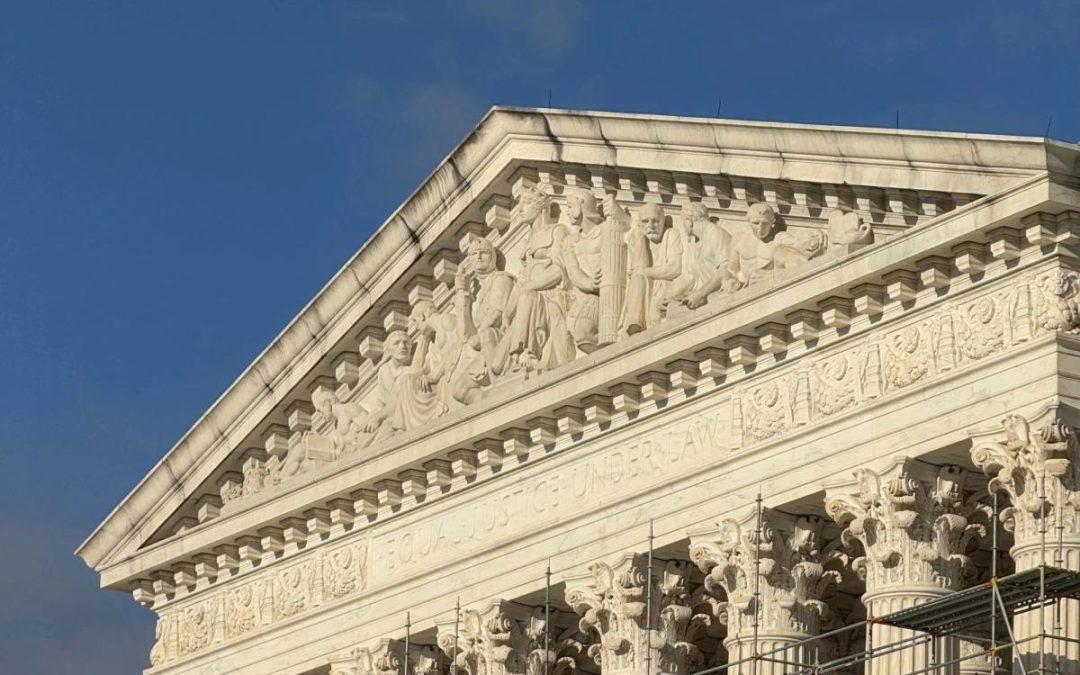
Do you have a young Supreme Court nerd in your life? After pointing them to children’s books by the current justices, consider checking out A Supreme Friendship, a new book on Justices Ruth Bader Ginsburg and Antonin Scalia and the importance of “not letting strong differences get in the way of a good friendship.”
At the Court
As part of a regularly scheduled summer order list, the Supreme Court announced on Monday that Jouppi v. Alaska, an Alaskan bush pilot’s challenge to the forfeiture of his $95,000 airplane over a six-pack of beer, had been taken up for argument during the 2026-27 term. For more on the dispute, see the On Site section below.
Morning Reads
TPS Update: DHS Warns of ‘Last Opportunity’ After Supreme Court Ruling
Dan Gooding, Newsweek
In a series of social media posts on Friday, James Percival, general counsel for the Department of Homeland Security, urged “those with an expiring … designation” under the Temporary Protected Status program “to accept $2,600 and a free flight home” – the benefits available to TPS holders who “self-deport before their legal status officially lapses,” according to Newsweek. Hundreds of thousands of TPS holders are expected to lose their legal status after the Supreme Court on June 25 held that the Trump administration could end removal protections for Syrian and Haitian nationals and cleared the way for the Trump administration to more broadly scale back the TPS program. Newsweek noted that “[b]usiness organizations, labor unions, and immigrant advocacy groups have warned that the administration’s decision to end work authorization for many TPS holders could have sweeping consequences for both workers and the U.S. economy.”
Court Drops Order Preserving Yemenis’ Deportation Protections
Andrew Kreighbaum, Bloomberg Law (paywalled)
Judge Dale E. Ho has “agreed to lift an order blocking the Trump administration’s termination of Temporary Protected Status for 2,800 Yemeni nationals in the US,” according to Bloomberg Law. “Ho found that he was bound by a US Supreme Court decision last month holding that decisions on the program are off limits from judicial review. His May 1 order had kept protections in place while a challenge played out over the termination for Yemen.”
Trump calls for review after climate manual for judges withdrawn
Zach Schonfeld, The Hill
In a Truth Social post on Sunday, President Donald Trump demanded review “of an updated judges’ manual that he claims the left improperly influenced,” according to The Hill. “These Manuals have been totally DISCREDITED,” Trump wrote. “Our Nation’s Federal Judges deserve Facts and Science, not Political Fraud and False Science on Climate.” The president’s comments come after “a controversial climate science chapter” was removed from “the updated ‘Reference Manual on Scientific Evidence,’ which federal judges use to aid them in cases involving complex scientific topics,” and after Justice Elena Kagan, who wrote the foreword for the manual, was asked about that chapter’s removal during her congressional testimony last week. Kagan said “she hadn’t read the chapter … and insisted the judge who managed the project is working to avoid a repeat.” “I know that she is engaged with members of Congress about … how to make sure that the processes that the Federal Judicial Center uses [to produce the manual] are good ones and that a situation like this does not come up again,” Kagan said.
‘Top Gun’ Magazine Article Heirs Appeal Spiked Paramount Lawsuit to Supreme Court
Casey Loving, The Wrap
In a petition for review filed earlier this month, “[t]he heirs to a 1983 magazine article that inspired the original ‘Top Gun’ film” urge the justices to take up their claim that Paramount violated copyright law by making “Top Gun: Maverick,” a sequel to the original film, without first re-securing the rights to draw on the article in their work, according to The Wrap. “The plaintiffs are the heirs of Ehud Yonay, who wrote an article titled ‘Top Guns’ for California Magazine that earned him a ‘story by’ credit for the original film.” They contend that the movie’s sequel also relies on Yonay’s work, but a federal district court and the U.S. Court of Appeals for the 9th Circuit held that the family “failed to establish a triable issue as to substantial similarity, as required to establish copyright infringement.”
The Supreme Court grapples with a new era of political violence
Alec Dent and Dan Merica, The Washington Post (paywalled)
For The Washington Post’s Early Brief newsletter, Alec Dent and Dan Merica revisited Justice Elena Kagan and Amy Coney Barrett’s testimony to Congress on the court’s growing security needs, exploring how political violence is affecting the justices’ work. “For most of its history, the Supreme Court has had the least visibility of the branches of government and, as a result, has required the least security,” they wrote. “But threats against Supreme Court justices have increased significantly in the last decade,” and it’s affecting more than just the nine current justices. SCOTUSblog’s Sarah Isgur told Dent and Merica that “the effect of the threats is actually to deter future people from taking these jobs.”
On Site
Court News
Supreme Court agrees to hear case on whether airplane was improperly seized for transporting a six-pack of beer
The court on Monday added a new case to its oral argument docket for the 2026-27 term. The justices agreed to review Jouppi v. Alaska, an Alaskan bush pilot’s challenge to the forfeiture of his $95,000 airplane – which prosecutors sought on the theory that he must have known that one of his passengers was bringing a six-pack of beer into an Alaskan village where alcohol is prohibited. That forfeiture, pilot Ken Jouppi contends, violates the Eighth Amendment’s ban on excessive fines.
From the SCOTUSblog Team
When it comes to getting the Supreme Court’s attention, does one state have an edge?
A SCOTUSblog analysis of the 35 argued cases with a single person (who was not a government official sued in their professional capacity) or family on one side of the “v.” found that five of these disputes centered on Texans. The next-closest states on this metric can claim only two. What explains why Texas stood out this term – and why the state often looms large at the court?
A Closer Look
When was the chief not in the majority this term?
Chief Justice John Roberts was in the majority 95% of the time in merits cases this term (tied with Justice Brett Kavanaugh for the top spot). Given that the court released 66 such opinions, that 95% figure translates to exactly three cases in which Roberts was on the dissenting side. Notably, the chief did not write a separate opinion in any of them (all six opinions he authored this term were majority opinions), meaning that in each of the three cases he joined a dissent written by someone else – twice by Justice Samuel Alito and once by Justice Amy Coney Barrett.
Roberts’ first non-majority vote (chronologically by opinion release date) came in Hencely v. Fluor Corporation, a case stemming from a 2016 Taliban attack at a U.S. base where an Army specialist was injured and later sued the military contractor under state law. During oral argument, the justices were “broadly skeptical” of the contractor’s assertion that it was immune from liability under prior Supreme Court precedent.
Justice Clarence Thomas wrote for the six-justice majority (including Justices Sonia Sotomayor, Elena Kagan, and Ketanji Brown Jackson, plus Justices Neil Gorsuch and Barrett), holding that military contractors do not have absolute immunity for negligence in an active war zone. Roberts dissented alongside Alito and Kavanaugh, with Alito’s dissent arguing that “this state-law tort case is preempted by the Constitution’s grant of war powers exclusively to the Federal Government … this state-law tort suit is not the way to give petitioner what he is due.”
Roberts’ next time breaking with the majority came in the late-May opinion release of Hamm v. Smith, an Alabama death penalty case about intellectual disability and IQ testing thresholds under 2002’s Atkins v. Virginia, which held that the Eighth Amendment prevents the execution of intellectually disabled persons. Rather than clarify how the lower courts should handle conflicting test results about one’s IQ, the court dismissed the case as improvidently granted (that is, it should not have been taken up in the first place) without explaining the vote. In response, Alito wrote a 24-page dissent joined by Thomas (who also wrote a dissent), along with Roberts and Gorsuch in part.
Alito’s dissent argued the court should have provided “workable rules” for weighing multiple IQ scores, writing that the DIG “will have regrettable consequences. Without clear rules for determining when multiple IQ scores are dispositive, nearly every Atkins case will devolve into an amorphous, individualized determination of whether the defendant meets an imprecisely defined notion of ‘significantly subaverage intellectual functioning’ under which the role of IQ is not clearly articulated.” (Roberts and Gorsuch did not join Part II of Alito’s dissent, which called for the justices to “reverse the lower courts’ erroneous analysis of Smith’s scores and remand for a fresh consideration of his Atkins claim using any sound method.”)
Roberts’ third non-majority vote came in T.M. v. University of Maryland Medical System Corp. Split 5-4, the justices held that the Rooker-Feldman doctrine, which prevents federal district courts from reviewing state-court judgments, applies even when the state-court judgment is not final. Sotomayor wrote the majority opinion, joined by Thomas, Alito, Kavanaugh, and Jackson. Thomas wrote a concurring opinion.
Barrett dissented and was joined by Roberts, Kagan, and Gorsuch, arguing that Rooker-Feldman doctrine “stands on shaky ground.” “In the end,” Barrett wrote (in reference to her colleagues’ majority opinion), “Rooker-Feldman has been given an inch – it should not be allowed to take a mile.”
What can we make of the few cases in which Roberts dissented? First, while certainly significant to the parties involved, none of these could be considered the “big cases” of the term (at least based on how they came out). Second, these decisions were all quite technical, dealing with federal court jurisdiction, questions of immunity, and competing conceptions of the court’s death penalty jurisprudence. Finally, this pattern is nothing new: In the 2024-25 term, Roberts was in the majority, you guessed it, 95% of the time, closely trailed by Kavanaugh (92%) and Barrett (89%).
SCOTUS Quote
MR. STEWART: “Let me give you my most extreme answer, and then let me give you a – a backup answer. The most extreme answer is the criminal alien who is detained for more than six months, unlike every other form of detention that are – is discussed in the briefs, that alien always has the option of terminating the detention by accepting a final order of removal and returning home.”
JUSTICE KAGAN: “I take it that that's your most extreme answer because it doesn't sound all that good.”
— Jennings v. Rodriguez (2017)
Recent Comments