
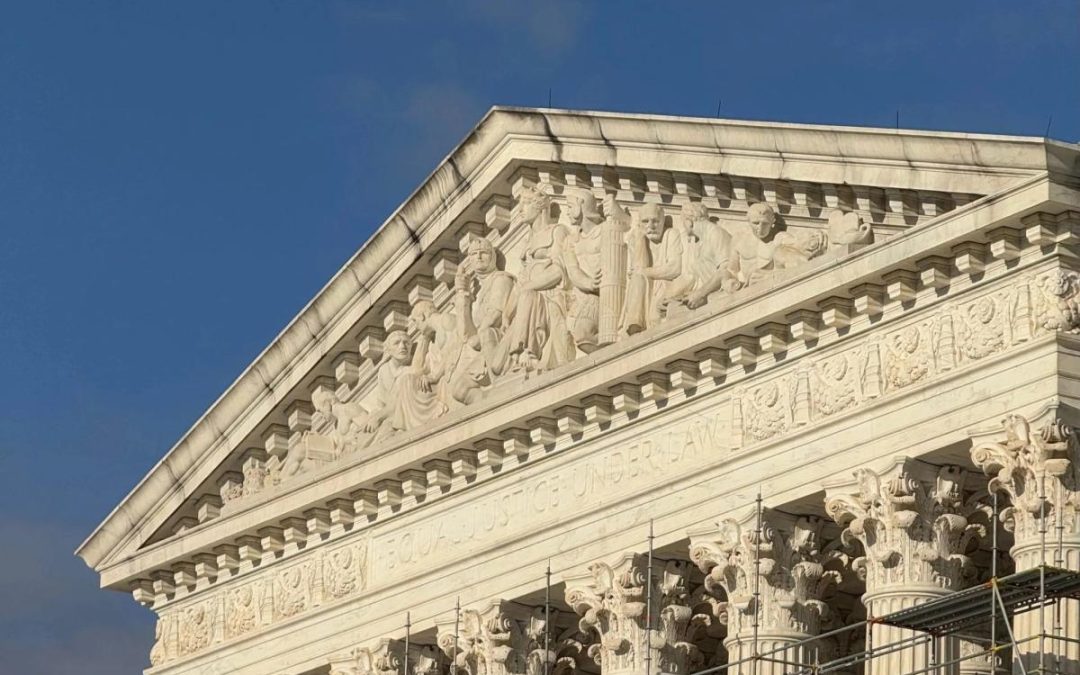
As the Supreme Court awaits word on whether Congress will approve its request for more security funding, Justice Ketanji Brown Jackson reflected on what it’s like to be accompanied by security guards 24/7. Keep reading to learn more about her comments.
At the Court
On Monday, the Trump administration asked the Supreme Court on its emergency docket to clear the way for the full implementation of President Donald Trump’s executive order on mail-in voting. On Tuesday, 12 states – led by Alabama – echoed this request in their own application. Responses to these requests from those states challenging the order are due on Monday by 4 p.m. EDT.
Morning Reads
Trump Says He Wants Supreme Court to Revive Suit Against Hillary Clinton
Greg Stohr and Erik Larson, Bloomberg (paywalled)
President Donald Trump has signaled that “he will ask the US Supreme Court to revive his failed lawsuit accusing Hillary Clinton, the Democratic National Committee and others of conspiring to tarnish his 2016 campaign with bogus claims of collusion with Russia,” according to Bloomberg. “In a Supreme Court filing made public Tuesday, the president requested an additional month, until Sept. 9, to seek review of a November appeals court decision that upheld dismissal of the case and affirmed almost $1 million in sanctions against Trump and one of his lawyers.” “The 3-0 ruling by [the] 11th US Circuit Court of Appeals faulted Trump and lawyer Alina Habba for filing a ‘frivolous’ lawsuit against his 2016 rival. Two of the judges on the panel were appointed by Republican presidents, including one by Trump.” In his recent filing with the Supreme Court, the president “indicated his appeal would focus on the appeals court’s conclusion that he waited too long to sue.”
Michelle Obama and Justice Jackson Talk Work-Life Balance and Public Service
Ann E. Marimow, The New York Times (paywalled)
During an appearance on former First Lady Michelle Obama’s podcast, Justice Ketanji Brown Jackson “commiserated” with Obama “about the stresses of co-parenting young children with an equally ambitious spouse, the adjustment to living with round-the-clock security and their experiences as Black college students at elite educational institutions,” according to The New York Times, which noted that the podcast episode was recorded in May. “While the two were in agreement about the privilege of serving at the highest levels of public office, both women lamented the adjustment to living in a bubble, accompanied at all times by security.” “I can’t go out in any meaningful way as I used to, and that can be a downside,” Jackson said.
Founders’ views on church-state relations face new scrutiny as Ten Commandments case heads to SCOTUS
Kelsey Reichmann, Courthouse News Service
Laws in conservative, southern states, including Texas, that require Ten Commandments displays in public school classrooms “set up a major clash over church-state relations” that’s expected to soon reach the Supreme Court. “A coalition of multifaith Texas families plans to ask the justices to review whether the display of the Christian religion in government-run schools violates the First Amendment,” according to Courthouse News Service. “While over four decades of precedent weighs against religious displays in public schools, the appeal comes amid the Supreme Court’s push toward originalism and a growing debate over the founders’ views on the separation of church and state.” Christopher Lund, a professor at Wayne State University, told Courthouse News Service that “the court is talking about history and tradition in ways that make it seem more sympathetic towards the government taking positions on religion – maybe even advancing them in the public schools. That’s the big question in the Ten Commandments case.”
Ho Suggests Justices Should Reverse Same-Sex Marriage Ruling
Jacqueline Thomsen, Bloomberg Law
At a July 17 event hosted by the First Liberty Institute, Judge James Ho of the U.S. Court of Appeals for the 5th Circuit, considered by many to be a “potential future Supreme Court pick,” “said the Supreme Court was wrong to reject President Donald Trump’s bid to end birthright citizenship, and suggested that the high court should overturn its decision legalizing same-sex marriage,” according to Bloomberg Law. “Ho said that he finds it ‘awkward’ to discuss the topic of ‘judicial courage,’ considering how federal courts have handled what he called ‘certain self-evident truths.’ ‘For example: What about the Biblical truth that marriage is the union of one man and one woman?,’” he added. Ho went on to say that the Supreme Court is unlikely to reconsider or reverse its same-sex marriage ruling in the near future, because “[w]e’re nowhere near the four votes necessary to grant a cert petition – or the five votes needed to rule on the merits.”
On Site
Court News
Trump asks Supreme Court to hear appeal of $83.3 million defamation verdict against him
Lawyers for President Donald Trump and the federal government on Tuesday asked the Supreme Court to take up his appeal of the defamation case brought against him by journalist E. Jean Carroll. A jury awarded Carroll $83.3 million in the case, and a federal appeals court in New York upheld that verdict last year.
From the SCOTUSblog Team
The push to reduce the Supreme Court’s power
Supreme Court reform is in the spotlight this summer after a contentious term. Here’s a look at proposals focused on Congress reclaiming some of the power to interpret the Constitution that now rests with the courts.
Court News
Gorsuch says Americans must study history, ‘warts, glories, and all’
During a virtual appearance on Tuesday at a forum organized by the Ronald Reagan Center on Civility and Democracy, Justice Neil Gorsuch called American democracy “very fragile,” while observing that young people need to study an unvarnished version of the nation’s history.
Podcasts
Amarica's Constitution
Faces of Intratextualism
Akhil Amar and Andy Lipka continue their study of the Roberts court’s oeuvre of constitutional cases, with particular emphasis on the series of cases that concerned making rules for voting and voting districts.
A Closer Look
Reel v. North Carolina
Approximately six years ago, three officers with the High Point Police Department in High Point, North Carolina, drove to the home of Quashaun Melsun Reel. They were following up on two complaints made to their chief’s office and Crime Stoppers about drug sales taking place at the address, and they planned to conduct a “knock and talk,” walking up to Reel’s door and then speaking with him about the complaints.
According to trial court findings, after parking, Officer Brian Hilliard, a member of the police department’s street crimes unit, first approached and tried to speak to a woman who had parked outside Reel’s home and was walking towards his residence. When she did not respond, he followed her to the door of the home, which Reel briefly opened to let the woman inside and then “slammed shut.” While the door was opened, “Hilliard detected the strong odor of marijuana,” which he determined gave him probable cause to enter without a warrant. He also believed Reel and the woman would rush to destroy evidence “if he did not immediately gain entry.”
The officers then “began to give commands for the door to be opened,” followed by an attempt to “shoulder” it open while Reel “attempt[ed] to push the door closed.” Following this, one of the officers with Hilliard kicked in Reel’s door. Inside, they found “[a] bag of marijuana, a bag of pills and a digital scale … in plain view,” according to the trial court. Reel was ultimately charged with several crimes, including possession with intent to sell or deliver schedule I and schedule VI controlled substances. In the trial court, Reel’s legal team filed a motion to suppress the evidence, contending that the officers had violated the Fourth Amendment, which outlaws “unreasonable searches and seizures.” Specifically, they argued that Hilliard needed a warrant before he walked up to Reel’s door, because the purpose of the so-called “walk and talk” was to gather evidence about Reel’s activities, not to simply have a brief chat.
North Carolina Superior Court Judge William A. Wood denied Reel’s motion, concluding that “Officer Hilliard’s approach to the front entrance of” Reel’s home “was legal in every way,” and that Hilliard and the other officers “had both probable cause and exigent circumstances to force entry.” Reel reached a plea agreement with the state under which he pled guilty to five of the charges, but he preserved his right to appeal the judge’s denial of his motion to suppress.
After sentencing, Reel appealed the denial to the North Carolina Court of Appeals, which affirmed Wood’s decision by a 2-1 vote. The judges in the majority acknowledged that the Supreme Court held in 2013’s Florida v. Jardines that the officers in that case had violated the Fourth Amendment when they brought a drug-detecting dog to a front porch without a warrant, but said that “knock and talk” visits remain “constitutionally permissible” because they involve police officers doing what any member of the public may do: “approach the home by the front path, knock promptly, wait briefly to be received, and then (absent invitation to linger longer) leave.” Reel appealed again, but the Supreme Court of North Carolina also affirmed the trial court’s denial of his motion to suppress.
In March, Reel filed his petition for review with the Supreme Court, urging the justices to address the lower courts’ “struggle[] to properly apply Jardines.” In that 2013 case, Reel explained, the court recognized that police officers have a right to approach the curtilage of a home – that is, the area immediately surrounding it and associated with it, like a front porch – in order to speak with the resident, like any member of the public might do. However, it also held that officers need a warrant for such a visit when the purpose is to gather information and potentially collect evidence. Many “walk and talk” investigations stem from the goal of “gathering incriminating evidence,” according to Reel, but lower courts are failing to distinguish them from permissible police visits. Such courts, Reel wrote, “are very confused how they analyze implied license to enter a home’s curtilage, knock and talk investigations, and law enforcement purpose.”
Initially, North Carolina waived its right to respond to Reel’s petition for review, but the justices requested a response in April. In that brief, which was filed in June, the state contends that there actually is no “doctrinal confusion among lower appellate courts” on the question of how to assess an officer’s purpose for conducting a “walk and talk” in order to determine whether the officer was behaving like any other visitor or if, instead, the officer was conducting a search of the area. “The alleged division and confusion is illusory,” according to the brief. “Of the nine courts cited by [Reel], four explicitly discuss officer purpose. As for the other five, the cases cited do not reveal any doctrinal division or confusion as to an officer’s purpose.”
Reel v. North Carolina is scheduled to be considered by the justices at their “long conference” on Sept. 28.
SCOTUS Quote
“The perpetuity of our institutions, and the liberty which is enjoyed under them, depend in no small degree upon the power given the judiciary to declare null and void all legislation that is clearly repugnant to the supreme law of the land.”
— Justice John Marshall Harlan in Smyth v. Ames (1898)
Recent Comments