
By León Fernando Del Canto, 9 August 2026
The word trust is used freely in Bogota, London, Madrid or Miami, with an ease that the institution it names has never possessed, and it is that discrepancy, rather than any difference of tax policy, which accounts for most of what goes wrong. I addressed some of these issues from a purely Spanish perspective in Common Law and Continental Law on Trusts. The Tax Problem and the Legal Solution, the Dutch Example.
I write this from Bogotá, where a question I have been asked many times in Madrid reaches me in an unfamiliar accent and carries a complication which Spain does not present. Colombia knows the fiducia intimately, having used it to build apartment blocks, to hold land while a project awaits its licence, to administer public money and to secure a loan, so that the word arrives here without any of the strangeness it carries in Europe, and it is precisely that familiarity which does the damage.
When a Colombian family holds part of its wealth through a Panama or Jersey settlement, much as a British family resident in Madrid may do, the adviser who opens the file finds fiducia upon one side of the page and “trust” upon the other, and proceeds, quite reasonably and quite wrongly, upon the assumption that the two words point at a single idea. The damage begins there, in an act of translation performed before any question of law has been put.
The timing is not accidental, since Colombia has just passed Decreto 0510 of 19 May 2026 where the Ministry of Finance added a new Title 5 to Book 5 of Part 2 of Decreto 2555 de 2010, assembling for the first time a systematic regulatory framework for the negocio fiduciario as a supervised financial service,1 so that any comparison drawn from older material will now misdescribe what Colombian law requires.
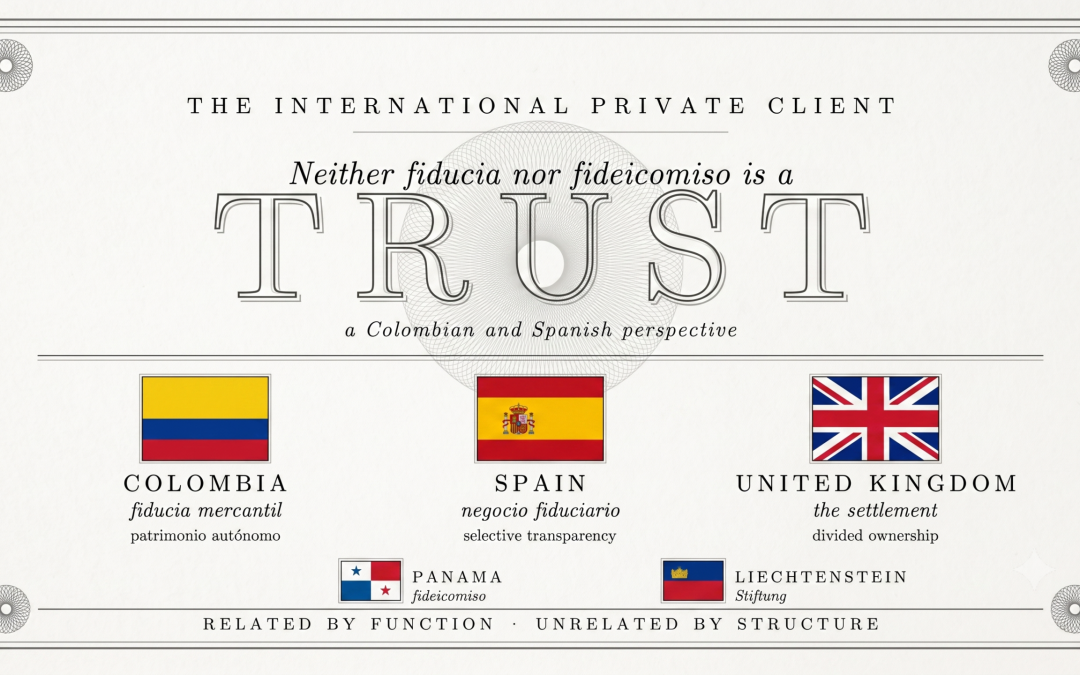
For those advising Colombian or Spanish tax residents whose structures include an Anglo-American trust, two fundamental ideas must be considered. First, the fiducia and the trust are related by function and unrelated by structure, and neither country possesses any mechanism for receiving the trust as such, so that each has improvised, the one by statute and the other by administrative habit.
The trust divides ownership
An English trust is not just a vehicle, it is an complex legal instrument. It achieves more than the separation of one fund from another, a service many systems perform by other means, since it divides ownership between two persons at the same moment and in respect of the same asset. The trustee holds the legal title, so that it is his name which appears upon the register and the bank mandate, while the beneficiary holds an interest in equity which is a right in the asset itself rather than a personal claim against its administrator, and which, being proprietary, binds third parties taking with notice, survives the trustee’s insolvency and follows the fund into substituted property.
That duality was the work of the Court of Chancery in England, and the Roman tradition produced nothing comparable, having built its law of property upon the axiom that a thing has one owner whose title is entire, so that whatever else exists is either a limited real right carved out of that ownership or a personal obligation. When an English settlement arrives in a codified system, the system finds itself holding a right for which it has no category.
What the fiducia is, and why it is not that
The question must be understood from a doctrinal, rather than statutory or legislative approach. A codified system admits only those real rights its statutes create, so that a form of ownership unknown to the code could not be manufactured by agreement, and after three failed attempts, Alfaro’s irrevocable agency, the unfolding of ownership into a legal and an economic right, and Lepaulle’s patrimony belonging to nobody, what survived was the trustee’s special-purpose patrimony, which is what the Colombian Commercial Code enacted.2
Colombian law accordingly contains a family of fiduciary institutions rather than one. The fideicomiso civil of articles 794 to 822 of the Código Civil burdens ownership itself, defining propiedad fiduciaria as ownership subject to the charge of passing to another upon a condition deemed to have failed if more than thirty years pass,3 and stands closer to the Spanish sustitución fideicomisaria than to anything in English Law, while the encargo fiduciario, whose delivery of assets does not carry the transfer of dominion,4 cannot be a trust at all. Between them sits the fiducia mercantil of articles 1226 to 1244 of the Código de Comercio,5 habitually offered as the local equivalent, and four of its features mark out the distance.
The assets form a patrimonio autónomo, kept separate from the fiduciary’s own and outside the general guarantee of his creditors,6 so that ring-fencing is achieved by segregating a patrimony within the transferee’s title rather than by dividing ownership. Successive benefit is prohibited, and although the twenty-year cap upon duration was repealed in 2009 the surviving prohibition strikes at the dynastic settlement more directly than the repealed one ever did, successive life interests being the ordinary architecture of the family trust.7 Upon termination the assets revert by default to the fideicomitente or his heirs,8 a default no English draftsman would recognise, the purpose of a settlement being that the property does not come back. And the beneficiario holds derechos fiduciarios, any participation in a contract of fiducia mercantil,9 which is a claim against the patrimony rather than equitable ownership of the portfolio.
The patrimonio autónomo is therefore not an approximation of the trust which fell short of its model, but the deliberate product of a doctrine which set out to reproduce the segregation of the fund without reproducing the division of ownership, and which succeeded. The decree of May 2026 confirms that distance rather than closing it, regulating the fiducia as a financial service supplied to a consumer, directing the fiduciary’s loyalty to the purpose set out in the contract rather than to the beneficiaries, and recognising five types of business, none corresponding to the multi-generational holding of family wealth.10
Recognition, and the analogy carrying the weight
Neither Colombia nor Spain has ratified the Hague Convention of 1 July 1985 on the Law Applicable to Trusts and on their Recognition, an instrument which has attracted fourteen Contracting Parties and no more since 2017, and the corridor described here runs across the division, Panama having acceded with effect from 1 December 2018.11 Ratification would in any event answer only half the question, article 19 preserving the fiscal powers of contracting States entirely, as the Netherlands demonstrated by ratifying and then attributing the assets of a separated private fund to the settlor irrespective of the civil validity of the arrangement.12
The civil consequence in Colombia is habitually passed over. Asked in September 2020 who is entered in the share register of a Colombian sociedad por acciones simplificada whose shares have been transferred to a foreign trust, the Superintendencia de Sociedades began by observing that the trust has been rendered in Colombian legislation through the fiducia mercantil, and answered accordingly, requiring the fiduciary company to appear as owner rather than as shareholder and the beneficiaries to be recorded with their percentages.13 There is no fiduciary company in an English settlement and no register entry for a trust, so the question as put had no clean answer, and such concepts resolve no particular case in any event.14 An administrative analogy never tested in a Colombian court is carrying the weight a ratified convention would otherwise carry, and a family accustomed to the confidentiality of a discretionary settlement should note that it discloses the beneficiaries.
Spain has less again, its negocio fiduciario, its sustitución fideicomisaria and the fiducia sucesoria of the derechos forales being fiduciary in vocabulary while none produces a fund held by one person at law for another in equity,15 and the Tribunal Supremo having addressed the common law trust in substance essentially once, in 2008, describing it as unknown to Spanish law both substantively and in private international law and, the governing foreign law not having been proved, applying Spanish law and disregarding the trust.16
Colombia answers by statute
Where recognition is improvised, taxation is legislated, and in this lies Colombia’s advantage over the Spanish position. Article 102 of the Estatuto Tributario states transparency in terms, requiring beneficiaries to include in their returns the income, costs and expenses accrued to the account of the patrimonio autónomo in the same year and upon the same conditions they would have borne had the activities been carried on directly.17 The mechanics repay attention, because the fiduciary company must certify the financial information to the fideicomitentes and beneficiaries under signature of its legal representative and its revisor fiscal, and it is upon that certificate that the resident reports.18 No such document exists at the other end of an offshore structure, so the beneficiary of a Jersey settlement must construct annually, and under penalty, what the Colombian system expects a licensed institution to certify. That gap is administrative rather than doctrinal, and it is where most of the practical failure occurs.
For foreign structures the reach is wider, the entidades controladas del exterior regime introduced in 2016 expressly comprehending trusts, autonomous patrimonies, collective investment funds and private interest foundations,19 and until 2022 the decisive question was whether a beneficiary held anything better than an expectation. The DIAN answered it on 10 April 2018 in a unified concept holding that residents effectively holding the right to the benefits are within the regime while those holding a mere future expectation or a conditioned right are not,20 which removed the beneficiaries of an irrevocable discretionary settlement altogether and upon which a generation of structures was built. Article 295-3 reversed the result for the wealth tax in December 2022, assimilating participations in foreign trusts and foundations to derechos fiduciarios and naming the founder as the person liable to declare wherever the beneficiaries are conditional or lack control, without regard to the discretionary, revocable or irrevocable character of the arrangement or to the powers of any protector.21
That drafting did not arrive from nowhere, the same language having appeared in the normalisation tax created for 2020.22 The practitioner therefore holds two administrative positions of opposite tendency, the concept of 2018 surviving for the income tax and cited as recently as 2025, and article 295-3 governing the wealth tax, and the error to avoid is carrying the older one across.
Two cautions follow. The charge itself is unstable, the structural reform of 2025 having been defeated in Congress, two emergency decrees having been struck down by the Corte Constitucional in April 2026 and the consolidated text of article 295-3 now carrying paragraphs added by emergency decree for 2026,23 so the attribution rule must be read against a charge which may not survive the year. And transparency is not a general principle of Colombian taxation, governing the income tax alone and not extending to stamp duty or, until Congress legislated, to the territorial taxes,24 so that the same structure carries a different taxable person in each tax.
The corollary for the reader is that the material in circulation ages faster than the advice built upon it, a study published in Trusts and Trustees in August 2009 having advised that a foreign trust carrying an effective condición suspensiva gave Colombian beneficiaries deferral until distribution and required no report to the DIAN,25 which was fair in 2009, became doubtful in 2016 and has been wrong since 2022. Nothing in it was careless, and that is the point.
Spain answers by administrative practice
Spain has enacted no regime for trusts, so that what the practitioner has is a body of consultas vinculantes of the Dirección General de Tributos from which a pattern emerges, and which I have described elsewhere as selective transparency. The administration looks through the trust and attributes assets and income directly to the Spanish resident, whether settlor or beneficiary, for income tax, wealth tax and the Impuesto Temporal de Solidaridad de las Grandes Fortunas, which ceased to be temporary in December 2023,26 wherever transparency yields the larger charge, and reverts to the proposition that the trust has no existence in Spanish law wherever the taxpayer seeks to rely upon it. The family holds a structure simultaneously present and absent according to which state produces the higher assessment.
One consulta states the Colombian corridor in a single document, the Directorate General having considered in November 2022 a trust governed by the law of the British Virgin Islands, constituted as revocable and later made irrevocable and discretionary, whose settlor was a national and tax resident of Colombia, whose trustee was a professional company not resident in Spain and whose beneficiary was resident in Spain, the trust holding neither assets nor income in Spanish territory.27 The institution not being recognised as autonomous, the relations between the person who contributed the assets and the person who receives them are treated as taking place directly between them, so that a distribution may fall to Inheritance and Gift Tax by personal obligation, the residence of the beneficiary being the only Spanish connecting factor. The life interest is analysed by analogy with the usufructo vitalicio, an analogy which is attractive and unreliable since the dispositive discretion of a trustee has no counterpart in a usufruct, and the same question of attribution must then be answered annually and under penalty in the declaration of foreign assets.28
Attribution is not a civil law reflex
It would be convenient to treat all of this as the awkwardness of a codified system which never developed equity, and the convenience would mislead, because the jurisdictions in which the trust is native look through it as well, the United Kingdom treating income arising under a settlement during the settlor’s life as his own where he or his spouse retains an interest,29 and the United States treating a person who transfers property while retaining an economic interest in it or control over it as the owner of the trust property.30
The distinction that matters is therefore not between systems which respect the trust and systems which do not, but between those which have decided by statute when the fund will be attributed and to whom, and those which decide the same question case by case in the exercise of an administrative doctrine. Colombia, the United Kingdom and the United States belong to the first group, Spain to the second, and that is the whole of the practitioner’s difficulty in Madrid.
The United Kingdom end of a Colombian structure
A Colombian patrimonio autónomo held for a family with a member resident in London raises three questions to which I can find no considered answer in the literature of either jurisdiction.
The first is characterisation. The settlements code does not ask whether there is a trust but whether there is a settlement, a word defined to take in any disposition, agreement, arrangement or transfer of assets and applying wherever made, so that an arrangement concluded in Bogotá with a licensed sociedad fiduciaria is a serious candidate, subject to the element of bounty which a commercial fiducia may fail and a family arrangement will not.31 Capital gains may answer differently, the charge upon settlors of non-resident settlements operating upon settled property, meaning property held in trust other than property held by a nominee or bare trustee, and a patrimonio autónomo is not property held in trust.32 The same arrangement may therefore be a settlement for income tax and not settled property for capital gains, and if it resolves instead into bare agency the assets are treated as the resident’s own. Escaping both codes would settle little, the transfer of assets abroad provisions reaching income becoming payable to a person abroad whether or not what that person administers is a settlement.33
The second question is the asymmetry itself, since the Colombian arrangement arriving in London meets three statutory codes competing to catch it while the English settlement arriving in Bogotá meets no statute at all.
The third is double attribution, and it is the one which produces assessments, article 102 attributing the income of the patrimonio autónomo to the Colombian beneficiary in the year it accrues while the settlements code attributes the income of a settlement to a United Kingdom resident settlor and to that settlor alone. Where settlor and beneficiary reside in different States, as in family structures they very often do, the same receipt is attributed to two persons in the same year, and the Convention between the two countries relieves the double taxation of a person rather than the double attribution of an income to two of them,34 so that credit relief may be unavailable precisely where the exposure is largest.
All of this became more pressing on 6 April 2025, the removal of the domicile condition and of the protections formerly available to settlor-interested non-resident settlements having brought within the arising basis a class of arrangement which had sat outside it.
Two jurisdictions which did legislate
Two comparisons are worth a paragraph, because they show what the Colombian and Spanish positions lack rather than merely differing from them. Panama is not a common law jurisdiction and yet legislated the trust directly, its fideicomiso having passed through statutes of 1925 and 1941 before reaching the law of 1984 now in force, which allows a trust constituted under a foreign law to elect Panamanian law and allows the trust and its assets to be moved to another jurisdiction where the instrument so provides, and Panama has since acceded to the Hague Convention.35 A civil law system has therefore built a statutory door through which the common law institution may pass in either direction.
Alongside it sits the fundación de interés privado, modelled upon the Liechtenstein Stiftung, which is a legal person owning its own assets outright, so that there is one owner and no division of title, which is precisely why civil lawyers find it congenial.36
For the tax analysis, however, the distinction largely collapses, article 295-3 naming private interest foundations and trusts in the same breath and Spanish administrative practice looking through the one as readily as the other, so that a family which moved from a trust to a foundation to escape a problem of characterisation has changed the vehicle without changing the answer.
Why conflict of laws is not enough
Confronted with all this the well-trained international lawyer reaches instinctively for private international law, and that instinct carries the file a considerable distance before abandoning it, because tax administrations characterise autonomously.
Neither the AEAT nor the DIAN applies conflict rules, so that a settlement unimpeachable as a matter of Jersey law may be looked through in Madrid, or attributed to its founder in Bogotá, without any court having pronounced upon its civil validity, and the two answers may point in opposite directions upon identical facts while both remain correct, a professio iuris under the European succession regulation allowing a British national resident in Spain to displace the legítima while leaving the Spanish charge to follow the residence of the beneficiary and the situs of the assets.37
The mismatch then compounds, every year of returns filed upon an untested assumption enlarging the exposure. The most expensive files which reach me are seldom those in which a hard question was answered badly, but those in which it was never identified, because the word fiducia appeared in a translation and everybody relaxed.
What the analysis requires
None of this is an argument that families ought to avoid trusts, many of which were established for reasons predating any Iberian or Colombian connection and cannot now be unwound at acceptable cost. It is an argument that the analysis must be built from both ends at once, by advisers each competent in their own system and willing to be interrogated by the other, and that five questions decide most files.
- Whether the settlor has retained powers sufficient for the administration to conclude that the assets never left him, which article 295-3 answers in Colombia by declaring those powers irrelevant.
- Whether the beneficiary’s interest is discretionary or fixed, vested or contingent, and by which system’s law.
- How it is to be valued, where Colombia supplies a statutory rule and Spain none.
- Whether a distribution is income, capital, gift or inheritance, and what credit is available for foreign tax.
- And, wherever the United Kingdom is involved, whether the arrangement is a settlement within the meaning each system gives that word.
That work is an investment decision, to be modelled and embedded within the family’s governance rather than recorded in a letter nobody reads twice, and in Spain the answer will often remain uncertain whatever care is taken, in which case the proper response is to record the reasoning, quantify the downside and decide with the client in front of you. Colombia, for all the intricacy of its attribution rules, hands the practitioner a text, and since May 2026 a considerably longer one, while Spain hands him a pattern of administrative behaviour and a Supreme Court which has barely spoken, and that asymmetry is itself a matter for families who still have a choice about where they live.
Which leaves the question I would put to colleagues upon both sides of the Atlantic. Given the range of vehicles now available, the Panamanian fideicomiso and fundación de interés privado, the Liechtenstein Stiftung, the Colombian fiducia mercantil and the ordinary holding company in a dozen jurisdictions, is the trust still an option at all.
My own conviction is that the question is wrongly framed, because it treats the trust as one vehicle among many when it is not a vehicle at all. A trust is a legal instrument for articulating rights and obligations over time among the settlor, the trustees who hold and administer, the protector who checks them and the beneficiaries in whose interest the whole exists, and vehicles sit beneath it, chosen for the assets they must reach and replaceable without disturbing the architecture above.
Understood in that way the trust deed, taken with the letter of wishes and a properly drawn protocolo familiar, is the constitutional document of the family and the foundation of a well constructed family office, and the reason so many of these arrangements fail is that it was treated as a formality to be executed.
That is a subject in itself, and it is the subject of my next article.
About the author
León Fernando Del Canto is a barrister of England and Wales, called by the Honourable Society of Lincoln’s Inn in 2006 and an ad eundem member of Middle Temple, an abogado of the Madrid Bar admitted in 1999 and a European Registered Lawyer before the Bar of Ireland, and was the first Spanish national admitted to both Bars. He practises from London in international private client work, advising upon cross-border tax, trusts and succession across the United Kingdom, Spain, Ireland, Colombia and the Gulf, and is completing doctoral research at the Institute of Advanced Legal Studies, University of London, upon the comparative regulation of the legal profession. He is the author of Abogacía Crítica (Thomson Reuters Aranzadi, 2021). His writing appears regularly in The International Private Client.
Notes
1. Decreto 0510 de 19 de mayo de 2026 (Ministerio de Hacienda y Crédito Público), por el cual se adiciona el Decreto 2555 de 2010 en lo relacionado con las normas aplicables a los negocios fiduciarios, art 1, adding Title 5 to Book 5 of Part 2, arts 2.5.5.1.1 to 2.5.5.7.5. Existing business continues under the rules in force when it was made, and the Superintendencia Financiera is to issue implementing instructions within twelve months of entry into force.
2. Nicolás Malumián, “Trusts in Latin America” (2010) 16(3) Trusts & Trustees 143, 144 to 147, and Trusts in Latin America (Oxford University Press, 2009), from which the account of the numerus clausus obstacle and of the successive theories is taken. The theory of the patrimony without an owner is that of Pierre Lepaulle, Tratado Teórico Práctico de los Trusts (1975) 23 to 24, as cited there. The fiducia mercantil took its present form in the Commercial Code of 1971.
3. Código Civil (Colombia), arts 794 and 800. Article 794 defines propiedad fiduciaria as ownership subject to the charge of passing to another upon the fulfilment of a condition, the transfer being the restitución; article 800 treats as failed any condition upon which restitution depends and which takes more than thirty years to be fulfilled.
4. Decreto 0510 de 2026, art 2.5.5.2.1, numeral 4: “En todo caso, dicha entrega no comporta la transferencia del derecho real de dominio sobre el bien objeto del encargo.”
5. Decreto 410 de 1971, Código de Comercio, art 1226, which permits one person to be at once fiduciante and beneficiario and confines the office of fiduciary to credit establishments and sociedades fiduciarias authorised by the supervisor, read by the recitals to Decreto 0510 de 2026 as the Superintendencia Financiera de Colombia.
6. Código de Comercio, arts 1227 and 1233. The fiduciary assets are to be kept separate from the rest of the fiduciary’s assets and from those of other fiduciary businesses, forming an autonomous patrimony dedicated to the purpose of the constitutive act, and do not form part of the general guarantee available to the fiduciary’s creditors.
7. Código de Comercio, art 1230, prohibiting secret fiduciary arrangements and those in which the benefit is conferred upon several persons successively. The third prohibition, capping duration at twenty years, was repealed by art 101 of Ley 1328 de 2009.
8. Código de Comercio, art 1242. Compare art 1238, under which the creditors of the fiduciante may not pursue the fiduciary assets save for debts predating the arrangement, and the creditors of the beneficiario may pursue only the yield.
9. Código de Comercio, art 1244, which renders ineffective any stipulation under which the fiduciary would definitively acquire ownership of the fiduciary assets. On derechos fiduciarios, Estatuto Tributario, art 271-1, parágrafo 1: “toda participación en un contrato de fiducia mercantil”.
10. Decreto 0510 de 2026, arts 2.5.5.3.1, numeral 3 (prevalence of the interests of the negocio over all others, including those of the fiduciary company, its shareholders, administrators, officers and affiliates), 2.5.5.4.5, numeral 1 (evaluation from the pre-contractual stage of the object and purpose of the arrangement, to verify that it is not an instrument to evade legal rules or to permit the fideicomitente to achieve indirectly what he could not execute directly) and 2.5.5.7.1 (guarantee, administration, investment, real estate and social security fiducia). The Title rests upon the financial consumer protection regime of Ley 1328 de 2009.
11. HCCH, status table for the Convention of 1 July 1985 on the Law Applicable to Trusts and on their Recognition, consulted on 9 August 2026 and there stated to have been last updated on 19 September 2017, recording fourteen Contracting Parties. Neither Colombia nor Spain appears. Panama acceded on 30 August 2017, the Convention entering into force for Panama on 1 December 2018. France and the United States have signed without ratifying.
12. Article 19 of the Convention provides that nothing in it prejudices the powers of States in fiscal matters. The Netherlands ratified with effect from 1 February 1996 and subsequently enacted its afgezonderd particulier vermogen regime, attributing the assets of a separated private fund to the settlor or his heirs for Dutch tax purposes irrespective of the civil validity of the arrangement.
13. Superintendencia de Sociedades, Oficio 220-191819 of 16 September 2020, “Algunas precisiones sobre la figura de la fiducia mercantil”, reiterating Oficio 220-249429 of 20 December 2016 and Oficio 220-075200 of 18 July 2019, and applying art 12 of Ley 1258 de 2008. The register must identify the fiduciary company “como propietaria, mas no como accionista” and record the beneficiaries of the patrimonio autónomo with their percentages.
14. Oficio 220-191819, invoking arts 14 and 28 of Ley 1755 de 2015, under which such concepts are of a general character and are not directed at resolving particular situations.
15. Código Civil (Spain), art 781, validating substitutions charging the heir to preserve and transmit the whole or part of the inheritance provided they do not pass the second degree or are made in favour of persons living at the testator’s death. The fiducia sucesoria survives in the derechos forales of Aragón, Navarra, Cataluña and the Basque Country.
16. Tribunal Supremo (Sala Primera, de lo Civil), Sentencia 338/2008 of 30 April 2008, concerning a trust constituted in Arizona with assets in Spain, describing the institution as “desconocida en derecho español, tanto material como internacional privado”. Some secondary sources give the date as 21 April, which is incorrect.
17. Estatuto Tributario, art 102, numeral 2, and art 271-1. Article 102 took its present structure from art 81 of Ley 223 de 1995; numeral 1 was modified by art 127 of Ley 1607 de 2012 and numeral 2 by art 59 of Ley 1819 de 2016. Numeral 3 taxes the income in the hands of the patrimonio autónomo where suspensive or resolutory conditions, substitutions or revocations prevent the beneficiaries being identified in the relevant year, and numeral 5 places the formal obligations upon the fiduciary company under a tax number distinct from its own.
18. DIAN, Oficio 1863 of 28 January 2020, radicado 100208221-000086, concluding that the fiduciary company must issue the certification to whoever holds the status of fideicomitente or beneficiario, and that income accrued by the autonomous patrimony is to be reported by them upon the basis of the financial information the fiduciary supplies. Parágrafo 3 of art 102 requires the certification to be signed by the legal representative and the financial information by the public accountant or revisor fiscal.
19. Estatuto Tributario, art 882, parágrafo 1, added by art 139 of Ley 1819 de 2016, under which controlled foreign entities comprise investment vehicles such as companies, autonomous patrimonies, trusts, collective investment funds, other fiduciary businesses and private interest foundations, whether or not possessing legal personality.
20. DIAN, Concepto General Unificado No 0386 of 10 April 2018, radicado 100202208-0386, published as Concepto 9193 de 2018 in Diario Oficial No 50.628 of 18 June 2018 and revoking the DIAN’s earlier doctrine upon the regime. Title 11 holds that those residents who effectively hold the right to receive the benefits, and not those holding a mere future expectation or a conditioned right, are called upon to comply. Earlier doctrine to similar effect is reported as Concepto 034071 de 2017, Concepto 1002022208-1440 of 20 December 2017 and Oficio 013287 de 2018. The unified concept remains in service, cited by the DIAN in Concepto 15498 de 2025.
21. Estatuto Tributario, art 295-3, parágrafo 3, numeral 3, added by art 37 of Ley 2277 de 13 de diciembre de 2022, which assimilates participations in foreign private interest foundations, trusts, insurance with a material savings component, investment funds and any other foreign fiduciary business to derechos fiduciarios, and designates the founder, constituent or originator as the person liable to declare where the beneficiaries are conditional or lack control or disposition of the underlying assets, “sin consideración de la calidad de discrecional, revocable o irrevocable” and without regard to the powers of any protector, investment adviser or investment committee. In Sentencia C-393 de 2023 of 5 October 2023 the Corte Constitucional inhibited itself from ruling upon art 37 for want of a properly constituted claim.
22. Ley 2010 de 27 de diciembre de 2019, arts 53 to 55, creating the complementary normalisation tax for 2020, art 55, parágrafo 1, using the same language of assimilation and of the founder as declarant; and Decreto 1010 de 14 de julio de 2020, regulating arts 53 to 60, which adds the sucesión ilíquida upon the founder’s death and refuses fiscal recognition to intermediate companies interposed for the purpose. Applied by the DIAN in Oficio 905133 de 2020 and Oficio 908676 de 2021.
23. The wealth tax became permanent for individuals from 2023 under arts 35 to 41 of Ley 2277 de 2022. For 2026 the position is unsettled. The structural reform presented in September 2025 was defeated in Congress on 9 December 2025; Decretos 1390 de 2025 and 1474 de 2025 were declared unconstitutional by the Corte Constitucional in April 2026 (Sentencias C-075 de 2026 and C-079 de 2026); and further measures were then adopted under the emergency declared by Decreto 0150 de 2026. The consolidated text of art 295-3 published by the Secretaría del Senado now carries paragraphs added by art 2 of Decreto Legislativo 173 de 2026, charging the wealth tax referred to in numeral 6 of art 292-3 upon patrimony held at 1 March 2026 of 200,000 UVT or more. The attribution rule in parágrafo 3 is untouched, but the surrounding charge should be checked at the date of any advice.
24. DIAN, Concepto 6995 (interno 824) de 2024, holding that the principle of fiscal transparency applies exclusively for the income tax and cannot be extrapolated to the national stamp duty, invoking the Concepto of the Sala de Consulta y Servicio Civil of the Consejo de Estado, C.P. Édgar González López, No Único 00005 of 30 June 2022. For the territorial taxes see Consejo de Estado, Sección Cuarta, Sentencia of 5 February 2009, expediente 16261, and the legislative reversal in art 54 of Ley 1430 de 2010 as modified by art 177 of Ley 1607 de 2012.
25. Timothy D Richards, “Trusts in Latin America. Mexico and Colombia” (2009) 15(6) Trusts & Trustees 472, advising that a foreign trust carrying an effective condición suspensiva affords Colombian beneficiaries deferral until distribution and that no report to the DIAN is required while the condition subsists. The article also describes Ley 80 de 1993 as legislation enabling the recognition of trusts, whereas that statute is the general public contracting code, art 32 of which deals with state contracts including the encargo fiduciario and the fiducia pública.
26. The Impuesto Temporal de Solidaridad de las Grandes Fortunas was created by art 3 of Ley 38/2022, de 27 de diciembre, initially for 2022 and 2023, and prorogued indefinitely by the fifth additional provision of Real Decreto-ley 8/2023, de 27 de diciembre, pending the review of wealth taxation in the context of the reform of regional financing, which also extended the exempt minimum of 700,000 euros to taxpayers charged by obligación real. It remains in force for 2026.
27. Dirección General de Tributos, consultas vinculantes V1454-22 of 20 June 2022 and V2429-22 of 23 November 2022. The second concerns a trust constituted in 2014 under the law of the British Virgin Islands, originally revocable and subsequently made irrevocable and discretionary, the settlor being a national and tax resident of Colombia, the trustee a regulated professional company not resident in Spain and the consultant a beneficiary resident in Spain, the trust holding neither assets nor income in Spain. Both are cited from consistent secondary reports, the Ministry’s database refusing automated access, and should be read in full before being relied upon.
28. Modelo 720, under the eighteenth additional provision of Ley 58/2003, de 17 de diciembre, General Tributaria, and arts 42 bis, 42 ter and 54 bis of the General Regulation approved by Real Decreto 1065/2007, together with the Modelo 721 for foreign virtual currencies.
29. Income Tax (Trading and Other Income) Act 2005, ss 619 to 648, and in particular s 624, under which income arising under a settlement during the life of the settlor is treated as the income of the settlor and of no other person where the settlor retains an interest. See HMRC, Trusts, Settlements and Estates Manual, TSEM4000 onwards.
30. Internal Revenue Code, ss 671 to 677, and s 679, under which a United States person transferring property to a foreign trust having a United States beneficiary is treated as the owner of the property transferred. See Internal Revenue Service, Foreign trust reporting requirements and tax consequences, and Forms 3520 and 3520-A.
31. Income Tax (Trading and Other Income) Act 2005, s 620(1), under which “settlement” includes any disposition, trust, covenant, agreement, arrangement or transfer of assets, s 620(3), treating as settlor a person who has provided funds directly or indirectly for the purpose of the settlement, and s 620(4), applying the Chapter to settlements wherever made. The width of the definition is limited by the requirement of an element of bounty, put by Lord Hoffmann in Jones v Garnett [2007] UKHL 35 at [7] as a benefit which would not have been provided in a transaction at arm’s length, and applied in Dunsby v Revenue and Customs Commissioners [2020] UKFTT 271 (TC).
32. Taxation of Chargeable Gains Act 1992, s 86 (attribution of gains to settlors with an interest in non-resident settlements), s 68 (settled property means any property held in trust other than property to which s 60 applies) and s 60 (assets held by a nominee, or by a trustee for a person absolutely entitled, treated as vested in the person for whom they are held). The domicile condition formerly in s 86(1)(c) was removed with effect from 6 April 2025 by Schedule 12 to the Finance Act 2025, which also withdrew the protections previously available to settlor-interested non-resident settlements, so that a United Kingdom resident settlor who does not qualify for the four-year foreign income and gains regime is taxed upon trust income and gains as they arise.
33. Income Tax Act 2007, ss 720 and 731, attributing income to a United Kingdom resident individual by reason of whose transfer income becomes payable to a person abroad, and charging benefits received from such arrangements. A sociedad fiduciaria administering a patrimonio autónomo is a person abroad whether or not the arrangement answers the description of a settlement.
34. Convention between the United Kingdom of Great Britain and Northern Ireland and the Republic of Colombia for the Elimination of Double Taxation with respect to Taxes on Income and on Capital Gains and the Prevention of Tax Evasion and Avoidance, signed in London on 2 November 2016, given effect by SI 2018/377 and entered into force on 13 December 2019, taking effect in Colombia from 1 January 2020 and in the United Kingdom for income tax and capital gains tax from 6 April 2020. See HMRC, Double Taxation Relief Manual DT5050. The Convention between Spain and Colombia was signed in Bogotá on 31 March 2005 and entered into force on 23 October 2008.
35. Ley 9 de 1925 (Panama), drafted by Ricardo J Alfaro upon the model of his El Fideicomiso (Imprenta Nacional, Panama 1920), replaced by Ley 17 de 1941 and then by Ley 1 de 5 de enero de 1984, as amended by Ley 21 de 10 de mayo de 2017 upon the supervision of fiduciaries. Articles 38 to 40 permit the trust and its assets to be moved to the laws or jurisdiction of another country where the instrument so provides, and permit a trust constituted under a foreign law to elect Panamanian law upon declaration by the settlor and fiduciary, or by the fiduciary alone where the instrument so authorises. Panama acceded to the Hague Convention on 30 August 2017, the Convention entering into force there on 1 December 2018.
36. Ley 25 de 12 de junio de 1995 (Panama), Gaceta Oficial 22804, regulating fundaciones de interés privado, modelled upon the Liechtenstein Stiftung under the Personen- und Gesellschaftsrecht of 1926. The foundation is constituted by a charter, supplemented by regulations which need not be public, and administered by a council rather than by a trustee, its beneficiaries holding a claim under the constitutive documents rather than a proprietary interest, with no court of equity standing behind them.
37. Regulation (EU) No 650/2012 of 4 July 2012 on jurisdiction, applicable law, recognition and enforcement of decisions and acceptance and enforcement of authentic instruments in matters of succession and on the creation of a European Certificate of Succession, arts 21 and 22.
Bibliography
Legislation and subordinate legislation
Colombia
Código Civil (Ley 57 de 1887), arts 794 to 822.
Código de Comercio (Decreto 410 de 1971), arts 1226 to 1244.
Estatuto Tributario (Decreto 624 de 1989), arts 102, 271-1, 292-3, 294-3, 295-3 and 882 to 884.
Ley 80 de 28 de octubre de 1993, Estatuto General de Contratación de la Administración Pública, art 32.
Ley 223 de 20 de diciembre de 1995, art 81.
Ley 1258 de 5 de diciembre de 2008, art 12.
Ley 1328 de 15 de julio de 2009, arts 101 and following.
Ley 1430 de 29 de diciembre de 2010, art 54, as modified by art 177 of Ley 1607 de 26 de diciembre de 2012.
Ley 1819 de 29 de diciembre de 2016, arts 59, 117 and 139.
Ley 2010 de 27 de diciembre de 2019, arts 53 to 60.
Ley 2277 de 13 de diciembre de 2022, arts 35 to 41.
Decreto 1010 de 14 de julio de 2020.
Decreto Legislativo 173 de 2026, art 2, and Decreto 0150 de 2026.
Decreto 0510 de 19 de mayo de 2026, adding Title 5 to Book 5 of Part 2 of Decreto 2555 de 2010.
Spain
Código Civil, art 781.
Ley 58/2003, de 17 de diciembre, General Tributaria, eighteenth additional provision.
Real Decreto 1065/2007, de 27 de julio, arts 42 bis, 42 ter and 54 bis.
Ley 38/2022, de 27 de diciembre, art 3 (Impuesto Temporal de Solidaridad de las Grandes Fortunas).
Real Decreto-ley 8/2023, de 27 de diciembre, fifth additional provision.
United Kingdom
Taxation of Chargeable Gains Act 1992, ss 60, 68 and 86, and Sch 5.
Income Tax (Trading and Other Income) Act 2005, ss 619 to 648.
Income Tax Act 2007, ss 720 and 731.
Finance Act 2025, Sch 12.
Double Taxation Relief and International Tax Enforcement (Colombia) Order 2018, SI 2018/377.
Comparators and international instruments
Panama: Ley 9 de 1925; Ley 17 de 1941; Ley 1 de 5 de enero de 1984, as amended by Ley 21 de 10 de mayo de 2017; Ley 25 de 12 de junio de 1995.
Liechtenstein: Personen- und Gesellschaftsrecht 1926.
United States: Internal Revenue Code, ss 671 to 679.
Hague Convention of 1 July 1985 on the Law Applicable to Trusts and on their Recognition.
Regulation (EU) No 650/2012 of 4 July 2012 on matters of succession.
Convention between the United Kingdom and the Republic of Colombia, signed 2 November 2016, in force 13 December 2019.
Convention between Spain and Colombia, signed 31 March 2005, in force 23 October 2008.
Case law
Consejo de Estado (Colombia), Sección Cuarta, Sentencia of 5 February 2009, expediente 16261.
Corte Constitucional (Colombia), Sentencia C-393 de 2023 of 5 October 2023; Sentencias C-075 de 2026 and C-079 de 2026.
Tribunal Supremo (Spain), Sala Primera, Sentencia 338/2008 of 30 April 2008.
Jones v Garnett [2007] UKHL 35.
Dunsby v Revenue and Customs Commissioners [2020] UKFTT 271 (TC).
Administrative doctrine and official materials
DIAN, Concepto General Unificado No 0386 of 10 April 2018 (Concepto 9193 de 2018), régimen de entidades controladas del exterior.
DIAN, Oficio 1863 of 28 January 2020, radicado 100208221-000086.
DIAN, Oficio 905133 de 2020; Oficio 908676 de 2021; Concepto 6995 (interno 824) de 2024; Concepto 15498 de 2025.
Superintendencia de Sociedades (Colombia), Oficio 220-191819 of 16 September 2020.
Dirección General de Tributos (Spain), consultas vinculantes V1454-22 of 20 June 2022 and V2429-22 of 23 November 2022.
Agencia Estatal de Administración Tributaria, Modelo 720 and Modelo 721.
HMRC, Trusts, Settlements and Estates Manual; Double Taxation Relief Manual DT5050.
Internal Revenue Service, Foreign trust reporting requirements and tax consequences; Forms 3520 and 3520-A.
Hague Conference on Private International Law, status table for Convention 30, consulted 9 August 2026.
Secondary sources
Alfaro, Ricardo J, El Fideicomiso. Estudio sobre la necesidad y conveniencia de introducir en la legislación de los pueblos latinos una institución nueva, semejante al trust del derecho inglés (Imprenta Nacional, Panama 1920).
Del Canto, León Fernando, Common Law and Continental Law on Trusts. The Tax Problem and the Legal Solution, the Dutch Example (The International Private Client, June 2026).
Lepaulle, Pierre, Tratado Teórico Práctico de los Trusts (1975).
Malumián, Nicolás, Trusts in Latin America (Oxford University Press, 2009).
Malumián, Nicolás, “Trusts in Latin America” (2010) 16(3) Trusts & Trustees 143.
Richards, Timothy D, “Trusts in Latin America. Mexico and Colombia” (2009) 15(6) Trusts & Trustees 472.
Saade Cotes, Jairo José, “Aspectos de tributación en la fiducia mercantil”, Revista de Derecho Privado núm 42 (Universidad de los Andes, December 2009), cited for the territorial tax position afterwards reversed by Ley 1430 de 2010.
Recent Comments