
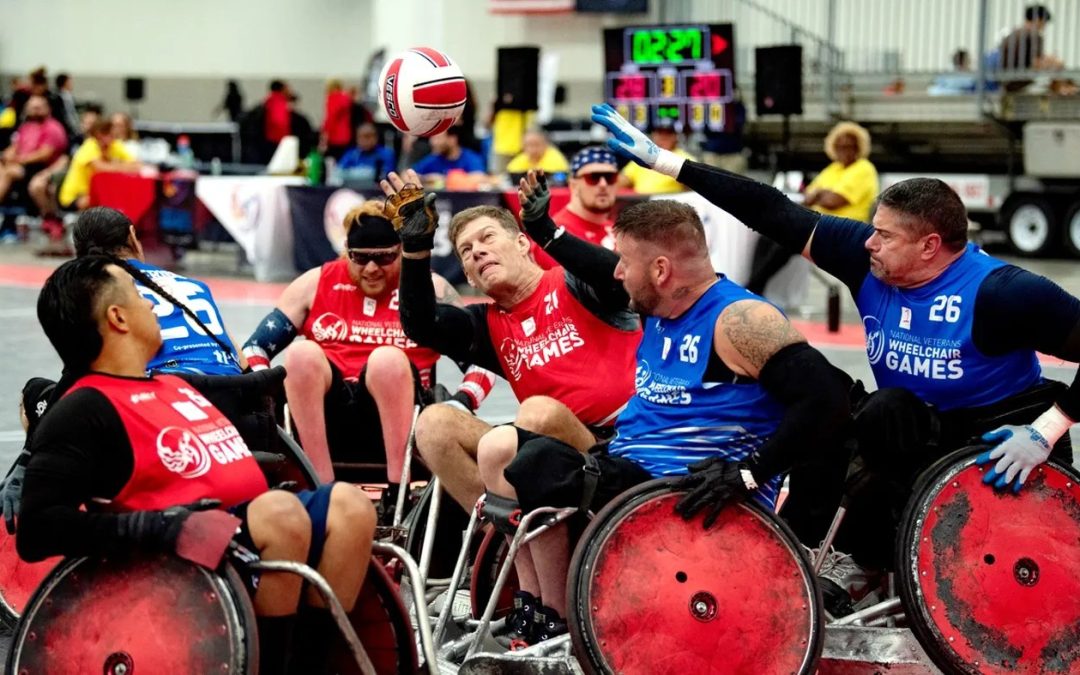
For a traveling team of VA doctors who recently attended the annual National Veterans Wheelchair Games, the experience meant more than a week of supporting hundreds of courageous Veterans in competition. It was also an opportunity to accelerate their Federal Electronic Health Record (EHR) training and then take their newfound know-how back to their respective VA sites for future deployments.
Over the 45-year history of the Wheelchair Games, VA providers have set up sideline clinics to care for the athletes, treat injuries, issue prescriptions and order medical equipment, as needed. This year’s games, held July 9-14 in Detroit, brought together providers from facilities yet to deploy the Federal EHR system, and all eager to see it in action.
Thanks to the mentorship of Federal EHR-experienced doctors from the Michigan market, which deployed the system in Detroit, Ann Arbor, Battle Creek, and Saginaw in April 2026, the team came away better prepared for their own go-live events.
First live interaction for some
Nearly all the visiting providers completed introductory Federal EHR training before arriving in Detroit. But the Wheelchair Games was their first live interaction.
“We were coming in cold turkey,” said Dr. Kenneth Lee, chief, Spinal Cord Injury Division, Zablocki VA Medical Center, Milwaukee, and the medical director for the Wheelchair Games.
Once in Detroit, Lee’s team set up a temporary acute care clinic at the Detroit Huntington Place Convention Center, the site of the games. Next, they were shown a series of brief peer-to-peer support videos, courtesy of Dr. Melissa Tinney, a physiatrist at Lieutenant Colonel Charles S. Kettles VA Medical Center (VAMC) in Ann Arbor. Additionally, Tinney shared her experience of working at previous Wheelchair Games.
“Dr. Tinney’s videos concentrated on topics like how to write a basic clinical note and how to put in an order” using the Federal EHR, said Dr. Lee. “And her information was also Wheelchair Games-specific. These virtual, elbow-to-elbow, one-minute video clips were essential to pre-clinic experience. Then her follow-up with face-to-face guidance was the key to our success. It was exactly what we needed.”
This year’s Wheelchair Games attracted more than 500 athletes competing in 25 sports, which meant 14-hour days for the doctors and nurses staffing the clinic. During the multi-day event, the team received direct instruction from Tinney as well as Dr. Erik Olsen, chief, Emergency Medicine for John D. Dingell VAMC in Detroit, and multiple Michigan-based residents—all whom Lee credited with lowering the hurdles to understanding the system.
“Everyone was surprised how easy it was working with the EHR, once we could see a few patients and write a few notes,” Lee said. “Everyone felt comfortable going back home with this hands-on experience. Especially for those going live in the next year, it was a fantastic experience for them. And for those going live in the future, instead of being afraid, they are excited. That’s the key.”
Recent Comments