
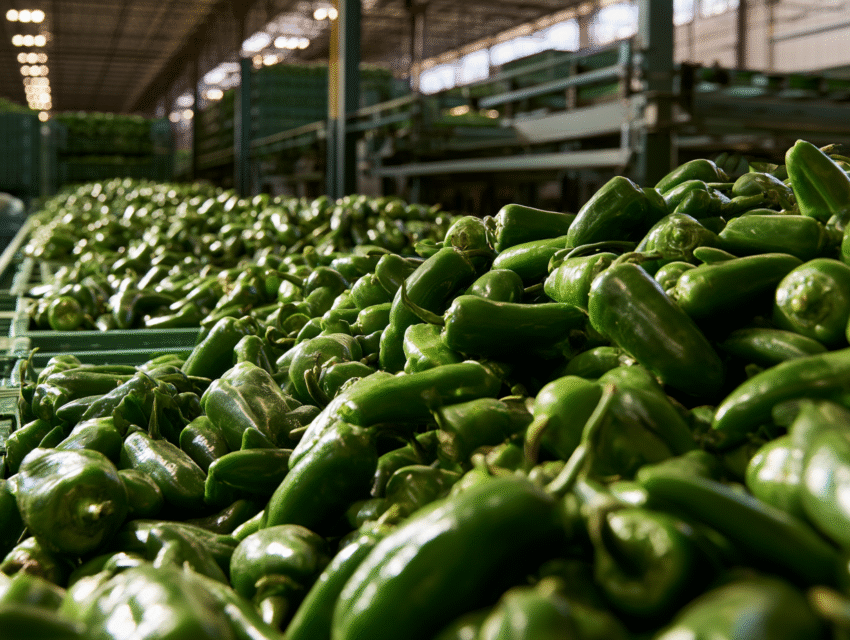
On Tuesday evening Albertsons Companies recalled fifty-nine store-made items — tortas, breakfast pizzas, catering trays, guacamole sold by the pound — from Amigos, Albertsons Market, Market Street and United stores in New Mexico and Texas. The trigger was a recall by a company called Ron’s Home Style Foods, whose pico de gallo was made with jalapeños tied to the Coast Citrus Distributors recall at the center of the Salmonella Javiana outbreak. It is the fifth downstream recall in this outbreak. It is also the second time in four days that a grocery chain has introduced the public to a company in this supply chain that no federal agency has ever mentioned.
The first was on August 8. Albertsons pulled four ready-to-eat items and explained that the peppers in them had been recalled by Taylor Farms’ distributor, Direct Roots. That name is not in FDA’s advisory. It is not in FDA’s posting of the Taylor Fresh Foods recall, or the Whole Foods recall, or USDA’s public health alert. Neither is Ron’s. Two firms handled these peppers on the way to the plate, and both of them entered the public record because a supermarket chain in Boise decided to say so.
It is worth knowing who they are, since nobody in College Park has volunteered it. Direct Roots is an import and export sourcing and consolidation company at 150 Main Street in Salinas, licensed in Arizona as a produce dealer with a physical address in Rio Rico, a few miles up the road from the Nogales crossing. It runs pool point consolidation centers in Salinas, Nogales, Laredo, McAllen, Chula Vista and Dallas. That is the layer of the chain where a load stops being one farm’s harvest and becomes freight — sorted, staged, combined and forwarded. It is exactly the layer that a traceback has to get right, and exactly the layer the public never sees.
Ron’s Home Style Foods is a family company in Houston, founded in 1985 by Ron Woodall, who had previously built and sold a fried chicken chain and who died in 2023 at ninety-six. It makes prepared deli salads, dips and entrees under its own name and under the Texas Kitchen Salads label, and it sells into H-E-B, Kroger and Brookshire Brothers. One of the fifty-nine recalled Albertsons items is listed, plainly, as RON PICO DE GALLO, variable weight, out of the service case. A company most shoppers have never heard of turns out to have been making the pico in a good part of West Texas and New Mexico.
Neither company is accused of doing anything wrong, and I want to be clear about that. Both of them bought a contaminated ingredient, the same as Taylor Farms did, and both of them told their customers. Ron’s initiated the recall that Albertsons then acted on. That is the system working at the private level. The problem is not that these companies behaved badly. The problem is that the only reason anyone knows they exist is that they behaved well, and there is no federal document anywhere that would have told you otherwise.
Look at what the fifty-nine items actually are, because it explains why this matters more than a salsa tub. There is a kids’ meal with a pizza and a small drink. There are Carry Out Catering fajita bars, taco bars, barbacoa fiesta packs, aram sandwich trays for eight to twelve and for eighteen to twenty-four, and an assorted dips platter. Those are the foods that show up on a folding table at an office party, a graduation or a funeral, with no package, no label and no brand on them at all. A guest cannot check a recall list against a paper plate. That is the same structural blindness that made the fatal 2024 romaine outbreak so hard to see, where the largest cluster came off a caterer’s tray at a high school luncheon.
The codes are the second problem, and it is now the third recall in a row with the same defect. Every one of the fifty-nine rows carries an eleven-digit internal store code ending in five zeros — 29456300000 for the Ron pico, 21903600000 for the kids’ meal — rather than a scannable retail UPC. Whole Foods’ forty-three items were listed the same way. A shopper holding a foam clamshell from the hot case has nothing on it that matches anything on the list. The notice is technically complete and practically unusable, which is a description that fits most of the paper generated by this outbreak.
The dates deserve a closer look than the earlier recalls got. The Taylor Farms items carried best-if-used-by dates beginning August 7, well after the last illness onset of July 20, which made that recall precautionary — product built from the same grower’s peppers, but not the food that made anyone sick. The Albertsons list is different. Its sell-through dates start on July 14 and run to August 14. Some of this food was on the shelf while people were still getting sick, and the notice came on August 11. Albertsons reports no illnesses connected to these items, and I have no reason to doubt it. But four weeks is a long time for a torta.
Now go look at what the government is telling you. FDA’s jalapeño advisory is stamped content current as of August 10. Its list of downstream recalls contains exactly two entries: Taylor Fresh Foods and the USDA alert. It does not contain the Whole Foods recall of forty-three of its own department-made guacamoles and salsas — a recall FDA itself published on its own recall page on August 12. It does not contain either Albertsons notice. And under the heading Stores affected, three days and a hundred products later, it still says that Coast Citrus Distributors does not appear to supply jalapeños directly to grocery stores.
Count the products. Twenty from Taylor Farms, eighteen on the USDA alert, forty-three from Whole Foods, four from Albertsons on August 8 and fifty-nine from Albertsons on August 11. That is one hundred forty-four individual items, across five separate notices, plus Costco’s two member alerts, Publix and the Brookshire’s group. Every one of those notices was written by a company. The importer whose recall set all of it in motion has still published nothing — no announcement, no lot codes, no consignee list — eight days after FDA said it had agreed to recall. And the grower in Sinaloa, the actual source, has never been named by anyone at all.
This is precisely the record that FSMA 204 was written to produce: a critical tracking event at every node, a traceability lot code that survives from the field through the consolidator and the processor to the store, retrievable within twenty-four hours. Under that rule, Direct Roots and Ron’s Home Style Foods would have been in the file on day one instead of surfacing in press releases nearly eight weeks after the first illness. The compliance date has been pushed to 2028. In the meantime the map of this outbreak is being drawn in public, in pieces, by grocery chains in Boise, Salinas, Houston and Austin — everyone except the two agencies that are supposed to have it.
Three hundred forty-five people in twenty-seven states, thirty-six of them in the hospital, and the counts have not moved since August 5. Two companies nobody outside the produce trade had heard of last week turn out to have been handling these peppers. There is no particular reason to believe they are the last two.
Recent Comments