
León Fernando Del Canto
The MICHELIN Guide has published an account of a journey through Cádiz in which the British chef Merlin Labron-Johnson, of Osip in Somerset, is taken by Juanlu Fernández of LÚ Cocina y Alma through the almadraba, the fixed-net tuna fishery the Phoenicians were working three thousand years ago, and then inland to Jerez. Read it. I am grateful to the Guide and to the Andalucía Tourist Board for recording what those of us from Jerez have long wanted recognised, which is a lived culture rather than a marketing proposition.
I would add a second name the Guide does not mention. Ann Mason, known to everyone as Annie B, was named Vejeriega de Adopción by the town of Vejer in September 2013 in recognition of what she has done to make its gastronomic culture legible to the outside world, and she is, in her own description, fluent in English, Spanish and Sherry. A remarkable number of the British families who now spend part of the year in this province, and some who have stayed for good, arrived first at her table.
The province is better than its reputation abroad
Seven starred restaurants, from three at Aponiente in El Puerto de Santa María, where Ángel León works an old tidal mill on the marshes, to two at LÚ in the middle of Jerez and one at a village tavern in Alcalá del Valle. Jerez is Spanish Capital of Gastronomy for 2026. The wine deserves a line and no more here. Sherry is being rediscovered by a generation that studied it and came home to explain it, en rama and single-cask bottlings now leave cellars that once sold only in bulk, and prices remain absurd against Burgundy. That will not last.
The frontier towns
Jerez de la Frontera, Chiclana de la Frontera, Vejer de la Frontera and Jimena de la Frontera all carry the suffix from the medieval boundary between Castile and Nasrid Granada, and the history is legible in the stone rather than confined to the name.
Jerez is the city. The Alcázar keeps its mosque, quiet and intact, alongside Arab baths and an octagonal tower, and the cathedral stands on the old mosque’s ground in a collision of Gothic, Renaissance and Baroque that somehow resolves. Around them lie the winding quarters of Santiago and San Miguel, palaces of the wine families behind sober facades and enormous courtyards, whitewashed bodegas built like cathedrals with high naves and shaded ventilation, and streets laid out at human scale. There is an airport, there are hospitals, there is the Royal Andalusian School of Equestrian Art, and there are hotels that hold their own anywhere in Andalucía. That infrastructure is what makes a full year, and not merely a season, entirely workable.
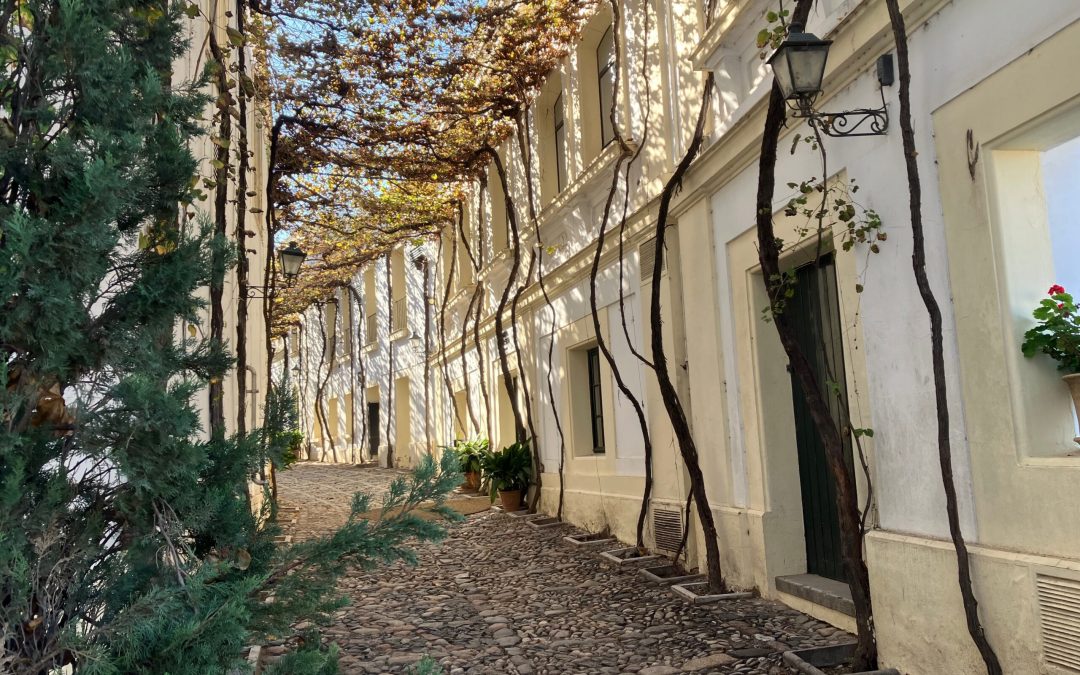
Vejer is the concentrated version, and arguably the most beautiful hill town in the province. Walled and white, set on a hill above the Barbate river with the Atlantic in view, it retains its Moorish street plan almost entirely, so that the town is a sequence of arches, tight staircases and courtyards that open without warning onto a view. The castle and the Mudéjar and Gothic church of the Divino Salvador sit at the top, the gates and walls remain, and the houses are the Andalusian courtyard type, meaning cool in summer without mechanical help. Very good houses here rarely reach the open market.
Few people realise that Vejer de la Frontera and Chefchaouen have been formally twinned since 2000, and that the resemblance is no accident: the Moroccan town is said to have been built in the image of its Andalusian counterpart.
Between them, Chiclana gives beach and pine forest with a settled year-round community, and Jimena, inside the cork oak forests of Los Alcornocales, gives altitude, silence, a Moorish castle on its ridge and easy reach of Gibraltar.
The weather, stated accurately
Cádiz is the Atlantic, not the Mediterranean, and the winter across the province stays mild and extraordinarily luminous through January and February, when northern Europe is at its least habitable. High summer needs an honest distinction, since Jerez sits inland and is genuinely hot in July and August, whereas Vejer, Chiclana and the coast are worked constantly by the poniente off the ocean and stay some degrees cooler than either Jerez or the Mediterranean side.
The old architecture assumes all of this, since the courtyard house, the thick lime-washed wall and the north-facing patio were built for this climate and still outperform the modern coastal villa.
Part of the year, or all of it, and the many arrangements in between
Most families I advise end up somewhere between the two poles rather than at either, and the useful point is that the combinations are numerous and each carries its own consequences. Some keep a London or New York base and take four or five months here, which sits below the Spanish threshold of more than 183 days in the calendar year. Some invert that after retirement, becoming Spanish resident and returning north for the summer. Some run a rotation across three countries in which no single one dominates, which is where treaty tie-breakers rather than day counts decide the question. Some arrive under the impatriate regime of article 93 of the Spanish personal income tax law, which requires genuine residence and no Spanish residence in the five preceding years, work here for its duration and then reconsider. Some test the ground for a year before committing. Two cautions apply across all of them. Spain, unlike the United Kingdom, has no split-year treatment, so residence attaches to the whole calendar year or to none of it, and the position of a non-separated spouse and minor children can pull an otherwise careful taxpayer into Spanish residence by presumption. Neither is a reason not to come. Both are reasons to fix the pattern deliberately rather than discover it in retrospect.
Andalucía is among the more generous regions on succession within the family and applies a full rebate against the wealth tax, though that rebate does not displace the State solidarity tax above the relevant threshold. Every route needs a visa in any event, since British and American passports now buy ninety days in any rolling one hundred and eighty and the investor route closed in April 2025, and American citizens carry their own tax system with them wherever they live, which makes the portfolio rather than the diary their governing question. We keep the detail current on the Del Canto Chambers blog, and the Spanish tax and legal and Spanish lawyers pages set out how the residence, visa and succession questions fit together.
Del Canto Chambers has kept offices in the province for decades, and much of that work has been the unglamorous business of matching a family’s calendar to its balance sheet, best begun before the house is chosen.
So, to the reader who has decided Spain is too hot. Have you tested that against a walled white town above the Atlantic in November, and asked yourself whether you would want to leave in March?
Recent Comments