
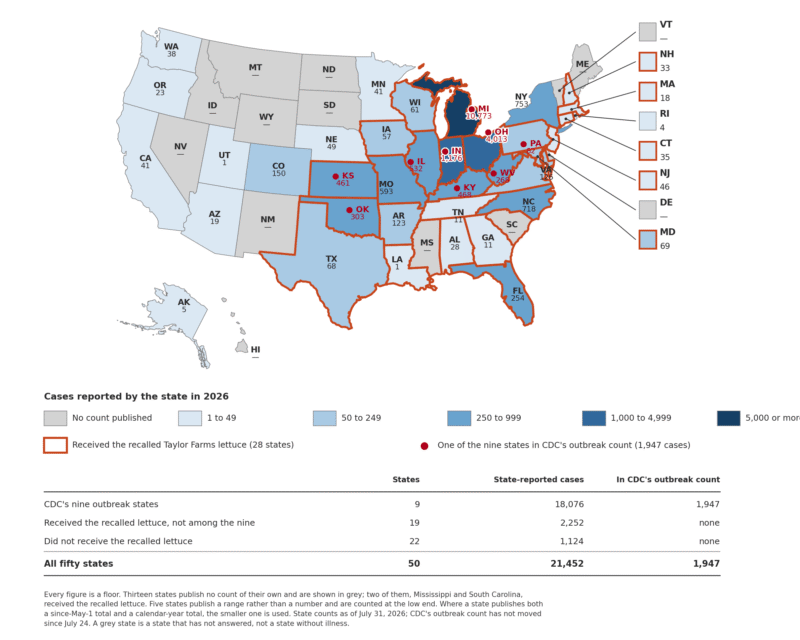
The Alabama Department of Public Health put out a news release on July 20 that, as far as I can tell, almost nobody outside Alabama read. It deserved better. Twenty-eight reported cases of cyclosporiasis as of that date, 22 of them in the Northern District, two hospitalizations, no deaths, four cases tied to international travel.
And then this, which is the reason to read it twice. Eight cases — 28.6 percent of the state’s total — are associated with two separate foodborne outbreaks at Mexican-style restaurants. ADPH added a parenthetical so there could be no confusion: not Taco Bell.
Two restaurant outbreaks. One state. Better than a quarter of its cases. And no vehicle named in either one.
Now hold that against the national count. CDC’s outbreak tally — 1,947 cases across nine states — is built on Taco Bell exposure. That is the entry ticket. Alabama is not one of the nine, and ADPH says plainly that none of its cases have been directly linked to the Taco Bell locations in Indiana, Kentucky, Michigan, Ohio and West Virginia. Even though Alabama received the recalled Taylor Farms iceberg lettuce, as 27 other states did, and even though it has two identified restaurant clusters sitting right there in a state press release, not one of its 28 cases appears in the number Atlanta publishes.
The same release notes that Taylor Farms de Mexico and Taylor Fresh Foods are voluntarily pulling all iceberg lettuce sourced from central Mexico from the U.S. market — product that went to KFC, Pizza Hut, Subway, Trader Joe’s, Walmart, Sysco, Cross Valley Farms and Peak Fresh Produce. That is the reach of the product. Nine states and one restaurant chain is the reach of the count. Taylor Farms recalled product did make it to Alabama.
Alabama is now the second state to put its finger on establishment-level illness outside the Taco Bell nine. New Hampshire was the first, when it named recalled Taylor Farms lettuce served at the Cheshire Medical Center cafeteria in Keene. The difference matters and I am not going to blur it: New Hampshire named the product, Alabama has not. ADPH ties its two restaurant clusters to Taylor Farms or to anything else exactly nowhere. But the two states are telling the same story from opposite ends. People are getting sick from Cyclospora at places that are not Taco Bell, and the only reason anyone knows it in these two states is that somebody thought to ask. FDA has said itself that it is seeing signals of more than one source.
Some perspective on the number 28. Alabama reported 139 cyclosporiasis cases in 2023, 30 in 2024 and 21 in 2025. The state had 11 confirmed on July 16 and 28 four days later. Before the end of July, Alabama had already passed each of its last two full years — in a state where cyclosporiasis is reportable, where cases get investigated as they are identified, and where the health department told clinicians in writing to think about this parasite when a patient shows up with prolonged or relapsing watery diarrhea. That is more than can be said for Mississippi, which took the same recalled lettuce, publishes no case count at all, and where, per CDC’s own notifiable disease table, this illness is not reportable in the first place.
One more thing, and I say it with real respect for a health department that did the work. The release correctly tells people that cooking produce to 158°F kills Cyclospora and that washing alone may not eliminate the parasite. Then it signs off: stay informed, wash your produce, and seek care if you develop symptoms. Both of those cannot be the advice. Washing does not reliably remove Cyclospora oocysts from leafy greens, and neither does the chlorine in a commercial flume — that is not my opinion, it is the reason the first sentence is in the release at all. There is no consumer-level kill step for a bagged salad. The kill step has to happen upstream, in the irrigation water, in the field sanitation, in whether the people harvesting the crop have somewhere to wash their hands.
Alabama did the part that is actually within a state’s control. It counted, it broke the number out by district, it separated travel cases from local ones, and it said out loud what it did and did not know. Twenty-eight cases, two restaurant outbreaks, no vehicle in either. That last part is not Alabama’s failure to fix.
Recent Comments