
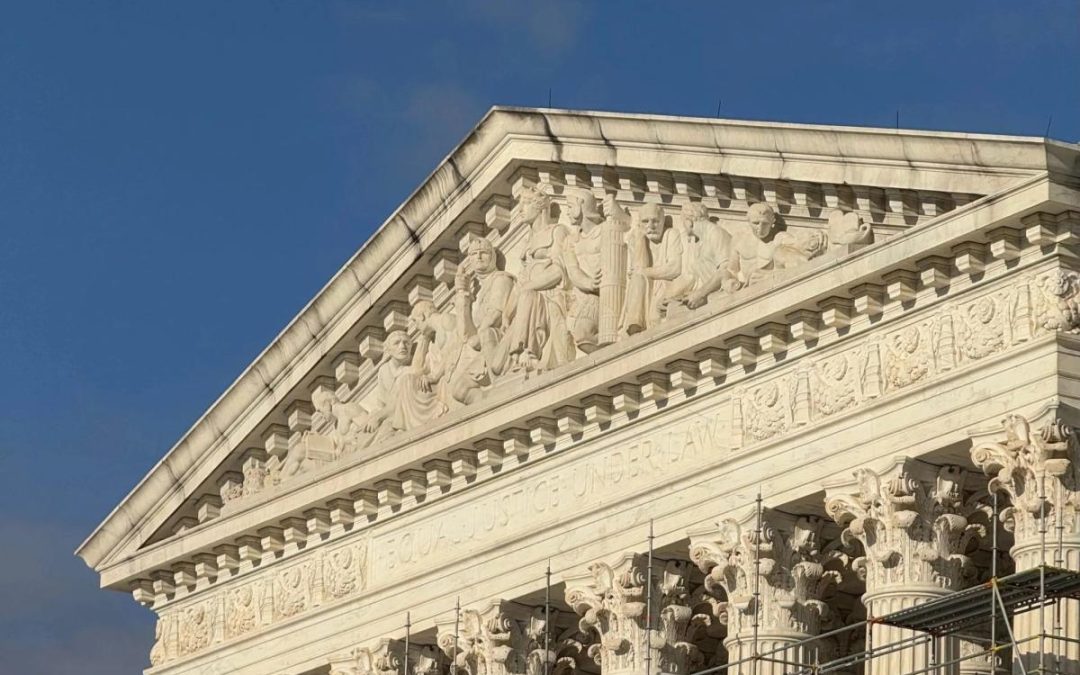
Stephen Breyer became an associate justice of the Supreme Court on this day in 1994. He retired at the end of the court’s 2021-22 term.
At the Court
Last week, the Trump administration asked the Supreme Court on its emergency docket to clear the way for the implementation of President Donald Trump’s executive order on mail-in voting. Twelve states – led by Alabama – later echoed this request in their own application. Responses to these requests from those states challenging the order are due today by 4 p.m. EDT.
The Supreme Court has indicated on its website that its courtroom will be closed beginning today until Monday, Aug. 31. No courtroom lectures will take place during this period.
Morning Reads
Trump Targets ‘Birth Tourism’ After Birthright Citizenship Loss
Andrew Kreighbaum and Celine Castronuovo, Bloomberg Law
After the Supreme Court struck down President Donald Trump’s executive order aimed at limiting access to birthright citizenship, the Trump administration and Republican allies have focused their attention on ending “birth tourism” – that is, when “foreign nationals [travel] to the US with the purpose of giving birth.” “The Justice Department has told US attorneys’ offices and the Criminal Division to prioritize the prosecution of birth tourism schemes,” according to Bloomberg Law. “Stepped up enforcement could result in intense scrutiny of visa applicants and travelers to the US and charges for people facilitating birth tourism, former consular officials and federal prosecutors said.”
Illinois Democrat appeals corruption conviction to Supreme Court
Zach Schonfeld, The Hill
Former Illinois House Speaker Michael Madigan, a Democrat, “ask[ed] the Supreme Court to review his corruption conviction,” according to The Hill. “The longest-serving legislative leader in U.S. history was sentenced to more than seven years in prison for using his position to financially reward himself and political associates.” “Madigan raised several arguments in his appeal, including that he didn’t act ‘corruptly,’ as is required by the federal program bribery statute.” “The novel bribery theories the government zealously pursued against Speaker Madigan stretch federal bribery law in ways that threaten to criminalize and chill lawful interactions between state and local officials and their constituents,” his lawyers wrote. The Hill noted that Madigan is “the latest in a line of elected leaders ensnared in corruption scandals who’ve taken claims to the nation’s highest court that they’re being criminally prosecuted over legitimate politics.”
Kamala Harris says the US Supreme Court should expand to 13 justices
Patrick Svitek, CNN
On Friday, former Vice President and potential 2028 presidential candidate Kamala Harris shared her support for expanding the Supreme Court. “We need to revisit the point of expanding the court to 13 justices,” Harris said at the National Urban League’s annual conference in Nashville. “As vice president, Harris backed Supreme Court changes proposed by President Joe Biden such as term limits, though those proposals did not include increasing the number of justices,” according to CNN. “Among other potential 2028 contenders, former Transportation Secretary Pete Buttigieg has long called for expanding the court, pitching a 15-member court in his 2020 run. Rep. Alexandria Ocasio-Cortez of New York is also a longtime proponent of adding more justices.”
Amazon says it got $600 million in Trump tariff refunds and will pass return along to some customers
Annie Palmer, CNBC
On Thursday, Amazon announced on an earnings call “that it has received $600 million in tariff refunds after the Supreme Court ruled that many of President Donald Trump’s levies were illegal,” according to CNBC. “Amazon previously hadn’t said whether it intended to apply for the refunds. In May, consumers filed a class-action lawsuit in federal court in Seattle, arguing that they were owed refunds for paying tariff-inflated prices and alleging the company wasn’t seeking refunds in order to ‘curry favor’ with Trump.” Brian Olsavsky, Amazon’s finance chief, “said some of the company’s tariff refunds will be returned to shoppers.” “We’ve identified a limited set of circumstances where we can trace that we’ve passed specific import charges onto customers, and when we receive those refunds, we will proactively contact affected customers and automatically issue refunds to them,” Olsavsky said.
Alabama Plans Inmate’s Execution After Supreme Court Blocked Last Attempt
Rick Rojas, The New York Times (paywalled)
In June, Alabama’s planned nitrogen gas execution of Jeffery Lee, who was convicted of “killing two people and wounding a third” in 1988, was postponed after lower court judges determined “that execution using the gas was ‘likely unconstitutional’ in Mr. Lee’s case” and the Supreme Court turned down the state’s request to allow the execution to proceed as scheduled. On Thursday, Alabama “Gov. Kay Ivey said … the state would try again to carry out the execution,” instructing “corrections officials to schedule the execution … for Sept. 17 – this time using lethal injection,” according to The New York Times. “In a statement on Thursday evening, Mr. Lee’s lawyers accused the state of trying to ‘outrun’ the Constitution by moving forward with a lethal injection execution.” They have previously said that such an execution “would violate an agreement that Mr. Lee reached with the state nearly a decade ago.” They “pointed to language in the agreement specifying that Mr. Lee would be executed by the gas and not the three-drug protocol used in lethal injection executions.”
On Site
From the SCOTUSblog Team
The court’s big gun cases – and what’s next
The 2025-26 term marked the first time since the court recognized an individual right to own a firearm for self-defense in 2008 that the justices decided more than one Second Amendment case in a single term. Alex explored the significance of the two rulings and the gun rights questions the court will tackle next.
Contributor Corner
The court and the “opinions of mankind”
In his Court Beyond Borders column, Martin Flaherty reflected on the Supreme Court’s approach to international law, contending that the current court has shown “increasing hostility to long established international human rights protections.”
A Closer Look
When was Justice Kavanaugh not in the majority?
Like Chief Justice John Roberts (whom we covered in an earlier closer look), Justice Brett Kavanaugh was in the majority 95% of the time when it came to merits cases this term – meaning he only fell on the dissenting side in three of these 66 written opinions. Much as Kavanaugh and the chief were “birds of the same feather” per SCOTUSblog’s Stat Pack (they voted together 94% of the time; 85% of the time in closely divided cases), their “non-majority” cases were not all identical. And unlike the chief, who did not write separately in any of the cases in which he dissented, Kavanaugh authored one of his three dissents.
Kavanaugh’s first vote in the non-majority coalition (chronologically by opinion release date) came in Learning Resources, Inc. v. Trump, better known as the tariffs case. As SCOTUSblog readers are likely well aware, on Feb. 20, 2026, the court held 6-3 that the International Emergency Economic Powers Act did not authorize President Donald Trump to impose tariffs. Roberts authored the majority opinion, which was joined at least in part by Justices Sonia Sotomayor, Elena Kagan, Neil Gorsuch, Amy Coney Barrett, and Ketanji Brown Jackson. Gorsuch and Barrett wrote concurring opinions, Kagan wrote an opinion concurring in part and concurring in the judgment (joined by Sotomayor and Jackson), and Jackson also wrote an opinion concurring in part and concurring in the judgment. Justice Clarence Thomas wrote a dissenting opinion, as did Kavanaugh. Kavanaugh’s 63-page dissent was joined by Thomas and Justice Samuel Alito.
Kavanaugh wrote that he “would conclude that the President’s power under IEEPA to ‘regulate . . . importation’ encompasses tariffs.” He also wrote that the “interim effects of the Court’s decision could be substantial,” stating that the refund process is “likely to be a ‘mess.’” And he ended with this other prognostication: “Although I firmly disagree with the Court’s holding today, the decision might not substantially constrain a President’s ability to order tariffs going forward … because numerous other federal statutes authorize the President to impose tariffs and might justify most (if not all) of the tariffs at issue in this case.” (Indeed, the president has attempted, at least in part, to do just that.)
Kavanaugh’s second dissenting vote came in Hencely v. Fluor Corporation, where he (along with the chief) joined Alito’s dissent. The case arose from a 2016 Taliban attack at a U.S. base where an Army specialist was injured and later sued the contractor under state law. Thomas wrote for the six-justice majority, holding that military contractors do not have absolute immunity for negligence in an active war zone. Alito wrote in dissent that “[u]nder the Constitution, the power to make war and conduct combat operations is entrusted exclusively to Congress and the President … This suit violates that cardinal principle.”
Kavanaugh’s third non-majority vote came in Watson v. Republican National Committee, decided 5-4 on June 29, in which the court held that the federal election-day statutes do not prevent states from counting mail-in ballots postmarked by Election Day but received afterward, and in Mississippi’s case, up to five days later. Barrett, joined by Roberts, Sotomayor, Kagan, and Jackson, wrote the majority opinion. “The election-day statutes say nothing about ballot receipt, and we cannot add to the words Congress chose,” Barrett wrote.
Alito wrote a dissenting opinion joined in full by Thomas and Gorsuch, and joined by Kavanaugh as to all but two sections (II-C-2 and III). In the part joined by all three, Alito wrote that “[t]he acceptance of these late-arriving ballots effectively postpones the date on which the electorate’s choice is made, and federal law precludes that postponement.” Part II-C-2, which, again, Kavanaugh did not join, criticized the majority’s treatment of the Civil War voting-practices example, while Part III addressed the majority’s reliance on the Uniformed and Overseas Citizens Absentee Voting Act, which (per the majority) “requires States to permit absent military and overseas voters to cast absentee ballots in federal elections.” Alito argued – among other things – that UOCAVA couldn’t dictate the meaning of such statutes since it was passed decades later.
What can we make of this? First, in contrast to the chief, whose three dissents came in technical, lower-profile disputes, Kavanaugh’s non-majority votes included two of the biggest cases of the term: the tariffs case and the mail-in ballots case. Second, while none of the three cases were 6-3 splits along ideological lines, in all three the court’s Democratic appointees were in the majority (at least in part), while Kavanaugh found himself in the dissent alongside another Republican appointee. Finally, as with the chief, being in the majority is familiar territory for Kavanaugh.
SCOTUS Quote
MR. ENGLERT: “… Chiarella says fraud in a statute is very broad, but it's broad enough to cover the common law and no more. If Congress wants to go broader than the common law –”
JUSTICE BREYER: “Well, fine. But what is – I'm talking the common law. All I know about contracts came from Blackjack Dawson, my contracts teacher –”
Universal Health Services, Inc. v. United States ex rel. Escobar (2016)
Recent Comments