
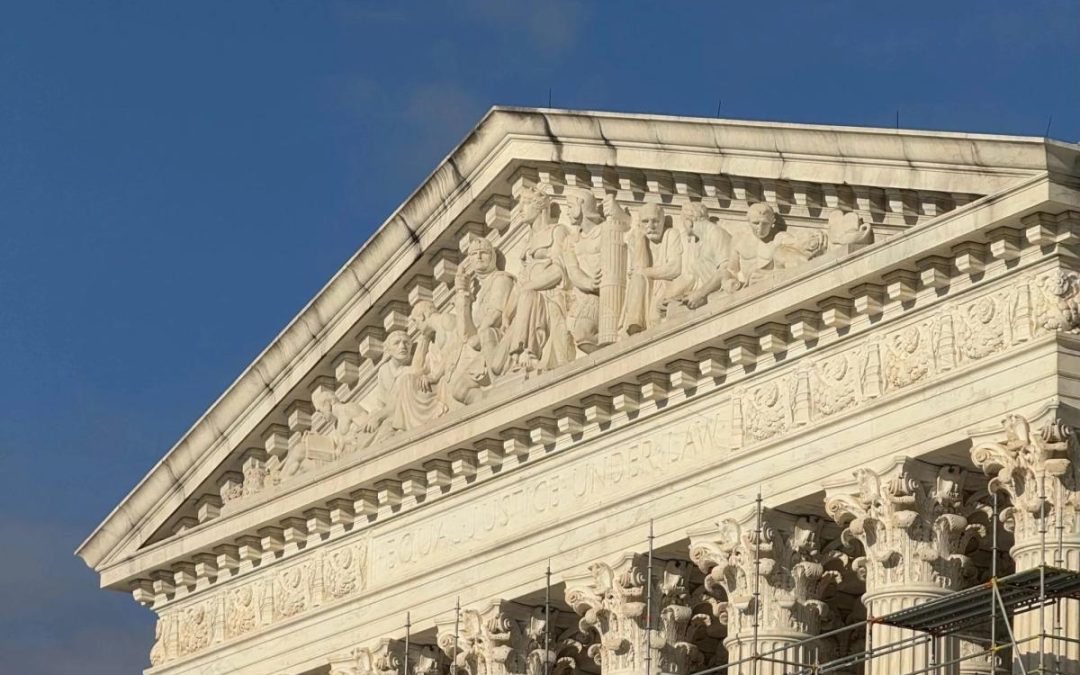
The Supreme Court’s collection of art and objects associated with the justices includes a top hat worn by Justice Felix Frankfurter. The hat was made by the same company that “later crafted the wide-brimmed hat worn by Indiana Jones in the 1981 film, Raiders of the Lost Ark,” according to the court’s website.
At the Court
Last week, the Trump administration asked the Supreme Court on its emergency docket to clear the way for the implementation of President Donald Trump’s executive order on mail-in voting. Twelve states – led by Alabama – later echoed this request in their own application. On Monday, the group of 23 states and the District of Columbia challenging the order urged the court to leave in place a lower-court decision preventing its full implementation.
Also on Monday, Justice Sonia Sotomayor denied a request from the Palestine Liberation Organization and the Palestinian Authority asking the court to pause a $655.5 million judgment against them while they prepare an appeal. The judgment came in a case brought against Palestinian authorities by American victims of attacks in Israel.
Morning Reads
Trump’s mail voting appeal tests Supreme Court’s anti-chaos election rule
John Fritze, CNN
In election-related cases over the past two decades, the Supreme Court has repeatedly returned to the “Purcell principle,” which “warns federal courts against making last-minute changes to voting rules.” That principle looms over the emergency docket dispute on President Donald Trump’s executive order on mail-in voting, according to CNN, because the Trump administration and the states that challenged the order are clashing over the timing of the states’ lawsuit. “Trump’s central argument is that the states and groups who are challenging his order sued too soon. If the Supreme Court agrees with Trump, then the states will have to wait to revive their litigation. And that will necessarily push the cases closer to the November election, allowing the administration to raise Purcell to bar courts from weighing in.”
She Voted for a Justice Who Overturned Roe. Now it Haunts Her on the Trail.
Lisa Lerer and Beth Reinhard, The New York Times (paywalled)
“Of the more than 10,000 votes cast by Senator Susan Collins of Maine, there is one that has shadowed her like no other as she runs for a sixth term,” according to The New York Times. Maine voters continue to question why “Collins, one of only two Senate Republicans who support abortion rights, cast a deciding vote to confirm Brett M. Kavanaugh” in 2018. “Four years later, Justice Kavanaugh voted with the conservative majority to overturn Roe v. Wade.” While on the campaign trail this year, the first time she’s run for reelection since that 2022 ruling, Collins has repeatedly said that she doesn’t regret supporting Kavanaugh. “But people who interacted with her during the Kavanaugh hearings say Ms. Collins still harbors frustrations about the continued backlash after a confirmation process she described in 2018 as ‘more like a caricature of a gutter-level political campaign.’”
Democratic US states sue to challenge Trump's latest tariffs
Dietrich Knauth, Reuters (paywalled)
On Monday, 25 states led by Democrats filed a lawsuit in the U.S. Court of International Trade against the Trump administration, “arguing that the president’s latest round of tariffs on goods from 60 trading partners, like most of his earlier sweeping tariffs, exceeds his legal authority to tax imports,” according to Reuters. The new tariffs were imposed on July 24 as part of the Trump administration’s effort to rebuild the tariff regime struck down by the Supreme Court in February. They were “imposed under Section 301 of the Trade Act of 1974, which is meant to combat unfair or discriminatory economic practices by other nations.” In their new lawsuit, the states contend “that Section 301 tariffs have historically been targeted to address specific nations and industries, and Trump’s broad-brush approach has no historical precedent.”
Meet The Spice Entrepreneur Challenging Trump's Newest Tariffs
Eric Boehm, Reason
Reason spoke with Ori Zohar, co-founder of Burlap & Barrel, “a single-source spice importer and retailer,” about his company’s effort to block President Donald Trump’s tariffs. Burlap & Barrel is “a lead plaintiff” in a challenge to temporary tariffs imposed after the Supreme Court “overturned tariffs imposed under the International Emergency Economic Powers Act,” and has also filed a lawsuit against tariffs announced late last month that “are ostensibly meant to combat ‘forced labor.’” Zohar said he was “struck by the big role that small businesses and entrepreneurs … have played in fighting the Trump administration’s tariff regime – while bigger companies with teams of lawyers have sat on the sidelines.” “A lot of companies are just afraid of the risk or hedging and just doing what they can to protect themselves,” he said.
New lawsuit claims law requiring Ten Commandments in schools violates Texas' parental rights
Haajrah Gilani, San Antonio Express-News (paywalled)
Last year, the Texas Legislature passed Senate Bill 10, a law requiring Ten Commandments posters to be hung in public school classrooms in districts where such posters have been donated. SB10 was quickly challenged by several Texas parents, who contended that the displays violated the First Amendment, but in April, the U.S. Court of Appeals for the 5th Circuit sided with state officials. While the families prepare their expected appeal to the Supreme Court, “three Houston-area mothers” are challenging SB10 on new grounds, arguing that it “violates a parental rights amendment voters added to the Texas Constitution last November,” as well as the Texas Religious Freedom Restoration Act, according to the San Antonio Express-News. “The suit … could be the first test of the GOP-backed constitutional amendment [on parental rights], which declares that parents have the ‘right to make decisions concerning the child’s upbringing.’”
On Site
Court News
States challenging executive order on mail-in voting ask justices to leave in place limits on its implementation
Lawyers for a group of 23 states and the District of Columbia urged the court to leave in place an order by a federal court in Boston that barred the federal government from fully implementing an executive order on mail-in voting. In a 45-page filing, the challengers wrote that granting a request to pause the lower court’s order “would allow the federal government to rush out an unprecedented, legally indefensible voter-verification and ballot-interception program that would, among other things, give the U.S. Postal Service far-reaching new powers and responsibilities.”
Contributor Corner
A court trapped in amber
In his Controlling Opinions column, Richard Re reflected on the Roberts court’s references to (and rejections of) “a law trapped in amber,” the idea that a law’s meaning is “trapped” or “immutably frozen.” With this language, according to Re, the most conservative court in some time “has indirectly embraced a form of living constitutionalism.”
Contributor Corner
Born free and equal
In his inaugural Born Free and Equal column, Steven Gow Calabresi explored what he believes is the “American national creed”: that all are “born free and equal.” Moving forward, his “column will explore, among other things, when and how the Supreme Court has lived up to this creed,” he wrote.
Podcasts
Divided Argument
Ice by Magneto
Will Baude and Dan Epps explore West Virginia v. B.P.J. and Little v. Hecox, the transgender athletes cases, reflecting on how the opinions were written, the significance of the litigants’ Title IX concession, and whether there is any such thing as an as-applied equal protection challenge.
A Closer Look
Dred Scott
Here we continue our series of Closer Looks on some of the most well-known Supreme Court plaintiffs. Today’s is on Dred Scott –perhaps the most famous plaintiff in Supreme Court history.
Dred Scott was born in Virginia around 1799 and was enslaved from birth by Peter Blow, a wealthy plantation owner. In 1833, Scott was purchased by Dr. John Emerson, a U.S. Army surgeon. Emerson brought Scott to Fort Armstrong at Rock Island, Illinois, and later Fort Snelling in the Wisconsin Territory, both of which had abolished slavery.
In 1846, Scott sued Emerson’s widow for his freedom, as well as that of his wife, Harriet, and their two daughters. Scott argued that because Emerson previously took him into free states, he had become legally free under the doctrine of “once free, always free.” In Scott’s first trial, in 1847, a jury sided against him based on a technicality – he was unable to prove that Emerson legally owned him. He was granted a new trial and a jury sided with Scott in 1850, but the decision was overturned by the Missouri Supreme Court two years later. Eventually the case made its way to the U.S. Supreme Court, which in 1857 held 7-2 that descendants of enslaved Africans were not citizens of the United States and Scott therefore did not have standing to sue in federal courts. Although Chief Justice Roger Taney hoped the decision would settle the bitter issue of slavery that was dividing the country, it instead fueled the flames of the Civil War.
Despite losing before the Supreme Court, Scott and his family were manumitted soon after. Specifically, in May 1857, Taylor Blow – a future Missouri congressman and lifelong friend of Scott, whose parents once enslaved him – acquired ownership of Scott and his family for $750. The family was then freed by Blow.
After obtaining his freedom, Scott took a job as a porter and doorman in St. Louis at Barnum’s Hotel. Owned by Theron Barnum, the cousin of circus magnate P.T. Barnum, the hotel was one of the best known establishments west of the Mississippi River. Although he was tasked with carrying bags and luggage, Scott’s declining health meant he primarily served as a celebrity greeter. He spoke to guests who were interested in his story and received tips. When he was not working as a porter, Scott delivered laundry for his wife Harriet’s laundry service.
In an interview after the decision, Scott revealed that he had previously been married, but the marriage “was disrupted when his wife was sold.” (They had two sons, although both had passed away.) Scott also recounted that he attempted to purchase his family’s freedom for $300 in 1846, but Emerson’s widow refused to allow for this.
In June 1857, Scott and Harriet had their engravings featured in Frank Leslie’s Illustrated Newspaper, one of the nation’s most prominent newspapers at the time. Historian Adam Arenson described the portrait as “The family appear[ing] dignified but without joy, their frustrations displayed in slow exposure.” (Harriet expressed on multiple occasions her displeasure with all the attention the family received resulting from Scott’s case.) The feature was one of the first times in American history that formerly enslaved individuals had their likeness portrayed in the national press.
Scott passed away in September 1858 from tuberculosis, just over a year after gaining his freedom. He was buried in the Wesleyan Cemetery in St. Louis. After the Wesleyan Cemetery closed, he was reinterred at Calvary Cemetery, in 1867, which was also in St. Louis. Both plots were purchased by Blow.
Speaking to a reporter after the decision bearing his name, Scott described the case as having presented him with “a heap o’ trouble” because it took more than 10 years to play out in the courts. He said if he knew “it was gwine to last so long,” he would not have brought it.
SCOTUS Quote
JUSTICE KAGAN: “… I'm told – maybe this is wrong, but I'm told that if somebody goes to London, almost every place that person goes there's a camera taking pictures, so that the police can put together snapshots of where everybody is all the time. So, why is this different from that?”
MR. LECKAR: “It's pretty scary. I wouldn't want to live in London under those circumstances.”
JUSTICE SCALIA: “Well, it must be unconstitutional if it's scary.”
(Laughter.)
JUSTICE SCALIA: “I mean, what is it, the scary provision of what article?”
— United States v. Jones (2011)
Recent Comments