
How one Veteran underwent a groundbreaking procedure that could change everything
For 28 years, Derrick Harpole has lived with uncontrolled epilepsy, suffering from debilitating seizures despite trying numerous medications. He has been robbed of his independence, his career and, in many ways, his sense of self. But one morning last week at the Michael E. DeBakey VA Medical Center (MEDVAMC) in Houston, the 50-year-old Navy Veteran from Vicksburg, Mississippi, woke up with something he hadn’t felt in decades: hope.
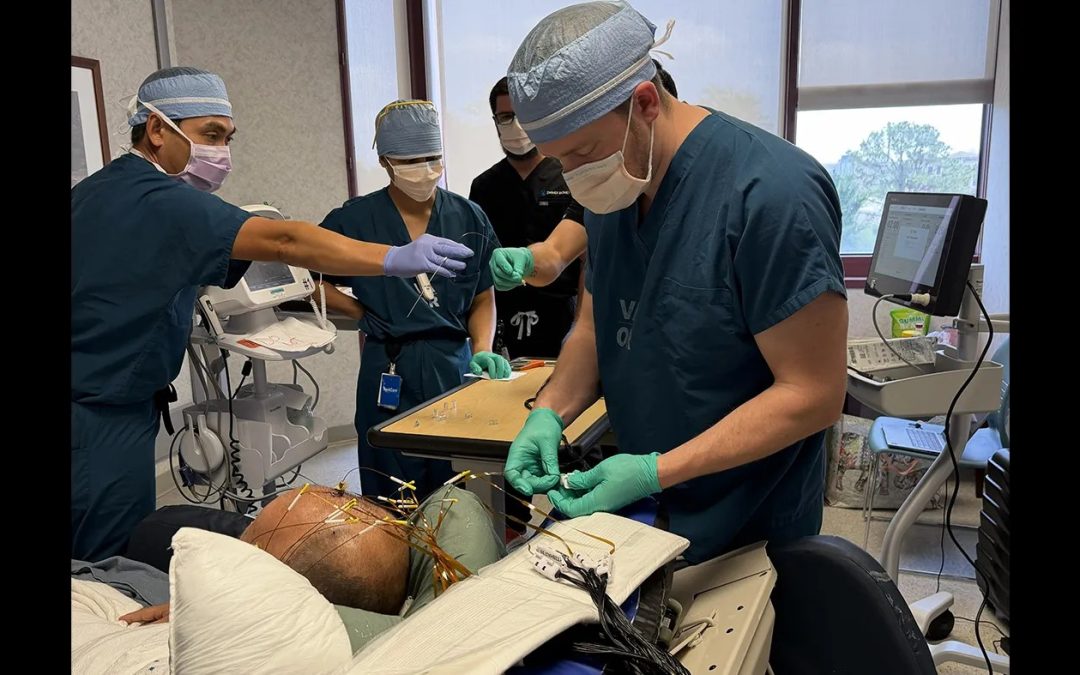
Harpole became the first Veteran at the MEDVAMC to undergo a procedure using the newly available NeuroOne electrode system, a cutting-edge technology that is redefining what’s possible for patients with drug-resistant epilepsy.
“Bright-eyed and bushy-tailed,” is how Harpole described feeling the morning after having the procedure. For a man who has spent nearly three decades navigating the relentless cycle of seizures, medications and their debilitating side effects, those words carry extra weight.
Harpole first began experiencing seizures while serving in the Navy, where he painted aircraft carriers. What started as a mildly alarming and unexplained neurological event eventually became the defining struggle of his adult life. For over 20 years, he has been unable to work. Simple freedoms most people take for granted, like driving to the store or hunting alone in the quiet of the Mississippi woods, have remained frustratingly out of reach. Doctors at numerous facilities could only offer more medication.
Then he came to MEDVAMC for help.
“Mr. Harpole has been on a significant number of medications for years,” said Dr. Hina Dave, a neurologist at the MEDVAMC and a member of his care team. “These medications affect his sleep, his mood and virtually all aspects of his life.”
Through it all, Harpole has had one constant: his wife, Delynn. She has stood beside him through every seizure, every medication adjustment and every disappointment; she has been a steadfast partner in a fight that has tested them both.
But last week [week of Aug. 3, 2026], everything changed.
A new tool in the fight against epilepsy
The MEDVAMC is now one of a select number of medical centers in the country offering a recently FDA-approved stereo electroencephalography (sEEG) system that is designed for diagnostic recording and therapeutic ablation. The system allows a precise burn to be created in the area of the brain that causes seizures while monitoring the local brain temperature for safety. This painless treatment can be performed in the epilepsy monitoring unit without anesthesia or going to the operating room. The patient can also continue to be monitored to assess the effect of the ablation.
“Our goal is to work to improve our Veterans’ quality of life,” said Dave, one of five epilepsy specialists in the MEDVAMC Epilepsy Center of Excellence. “Beyond controlling their seizure frequency and severity, our comprehensive care is aimed at allowing them to participate in daily work and family activities safely.”
The neurosurgeon who performed Harpole’s procedure, Dr. Garrett Banks, has quickly earned a reputation among his patients for his expertise and his passion for the work. Harpole couldn’t stop talking about him.
“Dr. Banks is incredibly knowledgeable and obviously loves his job. I knew immediately when I met him that I was in great hands,” Harpole said.
How the technology works
According to Banks, traditional epilepsy treatment follows a familiar and often frustrating path. The first line of defense is medication, but approximately one-third of epilepsy patients continue to suffer seizures despite drug therapy. For patients like Harpole, the next step is to determine the area of the brain where his seizures originate.
That process is lengthy and invasive, requiring expensive diagnostic work.
“All this work is simply to understand the origin of the patient’s seizures, and therapy is a completely separate next step,” Banks said. “The new NeuroOne system can transform this process.”
Rather than requiring separate devices and surgeries for diagnosis and treatment, the system’s thin, wire-like electrodes, embedded with precise metal contact points, can record electrical activity, stimulate brain tissue and ablate targeted tissue—all in one procedure.
“NeuroOne acts like an EKG for the brain,” Banks explained. “Just as electrodes placed on the chest capture the heart’s electrical signals, these electrodes capture the brain’s [signals]… except this device can also act, not just observe. It can result in fewer hospital stays and surgeries, reduced risk, and can help provide a clearer picture of how and where to intervene if further therapies for the Veteran are needed.”
“I just want my life back”
Harpole says undergoing the procedure was relatively easy. For him, the science is secondary to what the procedure represents: a chance to reclaim his life. He wants to go hunting again, alone, on his own terms, in the way he used to before seizures made solitude dangerous. He wants to drive. He wants to work, even a little. He wants to wake up in the morning and feel something other than the fog that years of seizure medication have cast over his days.
“I just want quality of life,” he said. “I want to start feeling things again.”
Harpole arrived at the MEDVAMC optimistic and found himself impressed not just by the technology, but by the entire team that cared for him. To him, the MEDVAMC isn’t just a hospital; it’s the team that finally looked beyond another prescription and offered him something different.
“Amazing doctors,” he added. He didn’t need more words than that.
With Delynn by his side and a VA care team committed to his recovery, Derrick Harpole is cautiously, joyfully stepping toward a future he had almost stopped imagining. His seizure burden has decreased significantly, and for the first time in decades, he is feeling like himself.
For the MEDVAMC, his story is just the beginning.
“We are thrilled to be able to offer our Veterans this new technology and state-of-the-art epilepsy care overall,” said Dave. “Going above and beyond for each and every one of our Veterans is what we are all about.”
Recent Comments