
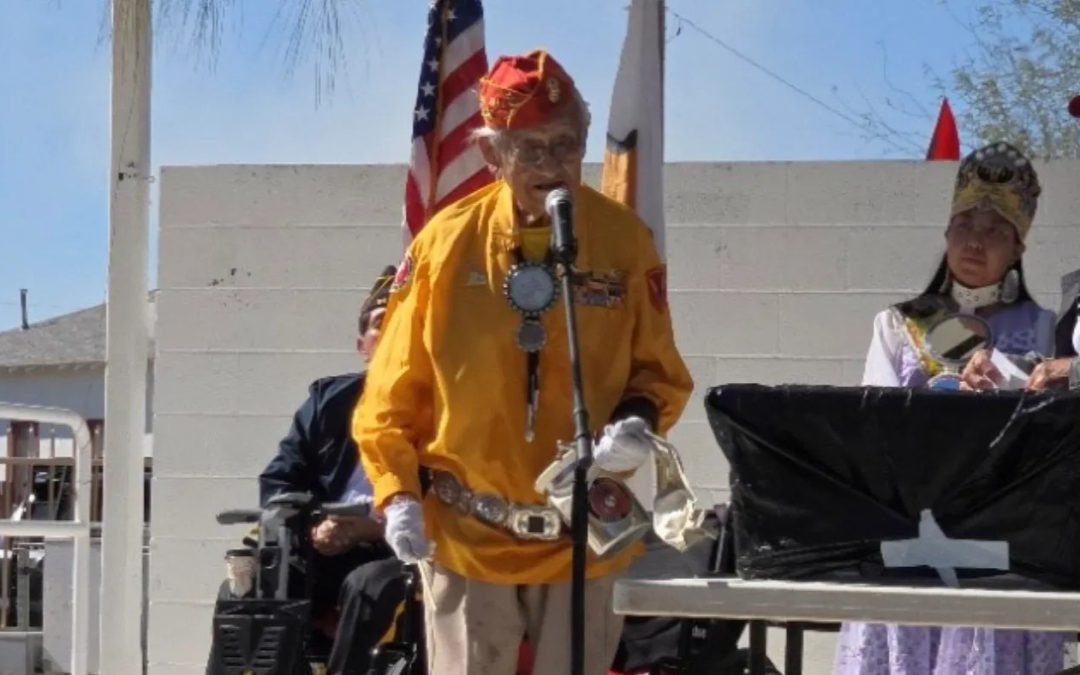
More than 81 years have passed since Feb. 23, 1945, when U.S. Marines raised the American flag atop Mount Suribachi on the island of Iwo Jima during World War II. As the battle for Iwo Jima continued, Navajo Code Talkers and other Native American service members played a critical role in helping U.S. forces secure the South Pacific island.
Using a complex oral code based on the Navajo language, Code Talkers shared secret battlefield messages that the enemy couldn’t decipher. Their work proved critical to U.S. success during World War II. In 1982, President Ronald Reagan designated August 14 as National Navajo Code Talkers Day to honor their service to our country.
Each year, the large Native American community of Sacaton, Arizona—located within the Gila River Indian Community—honors the heroic efforts of Native American Code Talkers with a community event and parade.
The legend of Thomas Begay
At this year’s commemoration event, Craig Filbeck, a Native American Direct Loan (NADL) coordinator with the Department of Veterans Affairs, shared information with Native American Veterans and service members about using the NADL benefit. While there, he had the honor of hearing from Thomas Begay, one of the last surviving Navajo Code Talkers.
During the battle for Iwo Jima, Begay and other Code Talkers passed more than 800 messages in 48 hours. Working in pairs, they transmitted battlefield, tactical, and bombing information that was key to capturing the island.
“Hearing about [Begay’s] and the other Navajo Code Talkers’ heroic actions on Iwo Jima was an honor and a highlight of my time at the event,” Filbeck said.
After serving in World War II, Begay went on to serve in Korea before leaving military service. Following his military service, he worked for the Bureau of Indian Affairs and had four children, all of whom served in the military.
Buy, build, renovate or refinance
Filbeck was in Sacaton for a reason: to make sure Veterans like Begay know about a benefit they’ve earned. As a NADL coordinator, he shared information about using the NADL benefit to buy, build, renovate or refinance a home on federal trust lands.
“These outreach events are important to VA and Native Americans, because they give us an opportunity to engage with the community and share information about the NADL benefit,” Filbeck said. “When Native Americans use these loans to build homes, it also helps alleviate housing deficiencies on tribal lands.”
Congress established the NADL program through the Veterans Home Loan Program Amendments of 1992. The program helps Native American Veterans and service members buy, build or refinance homes on federal trust lands. Under the Native American Programs Act of 1974, “Native American” includes Native Americans, Native Hawaiians, Alaska Natives and Pacific Islanders.
NADL loans offer many valuable benefits, including low interest rates (currently at 2.5%), no down payment, no private mortgage insurance and limited closing costs.
To qualify for NADL, Native American Veterans generally must belong to a federally recognized tribe that has signed a memorandum of understanding (MOU) with VA. To date, 120 tribes have signed MOUs. VA recently created a video to help tribes understand the MOU process. The video is available on the Loan Guaranty training website under “Available Training – Native American Direct Loans.”
VA Loan Guaranty Service is committed to connecting with Native American Veterans and service members to make sure they know about this earned benefit. Each year, NADL coordinators travel to tribal events across the country and work with Veterans and tribal leaders to expand the reach of the NADL program.
Through this outreach, VA ensures that heroes like Thomas Begay have the information they need to use NADL to buy, build, renovate and refinance homes.
Recent Comments