
Ed. note: Second in a series. Read the first installment here.
AI has made legal work faster in many cases, but on the most complex, high-stakes matters, speed can disappear.
The reason is that most AI tools are probabilistic and are simply predicting a likely answer. The output is nothing more than a best guess. For everyday tasks, a good guess is fine. On a detailed contract review or a comparison, one risk not identified or wrong or missing change can have a real impact on the client, the transaction, and overall trust.
The Verification Tax
A best guess also creates a hidden cost – a verification tax. When lawyers cannot tell which parts the AI got right, they have to check every line. Suddenly hours are being spent re-checking AI-generated drafts, searching for hallucinated clauses, and checking for redline errors that a general-purpose model introduced rather than caught.
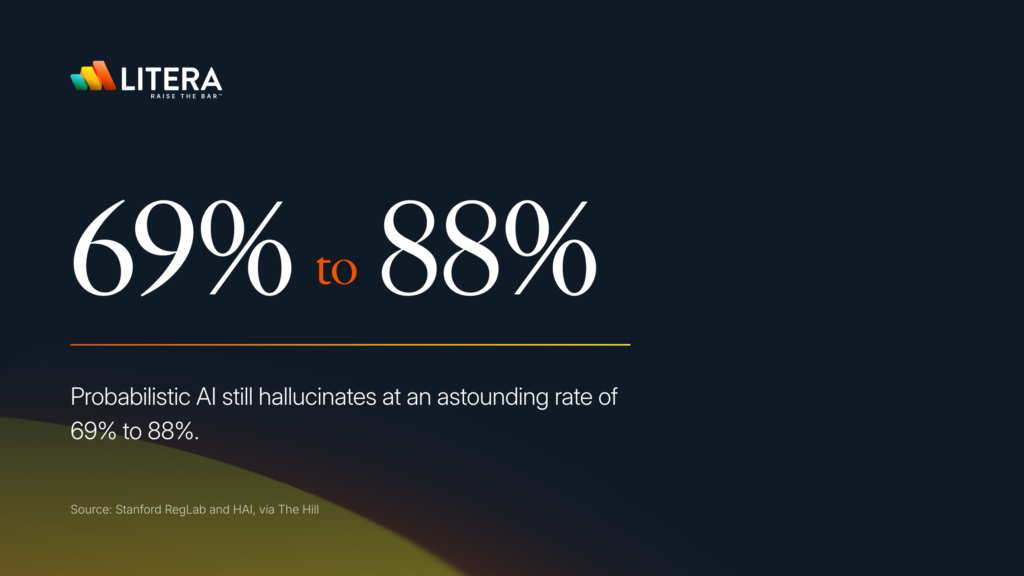
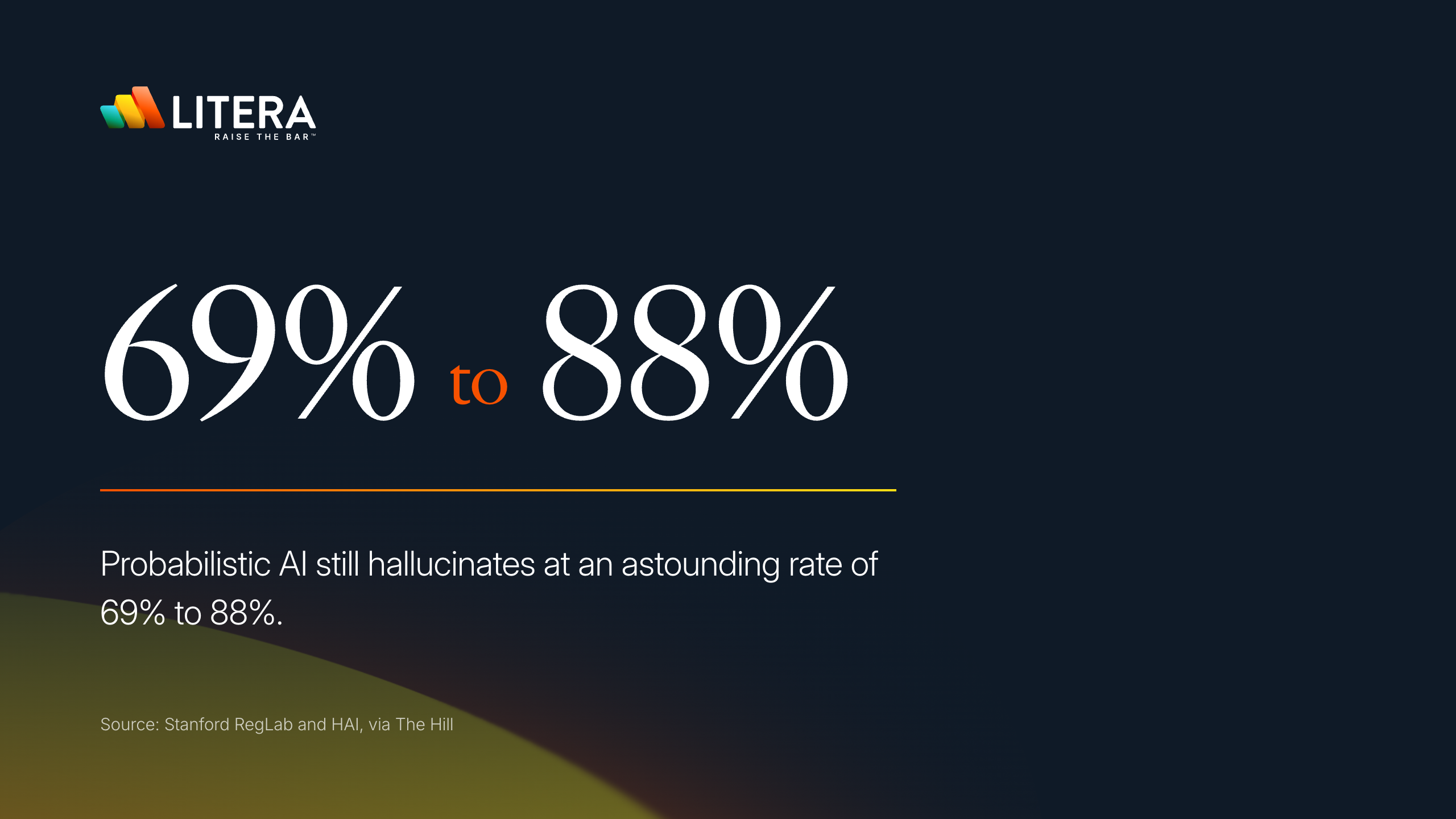
Probabilistic AI still hallucinates at an astounding rate of 69% to 88%. So, it is not a surprise that 39% of lawyers have said that lack of trust in the results is a top reason they hold back from AI. And clients feel it too: only 6% of clients today say their vendors deliver AI-enabled quality.
The result is a paradox most CIOs, innovation, and practice leaders recognize immediately. Firms either avoid AI on their most sensitive work, forfeiting the speed advantage entirely, or they use it and then re-check extensively, erasing the efficiency they paid for.
Deterministic vs. Probabilistic: The Difference that Decides Trust
The verification tax is not a flaw in one tool; it is inherent in how probabilistic AI works. But probabilistic models are not the only type of AI.
Deterministic AI works from fixed rules instead of predictions. The same input produces the same correct output every time. For a defined task like detecting exactly what changed between two versions of a contract, a rules-based system does not estimate the answer; it computes it. Ask twice, and you get the same result.
That is the real fork in Legal AI. A probabilistic model is trained to sound right. A deterministic engine is built to be right on any task that has a definable correct answer. One gives a strong opinion. The other gives a fact.
Both probabilistic and deterministic AI have use in legal. Probabilistic models are powerful for open-ended work like searching and summarizing, where no single answer is the correct one. Deterministic engines are the safer choice for exact, checkable work where being close is the same as being wrong. The strongest systems use both and know which task calls for which.
So, the question a firm should ask about any Legal AI is not how fast it runs, but whether it is applying the right AI for the right purpose.
The Point-Tool Problem
The next problem is fragmentation. Most AI tools speed up one step of a matter. One drafts, another reviews contracts, a third compares versions, a fourth handles transaction management. The lawyer on a complex deal toggles between platforms and logins and each time, loses context.
That carries a real cost, too. This was the context-switching that AI was supposed to end, but because no single tool sees the whole matter, accuracy falls to the lawyer to stitch outputs together and catch the gaps by hand. That becomes inefficiency dressed up as innovation.
The real question every firm should be asking is not how fast its AI makes one step, but whether the platform can handle every step of the most complex matter, from first draft to closing, with workflows built for lawyers that help to move the deal forward.
Five Steps from Draft to Close, One Connected Standard of Deterministic Accuracy
Value is created using AI in the practice of law when every step of a matter produces work that the firm can prove, and clients can rely on. There are five connected steps:
⒈ Drafting That Moves Fast Without Losing Firm Control: First drafts should start from the firm’s own work. When first drafts are grounded in firm-approved precedent, firm-standard clauses, and firm-specific formatting, they arrive up to 97% faster and require far less rework. Numbering, cross-references, and formatting follow set rules, so they come out right the first time. Speed and firm control together, not traded against each other.
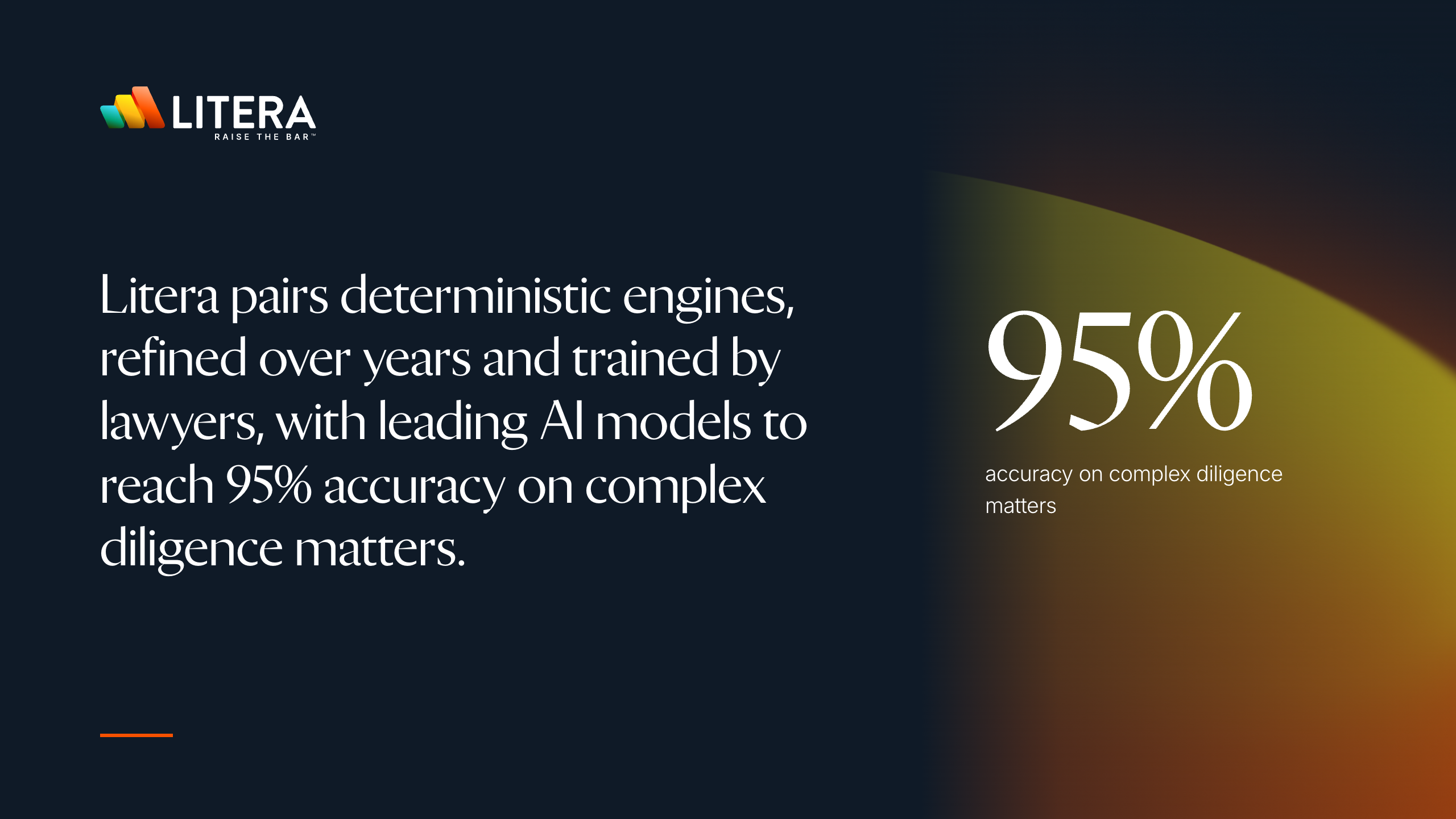
⒉ Review and Diligence with Legal Grade Accuracy: Contract analysis and due diligence are where a guess is most dangerous, and on complex matters involving hundreds or thousands of documents, firms need accuracy they can verify and prove. Litera pairs deterministic engines, like Kira, refined over years with the latest GenAI, working together. The result is 95% accuracy on complex diligence matters, relying on 1,400 review fields trained by lawyers and leading AI models. No general-purpose model or AI-first legal vendor can match that depth on its own.
⒊ Negotiation Intelligence Lawyers Can Trust: Here a single missed change can shift the terms of a deal. Comparing versions, analyzing redlines, incorporating feedback, and using deal-point intelligence to negotiate all depend on catching every change, every time. Litera’s proprietary redline algorithm built specifically for legal documents catches nuanced changes across text, images, tables, and embedded objects that generic tools miss. The Litera comparison engine is more accurate than general-purpose LLMs on this work, including Claude for Legal. On high-stakes matters, that is the difference between a clean close and a costly error.
⒋ Documents That Leave the Firm Polished, Protected, and Client-Ready: Before any document reaches a client, it needs to be proofed, repaired, formatted, cleaned of metadata, and secured. Litera’s deterministic engines catch nuanced proofing and formatting issues that generic tools miss. Metadata cleaning detects over 300 types of hidden data across every Outlook version. This is the work that protects the firm’s reputation on every matter, and the work most AI tools overlook.
⒌ Transaction Management Where the Last Mile Moves as Fast as the First: Finally, the stage that is often the most manual and the most error-prone is transaction management. With Litera Transact, checklists, signatures, approvals, bulk changes, and closing books are all connected to everything that came before, so matters close on time and nothing falls through the cracks.
Each of these steps matters on its own, but the real advantage is not any single step. It is what happens when all five connect.
When Accuracy Compounds into Growth
The outcomes of each step compound when every step is accurate and connected.
Run the five steps on a connected platform using one agent, instead of five separate tools, and the work does not just move faster, it gets better. The precedent library grows smarter with every draft. Diligence sharpens with every review. Redline intelligence deepens with every comparison. That is intelligence the firm earns, not rents, and no rival can copy it, because it is built from the firm’s own work.
But compounding accuracy does not just improve the work. It changes the relationship. Accuracy is what changes the equation. When every output from the platform is something the firm can stand behind, trust deepens. The firm stops being evaluated on speed alone and starts being valued for judgment, reliability, and the confidence its work creates. That is the shift from faster to indispensable. Accuracy is the foundation firm growth depends on.
This is how Litera builds both sides of the equation: ground high-stakes work in deterministic, rules-based engines, then layer leading GenAI where speed and language help. Lawyers still verify, but there is far less to fix, so the time comes back. That is the practice side. The business side is what that trust creates: the client confidence that leads to deeper relationships, expanded mandates, and new revenue. It is why firms keep saying the same thing: “We don’t trust it unless it’s gone through Litera.”
That same foundation is what makes agentic AI safe. Lito, Litera’s award-winning Legal AI agent, runs on the deterministic engines at the core of the Litera platform. Lito works from a redline that is verifiable and true, so every next step, from spotting risk to suggesting stronger language builds on the real set of changes, not a probable one. That is how Lito turns a five-hour review into 30 minutes without trading away accuracy.
This is the foundation the first article described: trusted Legal AI that creates the quality clients rely on, the accuracy the firm can prove, and the trust that turns efficiency into sustainable growth. That requires a strong foundation, not a bold promise, and it is one no AI-first startup can replicate.
See how Litera holds accuracy on the most complex matters. Explore the platform.
Josephine Good, Director, Client Value & Innovation, Litera.
Josephine was an M&A lawyer at Shearman & Sterling, where she worked on a variety of corporate matters across a broad range of sectors, focusing on private M&A, private equity, and private funds. In 2021, Josie joined Kira Systems as a Practice Advisor, just prior to the company joining the Litera family. In this role, she serves as a product and subject matter expert, and advises law firms across EMEA and APAC on how to best integrate Kira and Litera’s transaction management solutions into their existing workflows.
The post On The Most Complex Matters, Probably Right Is Not Good Enough appeared first on Above the Law.
Recent Comments