
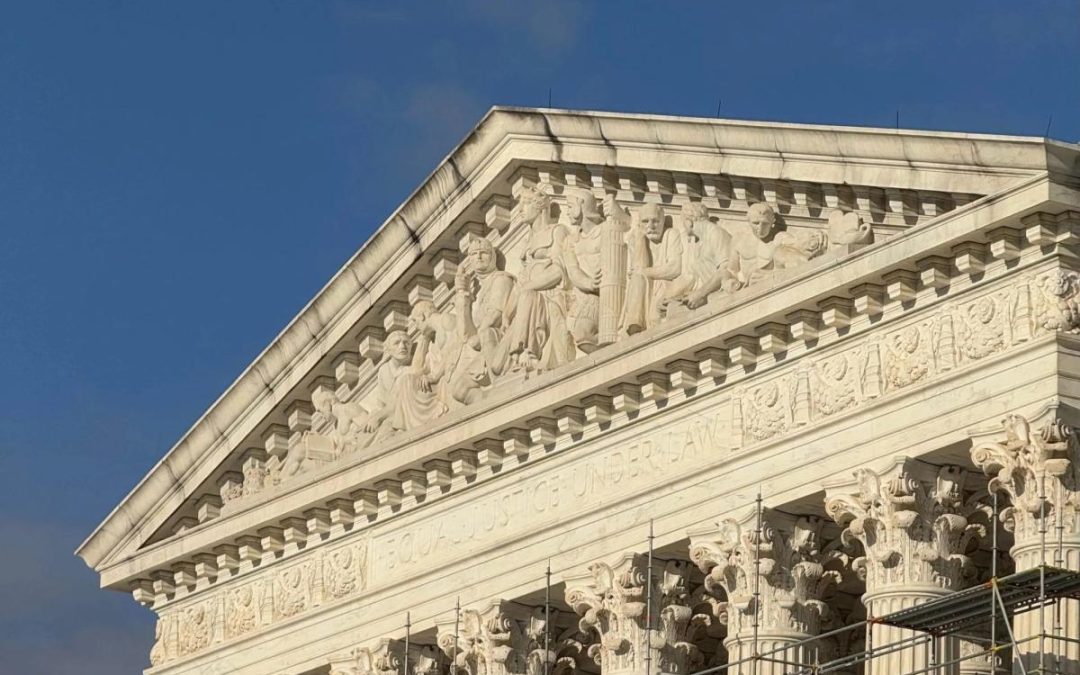
Tomorrow (Aug. 29) is Justice Neil Gorsuch’s birthday. Born in 1967, Gorsuch has served on the Supreme Court since 2017.
At the Court
Last Friday, Chief Justice John Roberts issued a temporary order, known as an administrative stay, allowing construction on the new White House ballroom to continue for now. The court could release its decision in the interim docket case at any time.
One week from today, on Friday, Sept. 4, at 9:30 a.m. EDT, the court will release its third and final summer order list. (We discussed what these lists typically address in our July 13 newsletter.)
Morning Reads
US opposes 9/11 attackers’ Supreme Court bid to avoid death penalty
Kaelan Deese, Washington Examiner (paywalled)
On Wednesday, U.S. Solicitor General D. John Sauer urged the court “to reject a bid by alleged Sept. 11 attack mastermind Khalid Sheikh Mohammed and a co-defendant to restore plea agreements that would spare them the death penalty,” according to the Washington Examiner. The filings came in response to the alleged attackers’ request for the court to review “a federal appeals court ruling that allowed the Pentagon to withdraw from the agreements.” “A Pentagon official under the Biden administration approved the agreements on July 31, 2024. Two days later, then-Defense Secretary Lloyd Austin canceled them, saying a decision of such significance should rest with him,” but a military judge later ruled “that Austin acted too late because the defendants had already begun carrying out their obligations” under the plea agreements. “A military appeals court upheld that decision. However, the D.C. Circuit reversed course in July 2025, blocking the military judge from accepting the guilty pleas and allowing the Pentagon’s withdrawal to stand.”
Clarence Thomas Says Farm Work Helped Shape View on Precedent
Jordan Fischer, Bloomberg Law
In the second part of his interview with Sen. Ted Cruz for Cruz’s podcast, Justice Clarence Thomas used a farming analogy to explain his views on reconsidering precedent. He noted that “[t]he alignment of the first row a farmer plows … will determine all the rest,” according to Bloomberg Law. “What if that first row is crooked?” Thomas said. “Do you keep going, pretending that it’s straight? Or do you go back and make it straight?” The justice also shared his belief that the Supreme Court has “over-intellectualized” the Constitution, saying “that he’s skeptical of any decision if he can’t ‘explain it to that guy on that ranch.’”
Judge, for now, refuses to dismiss Steve Bannon’s conviction in contempt of Congress case
Associated Press
On Wednesday, U.S. District Judge Carl Nichols “rejected the Justice Department’s request to erase Trump ally Steven Bannon’s criminal conviction for refusing to testify before the congressional committee that investigated a mob’s Jan. 6, 2021, attack on the U.S. Capitol” after determining “that prosecutors failed to properly explain their motivations for seeking the dismissal of Bannon’s indictment,” according to the Associated Press. Nichols’ decision came “several months after the U.S. Supreme Court – at prosecutors’ request – threw out an appellate ruling upholding Bannon’s conviction for defying a subpoena from the House committee,” clearing the way for Bannon and the Trump administration to continue working to get the criminal charges dismissed. Nichols said on Wednesday that “the government is free to renew its request in a manner that follows the law.”
‘The day I disclose, my career is over’: the journalist facing an $800 daily fine to keep her sources secret
Jeremy Barr, The Guardian
In 2017, journalist Catherine Herridge published a series of “stories about the Chinese-American scientist Yanping Chen, who had been federally investigated – but not charged – over her ties to China’s military and whether a Virginia school she operated was secretly aiding the communist country.” Chen then sued “four government agencies … over what she said was the government’s ‘illegal and unwarranted public disclosure of her personal information’ to a journalist.” As part of the lawsuit, Herridge was ordered by a judge to reveal her source and to pay $800 per day until she did. This summer, Herridge began making those payments, but the judge later clarified “that Herridge doesn’t need to pay the fine until” the Supreme Court responds to her petition for review, in which Herridge asks the justices to protect what she sees as her right as a journalist to not reveal her sources. “This is a landmark first amendment case – probably one of the most important first amendment cases in two decades,” Herridge told The Guardian.
Live audio drives trust in the Supreme Court. Visuals will, too.
Robert Green and Ian Green, The Hill
In a column for The Hill, Robert Green and Ian Green highlighted their research into how live audio of oral arguments, “first introduced in 2020,” has influenced Americans’ views of the Supreme Court. They noted that Baby Boomers and older voters typically don’t engage with the live audio feed but added that it’s been a positive development for members of younger generations. “Among those who have heard live audio, Gen X, Millennial and Gen Z voters say it gives them ‘a more positive view’ of the U.S. Supreme Court by a 58-18 percent margin,” Green and Green wrote. They contended that “[l]ive audio’s positive effect on Supreme Court favorability shows why courtroom cameras should be the court’s next step.”
On Site
Court News
Fed Governor Lisa Cook responds to Trump administration’s letter stating that it is “considering” her removal
A lawyer for Federal Reserve Governor Lisa Cook told the White House on Wednesday that allegations that Cook committed mortgage fraud before joining the Fed are “unfounded and untrue.” As a result, wrote attorney Abbe Lowell, any effort to remove Cook from her job based on those allegations would be “corrosive of the independence that Congress sought to preserve” for the Federal Reserve Bank.
From the SCOTUSblog Team
Has the Supreme Court rendered the First Amendment’s press clause invisible?
Although the First Amendment states that “Congress shall make no law … abridging the freedom of speech, or of the press,” Eli Kronenberg writes that the second clause has become increasingly inconsequential in the Supreme Court’s First Amendment jurisprudence, even in cases where matters of journalism and newsgathering are concerned.
SCOTUS Outside Opinions
What the public thinks of the Supreme Court
In a column for SCOTUSblog, Charles Franklin highlighted what he described as “fascinating results” from the Marquette Law School Poll’s July poll on the Supreme Court, including the significant gap between how Republicans and Democrats view the court and its decisions. For example, while 63% of Republicans say the court favors President Donald Trump only some of the time or almost never, 77% of Democrats think the court rules for Trump almost always or most of the time.
Podcasts
Advisory Opinions
How to Fix Congress | Interview: Rep. Jake Auchincloss
Sarah Isgur and David French invite real-life Rep. Jake Auchincloss of Massachusetts to discuss how to reform Congress, explain multi-member districting, and talk about whether the Supreme Court needs more justices. But first, forging Chief Justice John Roberts’ signature and fake arresting teenagers.
A Closer Look
Justice William Johnson
Although Justice William Johnson, Jr. has been called the Supreme Court’s “first dissenter,” this title has itself attracted some dissent – law professor Mark Killenbeck wrote that the first recorded dissent actually belonged to the other Justice (Thomas) Johnson, in 1792’s Georgia v. Brailsford, a dispute over whether a state or a British creditor was entitled to a debt seized during the American Revolution. According to Killenbeck, Justice William Johnson instead deserves “the reputation as the first persistently independent voice on the Court.” Indeed, Johnson wrote about half of all the dissents of the Marshall era.
Johnson was born in Charleston, South Carolina, in 1771. His father was a blacksmith; at the time of his death, he held 98 enslaved people. The elder Johnson helped lead Charleston’s secret revolutionary meetings under the “Liberty Tree,” and Gov. (and Chief Justice) John Rutledge later credited him with setting the Revolution in motion there. The British eventually imprisoned him and exiled the Johnson family to Philadelphia.
Johnson graduated at the top of his class at the College of New Jersey (now Princeton University) in 1790, read law with leading Federalist Charles Cotesworth Pinckney, and joined the bar in 1793. He was elected to the South Carolina House at age 22, married his wife that same year, and served as speaker during his third term. In 1799, the South Carolina Legislature placed him on the Court of Common Pleas, which came with a seat on the state’s highest appellate court, where each judge could announce his own views in a given case (Johnson kept this habit up during his later time on the Supreme Court).
When Justice Alfred Moore resigned in 1804, President Thomas Jefferson went looking for a Republican. Johnson was described as “an excellent lawyer, prompt, eloquent, of irreproachable character” and “of good nerves in his political principles.” Jefferson nominated him in March, the Senate confirmed him two days later, and at 32, he became the first justice who was not a Federalist.
When Johnson joined the bench, Chief Justice John Marshall announced nearly every decision himself. Johnson later wrote to Jefferson that the “real Cause” was his colleagues: “Cushing was incompetent. Chase could not be got to think or write – Paterson was a slow man,” and Marshall and Bushrod Washington were “commonly estimated as one Judge.” One of Johnson’s early dissents came in 1807’s Ex parte Bollman, a case arising from the Aaron Burr conspiracy in which Marshall held that the court could issue writs of habeas corpus; Johnson dissented, arguing that the court had no such power unless Congress expressly granted it, though he wrote of “the painful sensation” of breaking with the other justices, and reported after his first separate concurrence that he heard “nothing but Lectures on the Indecency of Judges cutting at each other.” Still, Johnson went on to write more than 160 opinions – behind only Marshall and Joseph Story – of which roughly one-third were separate concurrences or dissents. (He also wrote 112 majority opinions for the court – for example, in United States v. Hudson, he held that lower federal courts could not try crimes unless Congress had made the conduct illegal.)
Jefferson ultimately got less of a Republican than he was hoping for – in 1808 while riding circuit in Charleston, Johnson ordered the release of a ship detained under Jefferson’s Embargo Act of 1807, which barred American ships from foreign ports in an effort to pressure Britain and France economically. For this, Attorney General Caesar Rodney said to Jefferson that Johnson had caught “leprosy of the bench.” In Gibbons v. Ogden, the 1824 case establishing Congress’ authority over interstate commerce, Johnson’s concurrence claimed an even broader federal power than Marshall’s majority opinion did. He also joined McCulloch v. Maryland, which upheld Congress’ power to charter a national bank.
One of his more consequential opinions came while riding circuit in 1823 when Johnson held unconstitutional a South Carolina law authorizing the seizure of free Black sailors who arrived on ships docked in the state, holding that it conflicted with both Congress’ power over “commerce” and a U.S. treaty with Britain – although he had no power to actually free those before him and South Carolina ignored the ruling. For this, Marshall reportedly said that “our brother Johnson … has hung himself on a democratic snag in a hedge composed entirely of thorny states rights in South Carolina.” Johnson’s later rejection of nullification (and the resulting hostility towards him in South Carolina) caused him to move to Pennsylvania in 1833.
Johnson died in Brooklyn in August 1834 after surgery on his jaw. Although one scholar has called him “the first creative, the first scientific dissenter,” he remains relatively unrecognized despite his active role on the Marshall court.
SCOTUS Quote
MR. MARWELL: “… And you see it in the cases cited in our brief, where you either have somebody who, you know, was lawfully present, went into the bank or into the store, or you have a situation where the authorization to enter was disputed. And so the prosecution will charge both. And often the easier course, if you take the government's reading, is, well, don't worry about whether intent existed at the time of entry because, you know, there was a commission of a misdemeanor or a crime while you're – while you're –”
CHIEF JUSTICE ROBERTS: “It has to be – it has to be very unusual that someone enters a bank and only then does it occur to them that that's where money is that they might want to rob.”
— Quarles v. United States (2019)
Recent Comments