
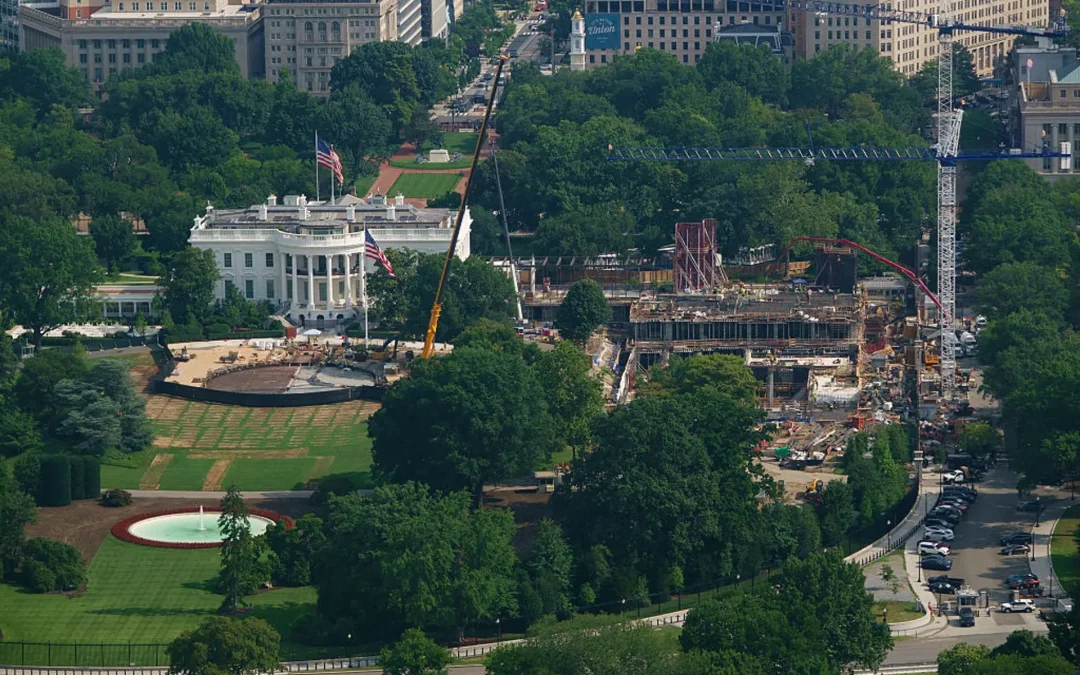
The Supreme Court on Monday granted the Trump administration’s request to allow construction on a new White House ballroom to continue. By a vote of 5-4, the court paused a ruling by a federal judge in Washington, D.C., that would have halted above-ground construction of the ballroom project.
In an eight-page, unsigned opinion, the majority emphasized that it was not deciding whether the project was legal. Instead, it stressed, the plaintiff likely lacks a legal right, known as standing, to challenge the project at all.
The court’s decision came 10 days after Chief Justice John Roberts issued a temporary order, known as an administrative stay, that put the lower court’s ruling on hold to give the justices more time to consider the government’s plea. On Monday, Roberts joined the court’s three Democratic appointees in dissenting. In their view, the construction “is likely unlawful,” and the majority’s decision was “no victory for the separation of powers.”
The order by Senior U.S. District Judge Richard Leon had never actually gone into effect. Monday’s announcement by the Supreme Court raises the prospect that the project, which the Trump administration on Aug. 13 described as “65% complete in its entirety, and moving quickly toward total completion,” could be finished, or nearly so, by the time the dispute is finally resolved.
The plaintiff in the case, the National Trust for Historic Preservation, is a private nonprofit that describes itself as having “led the movement to save America’s historic places” “[f]or more than 75 years.” It went to federal court in Washington, D.C., in December, where it asked Leon to pause construction until the National Capital Planning Commission and the Commission of Fine Arts could review the plans for the construction; the NCPC could approve those plans; and Congress could authorize the construction.
On March 31, Leon issued an order that temporarily blocked the construction of the ballroom above ground but allowed underground construction – of, for example, bomb shelters and bunkers – to move forward, along with any above-ground construction necessary for safety and security. The U.S. Court of Appeals for the District of Columbia Circuit paused Leon’s ruling before it could go into effect to give that court time to consider the government’s appeal.
On Aug. 7, by a vote of 2-1, the D.C. Circuit affirmed Leon’s ruling but gave the federal government 14 days to seek relief from the Supreme Court. Unless the justices intervened, it said, Leon’s ruling would go into effect on Aug. 21.
Writing for the majority, Judges Patricia Millett and Bradley Garcia emphasized that Congress, and only Congress, has the power “to regulate the construction and demolition of White House structures,” but it has not approved any money for the ballroom construction. If the construction is not put on hold, they said, and the ballroom is built, it will permanently harm (an important factor that courts consider in deciding whether to grant temporary relief) the members of the National Trust because the new structure will cause “irreversible historical-preservation, architectural, and visual damage.”
Judge Neomi Rao dissented. She argued (among other things) that the trust did not have standing to try to stop the ballroom construction. Moreover, she added, the president has the power to improve his residence, which likely includes the ballroom.
The Trump administration on Aug. 13 asked the Supreme Court to step in and temporarily block Leon’s ruling, calling it “extraordinary and unlawful.” U.S. Solicitor General D. John Sauer told the justices that Leon’s ruling would “halt the ongoing construction of the integrated military complex, including a totally secure ballroom space, at the East Wing of the White House, which is vitally required by national security.”
Like Rao, the Trump administration contended that the trust lacks standing to sue, because its claims rest on a member’s “dislike” for the new construction – which, it said, is not the kind of injury that would allow the lawsuit to go forward. Moreover, the government wrote, Congress has authorized the project, both by giving Trump and other presidents the power “to make ‘alteration[s]’ and ‘improvement[s]’ to the White House” and because it “broadly authorized the Executive to construct buildings in national parks.”
In its 40-page filing, the National Trust – represented by Tad Heuer of Foley Hoag – countered that Congress, rather than the president, “decides whether a ballroom can be built on federal property.” If the Trump administration “believe[s] there is a pressing need for a ballroom,” it contended, it can seek permission and funds from Congress to build one. But the government’s “efforts to foil judicial review and arrogate Congress’s exclusive powers should not be rewarded with a stay that allows [it] to complete a ballroom [it] lacked any authority to commence in the first place.”
If the Supreme Court denies the Trump administration’s request to pause Leon’s order, the trust argued, the Trump administration will not suffer any permanent harm. There is, it wrote, “nothing in the district court’s carefully tailored injunction [that] prevents them from continuing work on the bunker, securing the East Wing site, or ensuring the safety of the President, his family, and staff. All the injunction stops is construction of a ballroom without prior congressional approval.”
But if the court grants the government’s request and pauses Leon’s order, Heuer wrote, the trust will be permanently harmed. The government, he emphasized, has “raced to build as much of the ballroom as [it] can before the injunction goes into effect, proclaiming that ‘the structure should be substantially finished by November 2026.’” Indeed, he noted, the government has said that the project is now “beyond the point of return,” so that there would be no way to either take it down or change it.
On Aug. 21, the day that Leon’s order was scheduled to go into effect, Roberts issued a brief administrative stay that allowed construction to continue until the justices took further action.
On Monday, a divided court granted the government’s request for a stay, permitting construction to move forward while the litigation continues in the lower court. The majority’s opinion focused primarily on its conclusion that the National Trust likely does not have standing to challenge the project. The trust had submitted a declaration from Alison Hoagland, a member who lives in Washington, D.C., and said that she visits the area where the White House is located approximately once per month. Hoagland, who has “expertise in historic architecture,” claimed that the project caused “‘injuries’ to her ‘aesthetic, cultural, and historical interests’ because she finds the ‘scale,’ ‘height,’ and ‘massing’ of the government’s design distasteful.” But those are not the kind of “concrete” and specific injuries required to bring a lawsuit, the majority explained.
The majority also concluded that the government would be permanently harmed if Leon’s order were allowed to go into effect – another key criterion in determining whether to grant emergency relief. Among other things, it noted, senior government officials “attest[] that constructing something approximating the height and mass of the intended above-ground ballroom is ‘crucial’ to the security of the below-ground military installation.”
In his six-page dissent, which Justices Sonia Sotomayor, Elena Kagan, and Ketanji Brown Jackson joined, Roberts countered that “[a] historic preservationist such as Hoagland can be aesthetically injured in a concrete, particularized way by the transformation of a historic building that she frequently enjoys, just as,” based on prior court precedent, “an environmentalist can sustain a concrete, particularized aesthetic injury from the extinction of a particular animal or the transformation of a particular forest or river that he regularly enjoys.” Roberts ended the opinion by quoting Winston Churchill, who said that “[w]e shape our buildings, and afterwards our buildings shape us.” “All the more reason,” according to Roberts, “to ensure that those responsible follow the rules in deciding what to tear down and what to build up at the People’s House.”
Recent Comments