
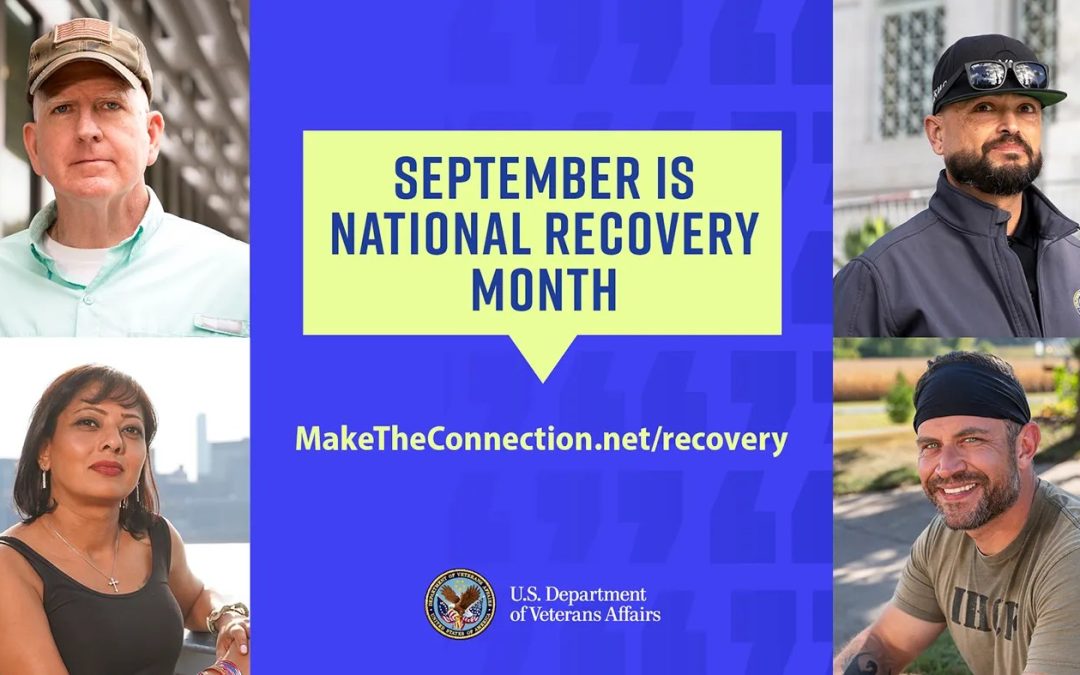
Veterans speak directly about how they found effective treatments and overcame setbacks
How do you start your path to recovery from addiction, trauma, depression, anxiety or other mental health challenges? How do you find effective treatments, deal with setbacks, keep moving forward and begin to heal?
For National Recovery Month this September, VA is sharing stories from hundreds of Veterans, speaking directly in their own words about the challenges they faced in their recoveries and how they found a brighter way forward. Every Veteran’s path takes its own turns, but these Veterans made some discoveries along the way that can be keys to recovery for anyone.
Recovery begins with recognition
“If you can recognize that broken link, you can fix it,” said Zack, an Army Veteran. “Just don’t avoid looking for that piece, no matter how uncomfortable it may be.”
Diagnosing the root causes of your challenges by yourself can be difficult, if not impossible, especially when you’re immersed in those challenges. It wasn’t until a friend asked Zack whether he could say that he loved himself (he couldn’t), and it was that realization that led Zack to understanding how much he needed help. He also recognized that he couldn’t recover on his own.
“I realized that something was broken,” he said. “That’s an empowering thought to me, because I grew up fixing things. Something’s broken, let me fix it. And that first step was seeking therapy.”
Recovery is always possible
“They took my handcuffs off, and then my journey began,” Mario, a Marine Corps Veteran, said of the moment he turned to treatment to overcome the drug and alcohol misuse that cost him his marriage, children, housing and freedom. Mario, who had already served 5 years in prison on a DUI charge, had gotten back into legal trouble. But court-ordered treatment with VA gave him a second chance.
The journey began with VA residential rehabilitation, which gave him intensive whole-health care, including access to primary and mental health services. It continued with VA-administered ketamine therapy for treatment-resistant depression. And it brought Mario to a better place where, sober and seeing life in a new way, he was hired by VA as a peer specialist to guide other Veterans and show them what they can achieve.
“I don’t want another Veteran to go through what I went through when there’s a way out,” Mario said.
Recovery takes effort
After her deployment with the Marine Corps for the U.S. invasion of Iraq in 2003, Shifali came home behaving very differently. “My family would tell me that I was very, very hypervigilant, like anything could set me off,” she said. “I didn’t want to be difficult to be around, and I needed to understand what was going on.”
She sought help at VA through therapy, but also discovered she had to do more than just go to appointments.
“There’s a difference between being in therapy and being present in therapy,” Shifali said. “You have to use what skills they give you. You have to put them in practice.”
So she did her homework.
“I’ve learned how to ground myself,” she shared. “I’ve learned a lot of calming breathing techniques. I can calm myself, self-soothe, pretty easy now. I like who I am now, whereas, before, I didn’t, because I didn’t have all these skills.”
Recovery has many paths
VA offers a host of evidence-based therapies in different settings, including in-person, telehealth and residential rehabilitation. That enables VA to tailor therapies to each Veteran’s needs, priorities, values, preferences and goals.
Harold, a Veteran of the Air Force and Army Reserve, said he went to VA for mental healthcare because he had begun drinking too much after his service in the 1970s. “I was a functional alcoholic and drug addict. I was killing myself slowly. Wasn’t enjoying life,” he shared.
In addition to getting therapy for PTSD, anxiety and depression, he started taking VA classes on whole health that opened his eyes to new possibilities. He discovered that talking to other older Veterans after VA-led activities like yoga was comforting, especially learning that they faced similar challenges. He started working out, swimming, bike riding, and practicing yoga and tai chi.
“I’m living a life I never dreamed I would be able to have,” he said.
Find a story that speaks to you
Find more stories of recovery from Veterans, and begin to discover your own path, by visiting VA’s National Recovery Month website.
Recent Comments