
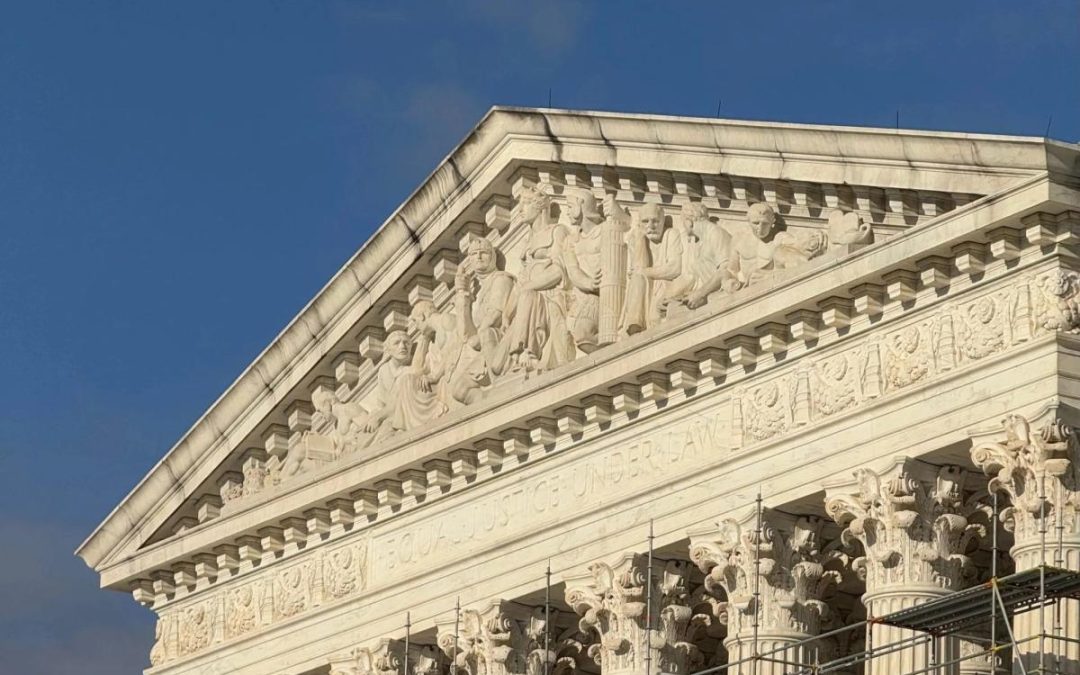
On this day in 1953, Chief Justice Fred Vinson died unexpectedly of a heart attack at age 63, seven years after he joined the Supreme Court.
At the Court
On Sunday, the Trump administration again appealed a dispute over President Donald Trump’s executive order on mail-in voting to the Supreme Court after withdrawing its application from Thursday. A response to the administration’s latest request is due on Wednesday by 4 p.m. EDT. For more on the filing, see the On Site section below.
On Friday night, Missouri Secretary of State Denny Hoskins filed an emergency application with the Supreme Court, urging the justices to clear the way for the state to use its new congressional map in the midterm elections. On Monday, Richard von Glahn, the challenger in the case, responded to this request. Find Amy’s coverage of the redistricting dispute in the On Site section.
Late last month, Republican groups asked the Supreme Court on its interim docket to block a decision by the U.S. Court of Appeals for the 4th Circuit preventing political parties and joint fundraising committees from paying preferential broadcast rates for political ads. On Friday, the court agreed to pause that ruling, at least for now. Justice Ketanji Brown Jackson was the lone dissenter. Learn more about the decision in the On Site section.
Also on Friday, the Supreme Court released its calendar for the December argument session, which lasts from Monday, Nov. 30, to Wednesday, Dec. 9. For more on the oral arguments in December, see the On Site section.
Friday morning, the court released its third and final summer order list, announcing, among other things, that it had denied a petition for rehearing from New York healthcare workers who were denied a religious accommodation from the state’s COVID-19 vaccine mandate for such workers. Find Amy’s coverage of the order list in the On Site section.
Morning Reads
How Two Men Without Lawyers Got Their Cases to the Supreme Court
James Romoser, The Wall Street Journal (paywalled)
The Supreme Court typically fills out its oral argument docket with cases brought to the justices by “elite appellate attorneys, who go to great lengths to identify cases that might interest the high court,” according to The Wall Street Journal. “It has been five years since the justices last heard arguments in a case filed by a person who came to the court without a lawyer. Now this fall, the court will do it twice.” The Journal highlighted the two “outsiders” who successfully caught the justices’ attention on their own: “[a]n Orthodox Jewish father of five who plays rock music in his spare time” and believes “he suffered religious discrimination from his city’s planning commission,” and “[a] federal prisoner serving a 20-year sentence for a Mafia-linked racketeering conviction” who “says he is entitled to be transferred to a halfway house or home confinement.” “By now, both men have teams of prestigious lawyers who will represent them at the Supreme Court lectern. But [Daniel] Grand and [William] Maxwell navigated the first phase on their own: writing and filing a pivotal brief, known as a ‘cert petition,’ that asks the court to take a case.”
Prediction markets’ regulation draws closer to Supreme Court
Zach Schonfeld, The Hill
In recent years, multiple lawsuits have been filed over regulation of prediction markets like Kalshi and Polymarket. States contend that “the new platforms are no different from regular gambling, which they regulate with broad control,” while the markets, as well as the Trump administration, are “trying to push states out, hoping to keep prediction markets under federal control.” Last week, New Jersey asked the justice to take up the issue in a petition for review filed immediately after a circuit split emerged on the topic. “Breaking with” the U.S. Court of Appeals for the 3rd Circuit “in New Jersey’s case, the U.S. Court of Appeals for the 9th Circuit sided last week with Nevada regulators. It ruled the state can regulate Kalshi’s sports contracts,” according to The Hill. “Many legal observers agree the justices at some point will feel compelled to get involved. But some aren’t so sure New Jersey’s case is the right one, suggesting the court may want the issue to percolate more in lower courts.” The Hill noted that “Kalshi is not allowing customers to place wagers on its case.” “Polymarket, however, allows people to place wagers on whether the high court will take up a sports event contract case by the end of the year.”
Is Letting Only Seniors Vote by Mail Unconstitutional?
Adam Liptak, The New York Times (paywalled)
In his newsletter for The New York Times, Adam Liptak examined a new “split among the federal appeals courts” over whether state laws allowing people 65 or older to more freely vote by mail than younger residents violate “the 26th Amendment, which says the right to vote ‘shall not be denied or abridged by the United States or by any state on account of age.’” The U.S. Court of Appeals for the 4th Circuit recently held that one such law in South Carolina is unconstitutional, while the 5th and 7th Circuits have upheld similar laws in Texas and Indiana, respectively. “The Supreme Court views resolving such splits as one of its core responsibilities,” Liptak noted, describing the South Carolina case as “a good candidate for Supreme Court review.”
The Justices’ Papers
Steve Vladeck, One First
In a post for his Substack, Steve Vladeck explored why he believes Congress should adopt a “uniform rule” governing when “justices’ papers are made public going forward.” “[I]t shouldn’t be controversial to suggest that public awareness of the Court is not well-served by a series of widely varying access rules crafted by the justices (or their estates) to serve the justices’ purposes, rather than the public’s,” Vladeck wrote. “Having a uniform and predictable set of legislatively imposed rules to govern the release of papers going forward would not only help to increase the Court’s transparency, but it would also reaffirm that the justices’ work, which increasingly affects all of us, also belongs to all of us.”
On Site
Court News
Trump administration again appeals mail-in ballot dispute to the Supreme Court
The Trump administration came to the Supreme Court on Sunday morning, asking the justices to pause a ruling by a federal judge in Massachusetts that bars the government from implementing parts of a U.S. Postal Service rule on mail-in ballots. U.S. Solicitor General D. John Sauer told the court that Friday’s order by U.S. District Judge Indira Talwani “nullif[ies] the Postal Service’s efforts to address the risk that the federal mails will be used to perpetrate voter fraud.”
Court News
Missouri urges Supreme Court to allow for use of congressional map expected to aid Republicans
Telling the justices that “[a] federal-election-administration disaster is unfolding in Missouri,” Missouri Secretary of State Denny Hoskins came to the court, asking the justices to intervene in a battle over the state’s congressional maps. Specifically, Hoskins urged the justices to pause a ruling by the Missouri Supreme Court that would require the state to use the map that it adopted in 2022 rather than a new map which could give Republicans an additional seat in the U.S. House of Representatives that it took up last year and used in its primary elections in August.
Court News
Missouri organizer urges Supreme Court to leave ruling in place preventing use of congressional map expected to benefit Republicans
A Missouri man on Monday urged the court to leave in place a ruling by the Missouri Supreme Court that bars the state from using a new congressional map. Richard von Glahn, one of the organizers of a referendum that would put the new map up for a vote on November’s ballot, told the justices that the case “does not present a real emergency.”
Court News
Court announces cases it will hear in December, including challenges to the constitutionality of bans on AR-15s
The court will hear a pair of challenges to the constitutionality of bans on AR-15s and other semiautomatic rifles on Dec. 2. The oral arguments in Viramontes v. Cook County, which has been consolidated with Grant v. Higgins, headline the December argument calendar, which was released on Friday afternoon.
Court News
Court grants request from Republican groups to pause ruling, for now, on political broadcasting rates
The Supreme Court on Friday cleared the way for political parties and joint fundraising committees, at least for now, to receive favorable advertising rates in the upcoming midterm elections. In a four-page, unsigned opinion, the justices temporarily paused a ruling by the U.S. Court of Appeals for the 4th Circuit that limited the favorable rates to candidates for federal office.
Court News
In final scheduled summer order list, Supreme Court again declines to weigh in on COVID-19 vaccine mandate case
The Supreme Court on Friday morning once again declined to weigh in on a case brought by New York healthcare workers who were denied a religious accommodation from the state’s COVID-19 vaccine mandate for healthcare workers and lost their jobs when they were not vaccinated. The denial of rehearing in Does 1-2 v. Hochul came as part of the third and final regularly scheduled list of summer orders.
SCOTUS Outside Opinions
Laboratories of (un)democracy
In a column for SCOTUSblog, Neil Weare explored “a series of 125-year-old Supreme Court decisions known as the Insular Cases, which addressed whether and how the Constitution applied in Puerto Rico, Guam, and other newly acquired U.S. territories following the 1898 Spanish American War.” These cases are newly significant as the Trump administration pushes to limit access to birthright citizenship in U.S. territories.
A Closer Look
Checking in on the Justices’ Fall Schedules
Before the 2026-27 term unofficially begins with the Supreme Court’s “long conference” on Sept. 28, at least five of the justices – Justices Samuel Alito, Neil Gorsuch, Brett Kavanaugh, Amy Coney Barrett, and Ketanji Brown Jackson – have public appearances still to make.
Kavanaugh is expected to speak on the 25th anniversary of the 9/11 attacks at Notre Dame’s Jeanie Poole O’Shaughnessy Memorial Lecture this Friday, Sept. 11. Per Notre Dame’s website, the event “commemorates the 25th anniversary of that day and provides an opportunity … to honor the American spirit of resilience in the wake of unfathomable tragedy.”
On Sept. 17, Barrett will appear at an event in Charlottesville, Virginia, sponsored by the UVA Karsh Institute of Democracy, to discuss her book, Listening to the Law: Reflections on the Court and Constitution. The conversation will be moderated by UVA School of Law professor John C. Jeffries Jr., who clerked for and wrote a book on Justice Lewis Powell. (Barrett also spoke on her book last September at SCOTUSblog’s inaugural summit.)
The same day, Jackson will remotely accept the Philadelphia Bar Association’s Justice Brennan Distinguished Jurist Award with remarks recorded for the association. According to the bar association, the award will “honor [Jackson’s] outstanding record of judicial service and the significant, positive impact she has made on the quality and administration of justice.” The last Supreme Court justice to receive the award was its namesake, William Brennan, in 1995. The association will present the Justice Sonia Sotomayor Award the following day, Sept. 18, to Judge Lydia Y. Kirkland.
One week later, on Sept. 24, Jackson will deliver the University of the District of Columbia David A Clarke School of Law’s annual Joseph L. Rauh Jr. Lecture in Washington, D.C. Past speakers at this event include Justices Ruth Bader Ginsburg and Sonia Sotomayor.
Gorsuch is expected to speak on Sept. 25 at the U.S. Court of Appeals for the 10th Circuit’s Bench & Bar Conference in Colorado Springs, Colorado (Gorsuch’s home state). He will be joined in a fireside chat by George Washington University Law School professor Jeffrey Rosen and Circuit Judge Timothy M. Tymkovich of the 10th Circuit. Rosen has previously interviewed Gorsuch about his books, although the event’s agenda states no recording or photography of this chat is allowed.
The next day, Sept. 26, Alito is scheduled to speak at the annual Pepperdine Caruso School of Law Dinner in Beverly Hills, California. The dinner is “[g]uided by this year’s theme, ‘For Greater Purpose,’” and “brings together alumni, students, faculty, and supporters to celebrate the Law School’s enduring commitment to academic excellence and Christian values,” per the school. Last year’s dinner featured a keynote with former solicitors general Elizabeth Prelogar and Noel Francisco, and Barrett spoke at the event in 2024.
Also on Sept. 26, Kavanaugh will keynote the Catholic Bar Association’s annual conference in Dallas, where he will receive the St. Thomas More Award, and Barrett will speak at a dedication ceremony in Atchison, Kansas, for Benedictine College’s new “Independence Hall-inspired library.” The next day, Jackson will give the Olga M. Jonasson Lecture – a “reflection of the capacity of women to reach academic pinnacles” – at the American College of Surgeons Clinical Congress at the Walter E. Washington Convention Center in D.C. – wrapping up her busy month of events just in time for the long conference.
SCOTUS Quote
MR. BUTLER: “… Now admittedly of course courts cannot make decision based on popularity polls, but the fact is and I think it's interesting to note in passing that a respected poll taken very recently across this entire nation shows, and it was not taken just in the south, it was throughout the entire United States, that 54% of the people favored Judge Lemley's decision and felt that it was the only way to solve this particular problem.”
JUSTICE FRANKFURTER: “I sometimes wonder why we have elections and not turn it all over to polls.”
— Cooper v. Aaron (1958)
Recent Comments