
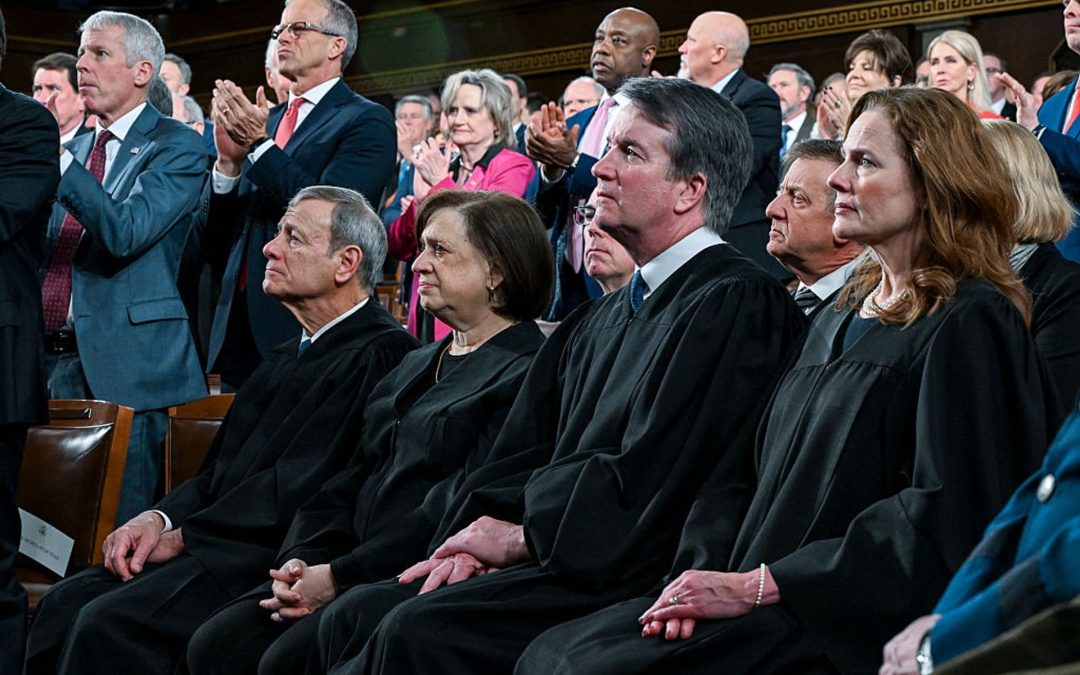
Upon introducing Amy Coney Barrett as his nominee to the Supreme Court in September 2020, President Donald Trump praised her as “a woman of unparalleled achievement, towering intellect, sterling credentials, and unyielding loyalty to the Constitution.” This view of her did not last. In April, after Barrett voted against Trump’s tariffs and in anticipation of a ruling striking down his executive order on birthright citizenship, the president posted to Truth Social that “certain ‘Republican’ Justices have just gone weak, stupid, and bad.” Barrett and Justice Neil Gorsuch, Trump wrote, “were appointed by me, and yet have hurt our Country so badly!”
Trump is certainly not the first president to have “presidential buyer’s remorse,” as Harvard Law School professor Jon Hanson called it. President Dwight Eisenhower, for one, chose Earl Warren as chief justice in 1953 because, among other things (including having promised him a seat on the court a year earlier in exchange for Warren’s political support) the California governor’s philosophy “pleased” him. Within a decade, however, Eisenhower supposedly called Warren’s appointment “the biggest damn fool mistake I ever made.” (There is some debate as to whether he actually said this.)
Judge Laurence Silberman of the U.S. Court of Appeals for the District of Columbia Circuit spoke of a potential cause for the phenomenon of ideological drift in a 1992 speech to the Federalist Society. There, he argued that The New York Times’ legal reporters existed mainly to “put activist heat on recently appointed Supreme Court justices,” who might then move leftward to “curry favor with or avoid criticism from the Washington press corps.” “Tom Sowell,” a prominent conservative economist and social theorist, Silberman continued, “described this technique as the ‘Greenhouse Effect.’”
Sowell coined the eponymous term in a column after Linda Greenhouse, the Times’ longtime Supreme Court correspondent (“[p]erhaps the most influential journalist who denigrates conservative judges and lionizes those on the left,” from Sowell’s point of view). According to Sowell, this phrase describes “the susceptibility of judges to such journalistic influence in general.” “The idea” of the “Greenhouse effect” “is that once confirmed, justices become desperate to be invited to the right cocktail parties and conform their views to those of the liberal intelligentsia,” as Slate reporter Dalhia Lithwick has characterized it.
Whether due to the Greenhouse effect or not, historically there has been significant frustration over judicial “drifting”: In the words of Silberman, “those of us who had been involved in judicial selection had watched with great disappointment as jurists seemed to change on the bench – or, as the press would say, ‘grow.’”
Perhaps exhibit A in modern times is Justice David Souter. John Sununu, who served as the governor of New Hampshire before becoming the chief of staff to President George H.W. Bush, “assured” conservatives in 1990 that the former New Hampshire Supreme Court associate justice would be “a home run,” even though Souter was a relative unknown who had spent just three months on the U.S. Court of Appeals for the 1st Circuit. Two years later, Souter joined Justices Anthony Kennedy and Sandra Day O’Connor in Planned Parenthood v. Casey to reaffirm the “essential holding” of Roe v. Wade. Over time, he came to align with Justice John Paul Stevens (another Republican appointee) as one of the most liberal justices on the court. Since then, it has become a mantra for some in the conservative legal movement to have “no more Souters”; that is, to rigorously guard against the type of jurist who would drift leftward.
So has this effort proven successful? And what does success look like here?
The “drifters”
A history of modern justices drifting to the left appears to be more than just anecdata. University of Virginia political scientist Larry Sabato estimated in 2005 that roughly a quarter of the justices confirmed over the preceding half-century turned out more moderate or liberal than expected. In 2007, political scientists Lee Epstein, Andrew Martin, Kevin Quinn, and Jeffrey Segal used justices’ ideological scores (known as Martin-Quinn scores, which “estimate each justice’s ideological position by modeling voting coalitions in non-unanimous cases”) to show that nearly every justice since 1937 had ideologically drifted during his or her tenure, and that presidents could expect their appointees to vote as predicted only for their first few terms.
President Richard Nixon, for example, selected Justice Harry Blackmun on the understanding that he was a rock-solid conservative – only for him to pen Roe v. Wade three years later. Stevens, who was nominated by President Gerald Ford, eventually proved the court’s most consistent liberal, coming to lead the left wing of the court. And Kennedy, once hailed as “Bork without the beard,” authored the court’s majority opinions in both Lawrence v. Texas and Obergefell v. Hodges, which held, respectively, that a Texas law criminalizing same-sex sexual conduct violated the due process clause and that the 14th Amendment gave same-sex couples an equal right to marry. Even arch-conservative Chief Justice William Rehnquist moved leftward over time, especially after his appointment as chief.
Other than the Greenhouse effect, several explanations have been offered for such drifts. Georgetown law professor Mark Tushnet argued that Justice Antonin Scalia’s “acerbic comments on his colleagues’ work” may have occasionally driven Kennedy into the arms of his liberal colleagues. Souter himself said he knew little about federal constitutional law when confirmed and formed his views on the job, coming to see himself as sticking to the precedents of the Warren and Burger courts while his conservative colleagues departed from these.
Along those lines, Hanson and Drexel law professor Adam Benforado have argued that the job changes people, as a justice who must decide real cases with real parties may not rely on the same intuitions that got him or her nominated. As Judge Richard Posner of the U.S. Court of Appeals for the 7th Circuit once put it based on his own experience, being a judge “is bound to moderate one’s views.”
The pipeline
In the face of such drift, one criticism (at least on the right) has been that Republican presidents and their staff have done a markedly poor job vetting their picks. There may be some truth to this claim, but it’s not entirely convincing. President Ronald Reagan’s Justice Department ran what a leading historian of judicial selection called the “most systematic philosophical screening” of judges in American history – this process produced Rehnquist as chief justice and Scalia, but also the more moderate O’Connor and Kennedy.
Law professor Michael Dorf has written that for every Republican nominee since Nixon (and up to 2007, when his paper was published), one variable – prior service in the federal executive branch – is an important predictor of whether a justice would “evolve.” Chief Justice Warren Burger and John Roberts, as well as Rehnquist, Scalia, and Justices Clarence Thomas and Samuel Alito had such experience (and therefore remained ideologically “solid,” with perhaps the exception of Roberts), while Blackmun, Powell, Stevens, O’Connor, Kennedy, and Souter had no such experience. According to Dorf, this phenomenon may stem from committed conservatives seeking out and working for the Justice Department in Republican administrations, while presidents have reached for somewhat unknown outsiders when they wanted to avoid a confirmation fight.
Others (in line with the Greenhouse effect) have focused more on what happens to the justices once they join the court, arguing that people respond less to public opinion than they do to the elite networks around them; as such, the argument goes, organizations must instead focus on “situational influences” that affect a judge’s behavior. One study tried to measure the effect using ideological scores for every Republican appointee from 1982 through 2021, and found that Republican appointees without a Federalist Society affiliation, for example, drifted left by about 0.07 points per year on the Martin-Quinn scale, while affiliated justices drifted right by about 0.05.
Today’s court
The current administration has taken ideological drift quite seriously. When the time came for Trump to nominate a Supreme Court justice to Scalia’s seat in 2017, he had already “worked closely with conservative legal groups like the Heritage Foundation and the Federalist Society to compile a list of potential nominees, which he released before the election,” according to SCOTUSblog's contemporaneous coverage. Various other media outlets reported that Leonard Leo, then executive vice president of the Federalist Society, at Trump’s request, “drew up the lists of potential justices that Donald Trump released during the 2016 campaign,” and “advised Trump on the nominations of Neil Gorsuch, Brett Kavanaugh and Amy Coney Barrett.”
In 2018, the lawyers advising Trump on Kennedy’s replacement reportedly “huddled on the fourth floor of the Eisenhower Executive Office Building for days to review the writings and opinions of the leading candidates … [and] continued sharpening the briefing and vetting materials.” The same year, Trump remarked that “[w]e’re going to have great judges, conservative, all picked by the Federalist Society.”
So how has this pipeline fared? Like many other things, it depends on who you ask and what metrics you use.
Trump’s first nomination to the Supreme Court, Gorsuch, measures as relatively conservative – his Martin-Quinn score places him as the third-most conservative justice on the current court, behind Thomas and Alito. Yet it’s a bit more complicated than that: Gorsuch is also the court’s most frequent bridge to the liberals in dissent, joining them in eight of his 46 dissents since Justice Ketanji Brown Jackson arrived on the court. And in the tariffs case, Gorsuch signed onto Roberts’ majority opinion in full (and wrote an even broader concurrence), striking down the president’s signature economic initiative and thereby incurring Trump’s wrath.
Kavanaugh is perceived to be less conservative than Gorsuch by some measures, and more so by others, specifically when it comes to the interim docket (again, it’s what metric you use!). In merits cases, Kavanaugh often aligns with Roberts, of whom the contemporary right is no fan, yet he was also the only member of the court’s center-right to side with the president in the tariffs case, writing the principal dissent and (whether he wanted it or not) garnering the president’s praise.
As for Barrett, she sits closest to the center according to several metrics. On the current court, she has also “drifted” the most leftward, according to an analysis by Adam Feldman; a separate study found that her share of conservative votes in divided cases fell from 65% in the 2020 term to 57% in the 2023-24 term. During the 2025-26 term, she also voted against two of the president’s most prominent executive orders (in both the tariffs and birthright cases), unlike Kavanaugh and Gorsuch. For this, she has generated a great deal of anger from the right.
Is “drift” even a fair standard?
Of course, whether Barrett has drifted depends on what “drift” means. Despite some prominent “defections,” she has joined her conservative colleagues in the majority of contentious cases on the merits and interim dockets.
But, perhaps most importantly, a justice’s judicial philosophy and the outcomes the party that nominated her support can be two different things. Barrett would argue that she is applying an originalist methodology regardless of where it leads, whether in Trump’s favor or to the president’s detriment. And, indeed, if a political movement’s constituency measures justices’ votes simply by their outcomes – as opposed to the reasoning used to get there – a pipeline’s success may look to that constituency like failure. While this might displease the partisans among us, some would argue that’s exactly the point of judicial independence.
Recent Comments