
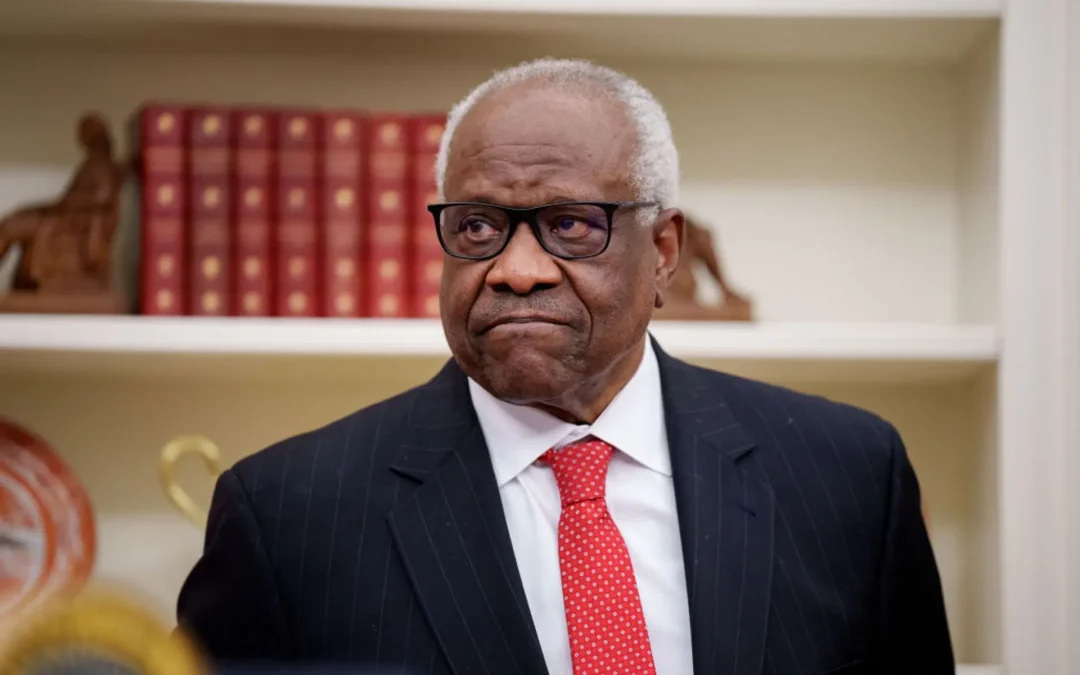
As a seminary student, Clarence Thomas worked especially hard studying Latin. According to him, excelling in the notoriously difficult subject was a way to prove his merit to those who believed, because he was Black, that he was inferior. After abandoning his plans for the priesthood, the future Supreme Court justice employed a similar tack at Yale Law School. When he heard that a professor flunked every Black student, he took his class, sat in the front row, and aced it.
These early accounts of Thomas are shared by Sen. Ted Cruz in “Going Further,” his biography of the jurist, which was published on Aug. 25 and debuted at No. 1 on The New York Times best-seller list for non-fiction. Unlike many third-party histories, the senator had extensive first-hand access to his subject. Thomas gave Cruz over nine hours of one-on-one interviews for the work.
In an interview with SCOTUSblog, Cruz explained that, key to Thomas’ response to racism was using the strongest tool he had: himself. “He’s very driven. He’s very disciplined,” Cruz says. “He wanted to go and do things where he could put in the hard work and excel on his own on the merits.”
Making the pitch
Cruz, 55, visited Thomas’ chambers in early 2025 to pitch his idea of interviewing the justice for a potential biography. The two have known each other since 1996 when the would-be legislator clerked for Thomas’ colleague at the time, Chief Justice William Rehnquist.
Thomas agreed immediately to the proposal. Cruz points to his own background for why Thomas allowed him to do so. In addition to being a former law clerk, much of Cruz’s professional career was as a Supreme Court litigator. He is now a senior member of the Senate Judiciary Committee and has been involved in the confirmation process for many federal judges, including numerous Supreme Court justices.
The 78-year-old justice told Cruz: “If it were a law professor or somebody else asking, I would say no. … You being who you are, I think you can tell this story.”
The book owes its title to Thomas’ belief that the Supreme Court’s highest authority is the text and original meaning of the Constitution. Of the nine justices, Cruz says that Thomas is by far “the most willing to overturn precedent if he believes that precedent was wrong.” In other words, Cruz writes, “Justice Thomas has not hesitated in saying that it is never too late to go back – or, as he has often put it, to go further.”
The book’s objectives
Cruz shares one objective for the project on the book’s back cover. “Someone so extraordinary, you would think, would be venerated,” Cruz writes. “And, if he were politically liberal, he would be.” But instead of honorary law degrees and elementary schools bearing his name, “the response is silence. And hate. It’s time for that silence to end.”
While Cruz laments such unfair treatment, throughout the book he makes the point that Thomas is not particularly bothered by it. Asked about this, Cruz told SCOTUSblog, “He’s a strong man and he knows what he believes. He’s not looking for affirmation from others.” Cruz elaborated by sharing a story of Justice Stephen Breyer asking Thomas if he “wants to go talk to law professors who were expressing derision toward him.” Thomas replied: “Steve, no offense, but why would I give a damn what those people think.”
Cruz’s other purpose is to tell Thomas’ “personal journey,” which he says is “unlike any other Supreme Court justice.”
He traces Thomas’s life from a young boy, growing up in the South in poverty and confronting racism, to becoming a “full-on liberal and left-wing radical” in college, before ending up “one of the most important conservative thinkers who have ever lived.” “There is no area of jurisprudence that Clarence Thomas has had a bigger impact on than race,” Cruz tells SCOTUSblog. “His time as a justice has been a clarion voice for a colorblind Constitution.”
It then comes as no surprise that Cruz has much to say in “Going Further” about Thomas’ concurring opinion in Students for Fair Admissions, Inc. v. President & Fellows of Harvard College, the Supreme Court’s 2023 decision striking down as unconstitutional race-based admissions programs used by Harvard and the University of North Carolina.
While Thomas joined the court’s six-justice-majority, he wrote separately and took the rare step of announcing his concurring opinion from the bench.
Justice Thomas stated: “We cannot be guided by those who would desire less in our Constitution, or by those who would desire more. ‘The Constitution abhors classifications based on race, not only because those classifications can harm favored races or are based on illegitimate motives, but also because every time the government places citizens on racial registers and makes race relevant to the provision of burdens or benefits, it demeans us all.’”
Cruz notes that this passage is from Thomas’ own dissenting opinion in 2003’s Grutter v. Bollinger, where the court upheld the University of Michigan Law School’s use of race as a factor in admissions decisions.
“For generations, when all of us are dead and buried,” Cruz told SCOTUSblog, “you will have students and lawyers and judges reading Clarence Thomas laying out the incredible importance of not discriminating based on race.”
Personal journey
Reflecting on his approach to the law, Cruz writes that Thomas told him, “I’ve thought about jurisprudence and biography. And virtually none of this comes from Yale. Virtually none of it comes from scholars.” Justice Thomas concluded: “It comes from the way you’re raised.”
In August 1955, seven-year-old Clarence Thomas and his brother went to live with their maternal grandparents in Pin Point, Georgia. Their father had abandoned the family shortly after Clarence was born. It had become too difficult for their mother to raise them while trying to keep a full-time job.
The boys moved into their grandparents’ home. While modest, it contained modern comforts that had been lacking in some of their prior accommodations across Georgia, such as indoor plumbing and running water.
Their grandfather, Myers Anderson, was a disciplinarian. School was first and foremost in the boys’ lives. Anderson, who could neither read nor write, was determined that his grandsons get the education he’d been deprived.
A convert to Catholicism, Anderson took the boys out of the public school and enrolled them in one run by the Catholic Church. Clarence would serve as an altar boy.
Anderson stressed self-reliance, refusing to accept government assistance even when he was barely making enough to survive. As he saw it, accepting money from the government was opening the door to allowing it into your home and dictating how you lived.
When they were not in school, Clarence and his brother were working, which included helping their grandfather in his job delivering fuel oil or laboring on the family’s farm located several miles out of town. Playing sports, considered a folly by Anderson, was not permitted. The only acceptable substitute for work was a trip to the library.
Cruz writes that “all conversations about Justice Thomas’s early years, including the extensive ones I conducted with him to write this book, begin and end with Myers Anderson.”
Thomas, who referred to his grandfather as “Daddy,” wrote in his 2007 memoir, “My Grandfather’s Son,” that the man was “determined to mold me in his image. … He was the one hero in my life. What I am is what he made me.”
The influence of the Catholic Church caused Thomas to pursue the priesthood. His grandfather enrolled him in a high-school-level preparatory seminary in Savannah, Georgia. Thomas was one of only two Black students in the school. Cruz writes that his “fellow seminarians had various ways of letting him know he wasn’t welcome,” describing shunning and racial slurs that he faced.
Disappointed that the Catholic Church was not doing enough to address civil rights, and not liking what he was seeing in his fellow seminarians, Thomas began to doubt his decision to become a priest.
Nonetheless, upon graduation in 1967, he entered Immaculate Conception Seminary in Missouri to complete his studies. But his time there would be short-lived. On Apr. 4, 1968, Dr. Martin Luther King, Jr. was assassinated. Thomas witnessed his fellow students celebrating the tragedy. “Then and there,” Cruz writes, “he felt the last of his resolve to join the priesthood drain out of him.”
A few days later, Thomas attended a march in Kansas City in King’s honor. Cruz writes that Thomas would later recall the event as one in which “he felt a connection with people that he’d never felt at the seminary. Finally, he was among like-minded folks who saw the civil rights movement as a righteous cause – one that needed to live on even after the death of its most extraordinary leader.”
Thomas subsequently enrolled at the College of the Holy Cross in Massachusetts. Dressed in military fatigues and combat boots, Cruz writes that he “attended meetings of the Black Student Union almost as often as he attended classes.”
Cruz writes that Thomas found himself with students whose mission was to address inequality by any means necessary. But, in discussing this period in his memoir, Thomas wrote that he had “no desire to burn down the country that had given me a chance.”
Legal career
Upon graduation from Holy Cross, Thomas enrolled at Yale Law School.
In his book, Cruz describes the experience for him as “confusing.” While Thomas was looking for an education in the law, Cruz explains that he was confronted with professors promoting a doctrine known as “legal realism.” Under this theory, laws did not have to mean what their drafters understood them to mean. Instead, laws were malleable and judges were free to change them if they believed it “necessary” to do so.
In search of guidance, Thomas turned to older books about the origins of law and government. Cruz writes that “[w]hat struck him was how different the founders’ world looked from the abstract theories that dominated his classes.”
Cruz adds: “With every book he consumed about the United States and its founders, he became more convinced than ever that his grandfather’s ideas about the world had been correct all along.”
While Thomas “did quite well at Yale Law School,” Cruz told SCOTUSblog that “not a single law firm in the country would hire him. They all turned him down. Law firms said ‘no thank you, we don’t want you here.’” “He discovered that when it is widely known that your admission was in some significant part because of the color of your skin, rather than academic accomplishments, employers did not trust the credential and that you were ready.”
Cruz shares that Thomas took a 15 cent price tag from a box of cigars, stuck it on his Yale degree, and proclaimed “that’s what it’s worth.”
The newly minted lawyer took the only job he could get, going to work for Missouri Attorney General John (“Jack”) Danforth. But despite being desperate for work, Thomas still posed a condition on Danforth, telling him “I have no interest being the token Black man on staff. I don’t want to work on civil rights matters. I just want you to treat me like all the other assistant AGs you have on staff.” Danforth would later be elected to the Senate. Following a foray into corporate law at chemical company Monsanto, Thomas joined his staff in Washington, D.C.
In 1991, after nearly eight years as chairman of the Equal Employment Opportunity Commission and only 18 months as a judge on the U.S. Court of Appeals for the D.C. Circuit, Thomas was nominated to the Supreme Court by President George H.W. Bush. Today, he is less than two years away from being the longest-serving justice.
Cruz delves deep into Thomas’s confirmation hearing and the allegation by former EEOC employee Anita Hill that her then-boss subjected her to conversations about pornographic material. Hill’s charge came after Thomas’s testimony had concluded and resulted in both the accuser and accused famously telling their side of the story in a televised hearing before the Senate Judiciary Committee.
Cruz says he thought back to the Thomas-Hill testimony in 2018 when Supreme Court Justice-nominee Judge Brett Kavanaugh, following the conclusion of his confirmation hearing, was accused of committing a sexual assault in high school. Some of Cruz’s Senate colleagues were ready to ignore the allegations and vote to move Kavanaugh’s nomination out of the Judiciary Committee and onto the full Senate. But Cruz says he objected. He pointed to Anita Hill’s allegations and swayed his colleagues that, before doing so, the American people deserved to hear both parties testify and make up their own minds. Just as three decades earlier, hearings took place.
Plowing a field
Cruz describes Thomas’ “going further” approach to deciding cases using an analogy the jurist shared. While working on the family farm, he learned how to plow a field.
“When you’re plowing a field,” Thomas told Cruz, “it’s very important that the first row you plow be straight. If the first row is crooked, every other row will be crooked as well.”
Look at what the Constitution says, Cruz told SCOTUSblog. “And if the Court got it wrong, that first row is crooked. And all of the rest of the jurisprudence is crooked as well.”
Cruz offers an example. In 2005, in Kelo v. City of New London, the Supreme Court upheld the Connecticut town’s use of eminent domain to purchase Susette Kelo’s home, allowing the land it sat on to be used by Pfizer, Inc. as part of a parking lot for a research campus to be constructed.
At issue was the Fifth Amendment’s “Takings Clause,” which states that “private property” shall not be taken “for public use, without just compensation.”
Writing for the five-justice-majority, Justice John Paul Stevens stated that the decision turned on whether “the City’s development plan serves a public purpose.” It did, the majority concluded, pointing to economic benefits to the community, including new jobs and increased tax revenue.
Thomas joined Justice Sandra Day O’Connor’s dissent but also wrote separately to elaborate on the majority’s flawed focus on a “public purpose” to evaluate the permissibility of eminent domain, a term that is broader than “public use,” which is the phrase contained in the Constitution.
Thomas argued that the Supreme Court’s long-ago adoption of a “public purpose” standard in eminent domain cases was done “blindly, with little discussion of the Clause’s history and original meaning.” He then proceeded to fill in this oversight, including examining the framers’ understanding of eminent domain and drawing support for a narrow reading of “public use” based on the meaning of the word “use” as it appears in two other clauses in the Constitution.
Thomas concluded that “the Public Use Clause, originally understood, is a meaningful limit on the government’s eminent domain power” and the court should return to its “original meaning…: the government may take property only if it actually uses or gives the public a legal right to use the property.”
Following the Supreme Court’s decision, Kelo was forced to sell her land but she saved her home by moving it piece-by-piece to a new location. The planned development never came about.
Cruz told SCOTUSblog that “the reasoning in Justice Thomas’ dissent I think has prevailed in the national discourse. Many states, including my home state of Texas, have passed laws requiring that eminent domain be used only for a public use.” But Cruz says in “Going Further” that this was not his objective: “Justice Thomas does not write opinions – particularly dissents – because he believes he is shifting the direction of American law. … He simply says what he believes is true, steps back, and moves on to the next case.”
Samuel Alito was a Yale student a year behind Thomas, but they did not know each other. Years later, Thomas asked Alito why they weren’t friends. “Clarence, you were scary,” was his reply. Thomas, who says he wore bib overalls and combat boots in law school, objected to being called scary, but conceded that he didn’t suffer fools lightly.
“That’s the throughline of Clarence Thomas,” Cruz told SCOTUSblog after recounting this story. “Even as he is learning what he believes, he has that foundation that he had from his upbringing, from his grandfather.”
Recent Comments