
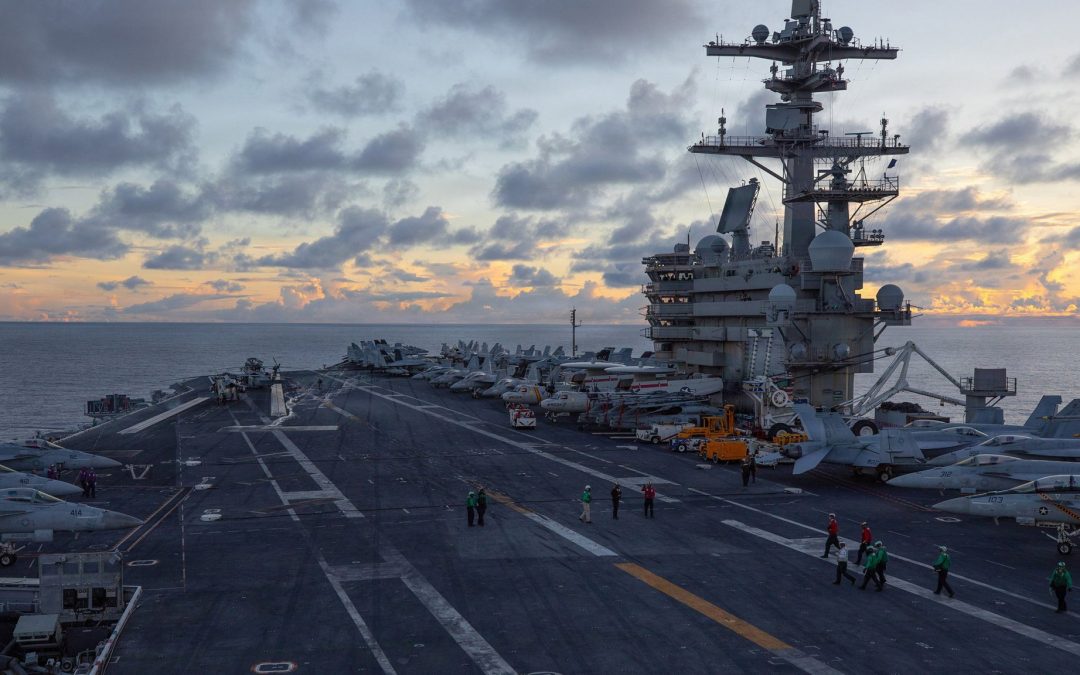
The USS George H.W. Bush arrived in Phuket, Thailand on Sunday after quietly leaving the Middle East, where the ship and its crew spent several months supporting the war with Iran.
On Sunday, the Navy’s 7th Fleet announced that the Nimitz-class aircraft carrier the USS George H.W. Bush, as well as the Arleigh Burke-class guided-missile destroyer USS Delbert D. Black, had made a scheduled port visit to Phuket.
“Our crew has performed exceptionally while underway, demonstrating discipline, resilience, and unity,” Capt. Justin T. Issler, the carrier’s commanding officer, said in a statement from the Navy. “This port visit provides a well-earned opportunity for our sailors to rest while reflecting on the professionalism they bring to every mission. We are honored to experience Thailand’s rich culture, engage with the local community, and strengthen our enduring relationship with our Thai maritime partners.”
The USS George H.W. quietly left the Middle East, with neither U.S. Central Command nor the Navy’s 5th Fleet giving any indication that the carrier and its supporting ships were sailing out of the region. On Sept. 30, CENTCOM posted a photo to social media showing the carrier in the Arabian Sea, although it is unclear when the photo was taken. Last week, local Thai media reported that the carrier would be visiting the country, citing police who had met with officials from the U.S. embassy in the country.
Today’s arrival in Thailand is the first port visit for the carrier. It is not immediately clear where the rest of the carrier strike group — whose composition had changed but according to the 7th Fleet currently includes the destroyers USS Mason, USS Ross and USS Donald Cook — will stop at Phuket.
The ship is the second American aircraft carrier to make a stop in Thailand. The USS Abraham Lincoln visited the country in early September, its first port call since 2025. The 7th Fleet did not say how long the port call will last, although Thai media said that the visit is expected to last through Oct. 9.
The USS George H.W. Bush left its home port at Norfolk, Virginia on March 31, sent to the Middle East to join the rest of a large naval force already engaged with Iran. After direct fighting paused in April following a brief ceasefire, the ship and its carrier strike group supported a blockade in the Strait of Hormuz. After fighting restarted in July, the ship has been part of the naval presence in the Arabian Sea supporting U.S. operations.
The carrier left the region after Iran and the United States traded attacks. Iranian missiles and drones targeted American bases in Jordan, as well as at least one aircraft carrier in the Arabian Sea. Nine Marines and 29 sailors were wounded in action in September, according to the Department of Defense’s casualty database.
The George H.W. Bush was the third carrier sent to support the war effort and is now the third to leave. The USS Gerald R. Ford and USS Abraham Lincoln saw extended tours at sea. The former left Europe to support operations against Venezuela last year, before being shifted to the Middle East. The Lincoln spent months at sea without a port call, leading to reports of poor conditions, deteriorating morale and suicide attempts. The Navy confirmed last month that eight service members in the USS Abraham Lincoln’s carrier strike group attempted suicide. It is unclear if the USS George H.W. Bush is on its way back to the United States or will stay in the Pacific.
That leaves just the USS George Washington in the Middle East. The USS Theodore Roosevelt is on its way but won’t arrive in the immediate next few days. The Makin Island Amphibious Ready Group, carrying sailors and Marines from the 13th Marine Expeditionary Unit, also deployed from San Diego last week. It’s unclear how long the Washington will remain once the Roosevelt arrives.
The post USS George HW Bush stops in Thailand after leaving the Middle East appeared first on Task & Purpose.
Recent Comments