
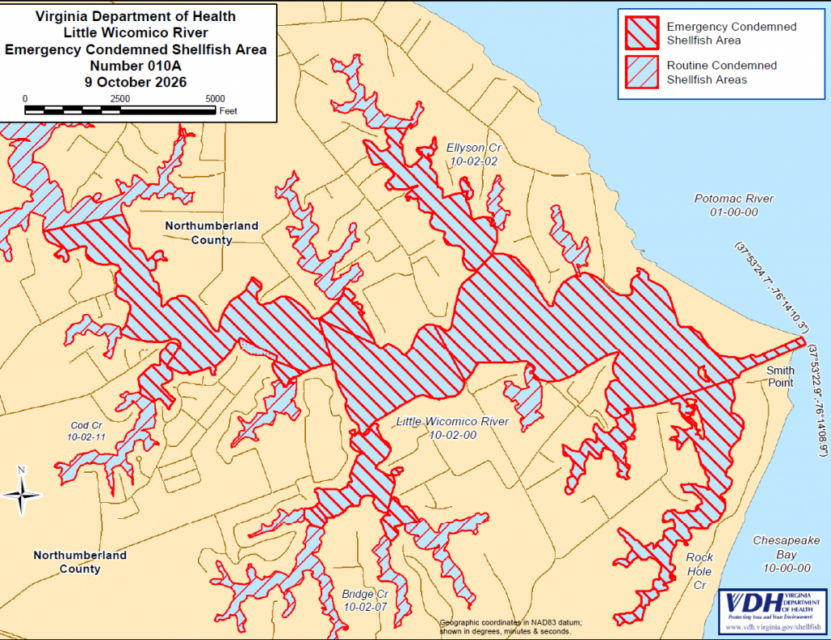
Effective October 9, out of an abundance of caution and in conformance with recommendations from the U.S. Food and Drug Administration (FDA), the Virginia Department of Health (VDH) closed the waters of the Little Wicomico River in Northumberland County to the harvesting of oysters and clams due to a link to a Salmonella outbreak in Pennsylvania.
According to VDH, the agency was recently notified of a Salmonella outbreak in Pennsylvania that has been epidemiologically linked to shellfish harvested from this area. VDH is currently testing shellfish in the implicated area. The Pennsylvania outbreak has sickened at least five people so far, according to WRIC ABC 8News.
The temporary emergency closure is effective October 9 through November 7. The affected shellfish are bivalve mollusks, including oysters and clams, but not crabs or finfish. VDH stated that the closure has no impact on drinking water. More information on shellfish closures is available on the VDH Division of Shellfish Safetywebpage.
The Little Wicomico closure is not the only one in the area. Hoodline reported that VDH issued a second emergency shellfish closure the same day, temporarily barring harvesting in portions of Lower Machodoc Creek in nearby Westmoreland County through October 29. VDH has not publicly tied that closure to the Pennsylvania outbreak.
Not yet public: the restaurants, retailers, and distributors that received shellfish from the implicated waters, the Salmonella serotype involved, and whether any product has been recalled.
This is the second time in less than a year that raw oysters and Pennsylvania have been at the center of a Salmonella outbreak. In December 2025, the CDC reported a Salmonella Telelkebir outbreak linked to raw oysters that sickened 64 people in 22 states, with Pennsylvania reporting the most cases (10). Twenty people were hospitalized, according to WPXI.
Raw oysters and clams can be contaminated at any time of year. Cooking them thoroughly reduces the risk of illness; hot sauce and lemon juice do not kill bacteria. Anyone who ate oysters or clams harvested from the Little Wicomico River and developed symptoms of a Salmonella infection should contact a health care provider and mention the possible exposure.
Symptoms of Salmonella infection typically begin 6 hours to 6 days after exposure and include diarrhea, fever, and stomach cramps. Most people recover within four to seven days, but young children, older adults, and people with weakened immune systems are at greater risk of severe illness requiring hospitalization.
Salmonella: Marler Clark, The Food Safety Law Firm, is the nation’s leading law firm representing victims of Salmonella outbreaks. The Marler Clark Salmonella lawyers have represented thousands of victims of Salmonella and other foodborne illness outbreaks and have recovered over $900 million for clients. Marler Clark is the only law firm in the nation with a practice focused exclusively on foodborne illness litigation. Our Salmonella lawyers have litigated Salmonella cases stemming from outbreaks traced to a variety of foods, such as cantaloupe, tomatoes, ground turkey, salami, sprouts, cereal, peanut butter, and food served in restaurants. The law firm has brought Salmonella lawsuits against such companies as Cadbury, Chi-Chi’s, Cozy Vale, ConAgra, Jimmy John’s, Peanut Corporation of America, Sheetz, Taco Bell, Subway and Wal-Mart.
If you or a family member became ill with Salmonella or Reactive Arthritis after consuming food and you’re interested in pursuing a legal claim, contact the Marler Clark Salmonella attorneys for a free case evaluation.
Recent Comments