
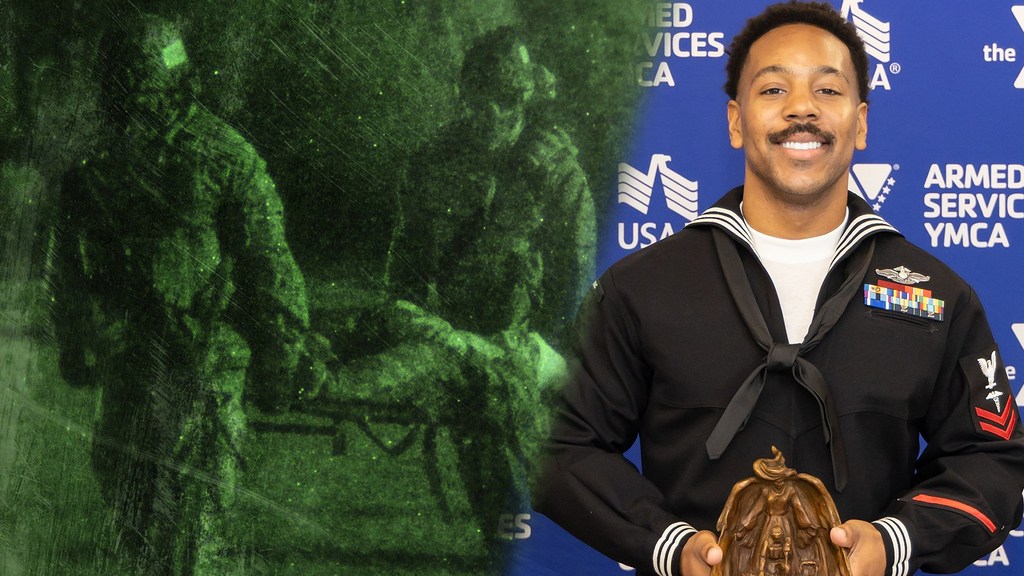
A Navy corpsman with Marine special operations forces was recognized with a battlefield medic award for saving the lives of French soldiers injured in a drone attack during the first month of the Iran war.
“It was just a surreal moment … You train and you practice for real-world scenarios like this. However, every corpsman doesn’t get the opportunity or will not have that experience to actually be in a moment like that, or to even provide real-world care to that extent,” Petty Officer 2nd Class Jajuan Hernandez told Task & Purpose. “No matter the extent, the environment, whatever is going on, or how you may be feeling personally, we’re trained to just put ourselves in danger in any situation to save the lives of others.”
Earlier this month, Hernandez received the Marine Corps’ 2026 Angels of the Battlefield Award for his medical care of French soldiers injured in a drone attack while he was deployed with the Marine Corps 2nd Raider Battalion. His award was presented by acting Surgeon General of the Navy, Rear Adm. Matthew Case.
In a video recording of the October award ceremony in Washington, D.C., Case said Hernandez was supporting Operation Epic Fury when “an enemy one-way unmanned aerial vehicle detonated about 25 meters from his position,” on March 12.
“He ran to the fire. He did not hesitate. He moved directly into a burning berthing area amidst secondary ammunition explosions. He located, extricated, and triaged seven critically wounded French coalition soldiers,” Case said.
Marine Corps officials did not say the country that Hernandez was deployed to during the attack, but confirmed that he was deployed in support of Operation Inherent Resolve.
However, French President Emmanuel Macron announced in a March 12 post on X that an Iranian drone attack near Erbil, Iraq killed a French officer and injured several more. The French military confirmed that six soldiers were injured.
Earlier that week, pro-Iranian Iraqi group, Ashab Alkahf, reportedly warned that French assets in the region would be targeted after the country sent an aircraft carrier to U.S. Central Command’s area of operations.
Aspirant Clémence, a spokesperson with France’s Office of the Chief of the Defence, told Task & Purpose that the unit was deployed to Erbil in northern Iraq for counterterrorism training with several Iraqi military units. The French troops were also there as part of Operation Inherent Resolve — the U.S. military-led international coalition’s fight against the Islamic State. In September, the U.S. formally announced the end of that mission in Iraq and the departure of most American personnel and resources from Erbil Air Base.
‘I was the only U.S. medic and corpsman at the location’
Hernandez said he was the “only medic in the vicinity” when the drone struck their base on March 12. He recounted those first few minutes after the attack to Task & Purpose. It was nighttime, and he was on his computer when he got a notification to take cover. The alert was not an alarm, but “just a yell out, ‘hey, bunkers’ — something like that,” he said.
“When I made it to the door, I heard just like an intense buzzing noise, and before I could walk out of the door, I just saw a big explosion that was about 25 meters away,” he said.
He ran to his living quarters, grabbed his weapon and medical equipment and headed to the bunker. He watched other personnel head inside while he stayed outside, expecting to be called on to help.
“I was the only U.S. medic and corpsman at the location, and if there were any potential casualties, my name was going to get called,” he said.
When that call did come, Hernandez ran through the field and made his way to the area of the drone attack. He spotted seven soldiers lying on the ground and began triaging: sorting injuries from most to least urgent.
“It was just sort of a shock, but it was nothing that scared me or made me hesitant,” he said.
He got to work and directed a handful of Marines to grab equipment and help him treat less critically injured patients with IVs and bandages. Hernandez credited the Marine Raiders in his unit who used their “extensive level of medical knowledge” to provide aid, adding, “I wouldn’t have been able to do all of the things that were done that night.”
One of the first things Hernandez did was start running IVs to get the soldiers fluids before any of them went into shock. Then he began applying chest seals to shrapnel injuries and tourniquets to keep them from bleeding out. He and his impromptu medical team of Marines draped blankets over them to prevent hypothermia.
Hernandez personally provided “life-saving trauma interventions,” Case said, like administering whole blood “via the bone,” and doing a needle decompression and blunt thoracostomy, which includes making a chest incision to relieve air pressure on the heart and blood vessels.
To make an already dire and complex situation more challenging, Hernandez had to navigate language barriers.
“If something needs to be done or I need a piece of equipment and I can’t verbally say that and that be understood, there needs to be some form of communication,” he said. “Whether you’re pointing or whether you’re grabbing another piece of equipment that’s similar, so they understand — all of that is like a form of communication.”
Case credited Hernandez’s “swift actions” and skillful medical care with “directly” saving the lives of six coalition partners, who were subsequently evacuated to nearby hospitals.
And in his remarks, Case noted that Hernandez’s actions were crucial for a deployment that was “devoid of higher levels of care.”
Hernandez echoed the same, saying that the situation really highlighted the military’s push for prolonged combat casualty care, where medical personnel have to expect to do more life-saving care in the field if medical evacuations are dangerous or nearly impossible.
“A medevac may not always be there. You may not always be able to transport this patient immediately,” he said.
“It was a real [mass casualty] scenario.”
The post Navy corpsman with Marine Raiders ran into burning building to save French soldiers after Iranian attack appeared first on Task & Purpose.
Recent Comments