
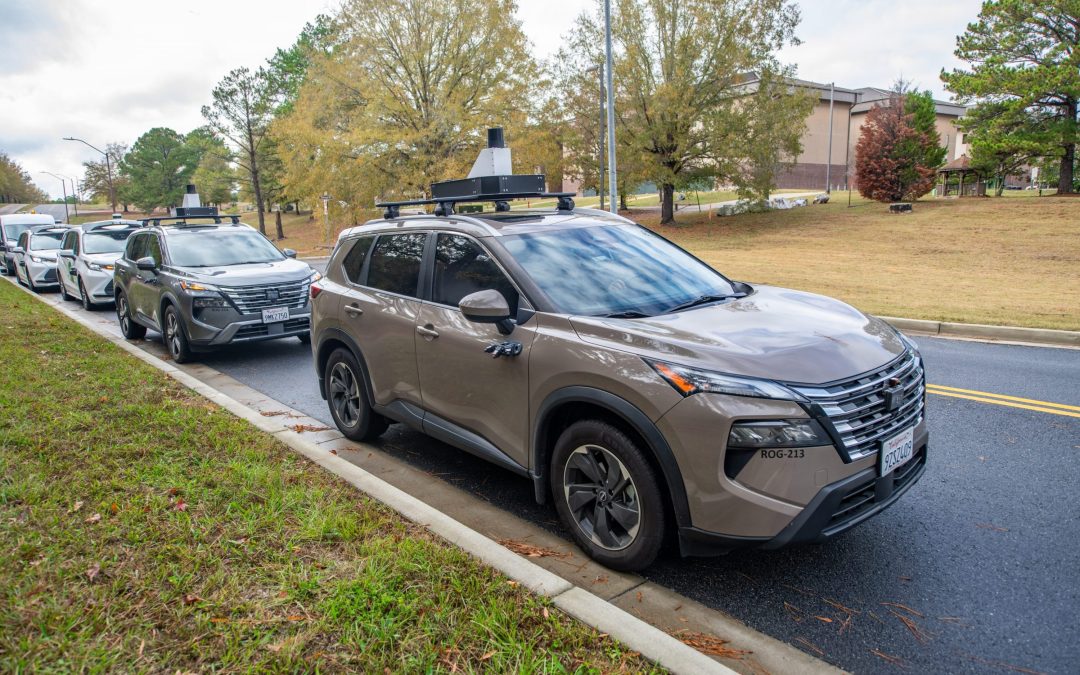
The Army is looking to join the world of Waymo and Tesla Robotaxi, and take soldiers across base by self-driving car instead of having their peers shuttle them around to field exercises or other official duty events.
Officials at Fort Benning, Georgia, began testing several autonomous cars and vans as part of a pilot and larger Department of Defense effort to replace the military’s fleet of non-tactical vehicles used to move heavy supplies for field exercises, or transport troops for training or official ceremonies.
“Every day, thousands of initial-entry trainees, permanent-party cadre, and tenant unit soldiers move across Fort Benning’s expansive ranges, cantonment areas, and support facilities,” Charles Auer, head of the autonomous vehicle pilot at the Georgia base, said in a recent Army news release.
In May, the Army and the Defense Innovation Unit launched the Robotic Operation for Autonomous Delivery and Sustainment challenge, offering commercial companies up to $30 million in prizes to pitch autonomous options as replacements for the Defense Department’s fleet of more than 150,000 “non-tactical” vehicles like sedans, SUVs, trucks and vans. According to the innovation unit, the goal is to reduce the demand on military personnel (some of whom drive trucks as an assigned duty) and lower transportation costs.
“We want vehicles that let our soldiers operate more safely, more efficiently, and over time, give them more time to focus on core soldier activities other than driving water and MREs around post,” said Alex Miller, Chief Technology Officer for the Army Chief of Staff.
Top Stories This Week
The innovation unit announced that five companies would move on to the next stage of fielding and testing their vehicles and self-driving systems at Fort Benning and Fort Hood, Texas. Those companies include: Applied Intuition, Forterra/May Mobility, Perrone Robotics, Overland AI/Gatik and Bot Auto.
According to Fort Benning officials, their pilot will have several phases. For the first few weeks, humans will drive cars around base to collect data and video to build out the maps and GPS that fuel the self-driving system’s architecture. Officials noted that driving routes will “explicitly exclude” sensitive facilities like the base airfield, ammunition supply points, and tactical compounds.
Following this so-called “mapping phase,” the companies will run self-driving development and safety tests through the end of 2026.
“Safety remains the overriding priority throughout this pilot,” Auer said. “Before we transition to completely driverless operations, each vehicle will undergo rigorous testing with a safety driver on board.”
Autonomous, self-driving cars are the latest effort to modernize the military’s set of non-tactical vehicles. In 2021, President Biden signed an executive order to replace all federal government vehicles with zero-emission cars, vans and trucks over the next decade. In 2022, the Army released its own climate strategy, which noted that the service had already replaced 18,000 fuel-powered non-tactical vehicles with electric or hybrid versions.
For the Fort Benning pilot, officials said they plan to bring in four electric and two hybrid vehicles from three of the five private companies.
Forterra, which was chosen for tests at Fort Benning, said in a release that their technology includes a command and control system that gives commanders a live map and dashboard of every vehicle and the ability to adjust parameters and requirements specific to the base. The plan, according to the company, is for soldiers to be able to request a car through a rideshare app.
According to Forterra, the company has already fielded more than 250 autonomous systems for Defense Department programs, including robotaxis for soldiers at Womack Army Medical Center at Fort Bragg, North Carolina. The company also says it was one of the first American companies to deploy ground autonomous systems in Ukraine and has helped with dozens of casualty evacuation missions in the war.
The post The Army is testing self-driving vehicles at bases in Georgia and Texas appeared first on Task & Purpose.
Recent Comments