
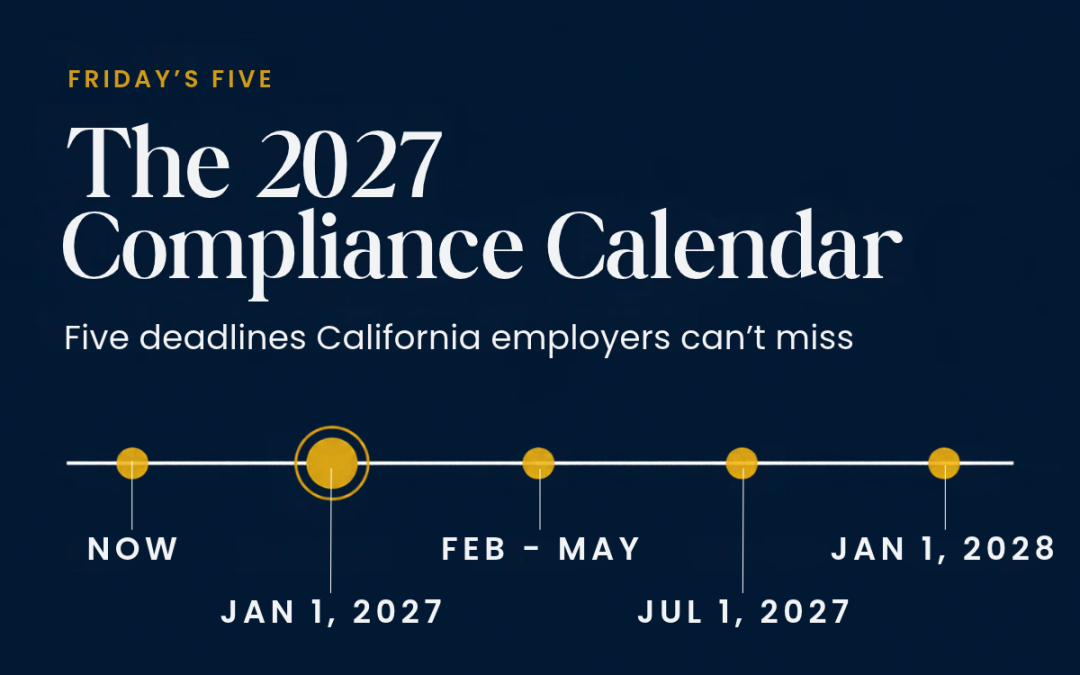
At our Employers Summit this week, we closed the legislative update with a single slide: the 2027 compliance calendar. In October, I walked through which bills Governor Newsom signed and which two he vetoed. This week is about timing — what has to be done, and by when.
The short version: most of the work lands before January 1, which is about six weeks away with two holiday weeks in between. The automated decision system rules give you until July 1, 2027, and the new harassment training component waits until 2028. Here is the calendar, deadline by deadline.
1. Now: Finish the stay-or-pay review.
One bill that took effect on signature as urgency measures belong at the top of the list.
- Stay-or-pay agreements (AB 1697). Last year’s ban on requiring workers to repay money when employment ends (AB 692, codified at Business and Professions Code § 16608 and Labor Code § 926) now applies to contracts entered into on or after January 1, 2027. AB 1697 also added exceptions, including grant-funded recruitment and retention bonus programs and repayment of advanced PTO on voluntary separation. If you use training repayment agreements, sign-on bonus clawbacks, or advanced-PTO repayment terms, review the templates now, so that anything signed after January 1 fits an exception or comes out. Keep in mind that agreements signed before then are still subject to existing law, including the expense reimbursement rule in Labor Code § 2802.
2. By January 1, 2027: Pay rates, handbook updates, manager training, and two vendor checks.
This is the heaviest deadline on the calendar. Break it into four workstreams.
- Pay. The statewide minimum wage rises to $17.40 per hour for all employers, regardless of size. The minimum salary for most exempt employees rises to $72,384 per year ($6,032 per month), up from $70,304. The salary test is unforgiving: an exempt employee paid below the threshold in any pay period loses the exemption for that period. Check local minimum wage ordinances as well, since you must pay the highest applicable rate, and confirm that exempt computer professionals meet that exemption’s separately adjusted threshold.
- Fast food: The $20.00 minimum wage under AB 1228 for limited-service chains with 60 or more establishments nationally is unchanged for 2027. The Fast Food Council has not had a chair since spring 2025 and cannot meet without one, so no increase has been voted on. Budget at $20 for 2027 (and $83,200 for exempt fast-food managers), but watch for a chair appointment under the new governor, which would restart the council.
- Handbook. Four policies need updating:
- Bereavement leave for a “designated person” (SB 1149). Employers may limit employees to one designated person per 12-month period.
- Anti-retaliation language that specifically addresses immigration-related comments, questions, and threats (AB 2495, amending Labor Code § 1019), with liability of up to $10,000 per employee or person for each violation.
- Surveillance and device policies that exclude workplace bathrooms (AB 1331).
- Dress code, grooming, and uniform rules that differ by gender, which deserve a fresh look now that AB 2563 defines sex discrimination to include conformity to sex or gender stereotypes.
- Manager training. Train managers and anyone involved in hiring or I-9 verification on immigration-related conduct under AB 2495. Train site leaders on Cal/OSHA inspection response: willfully interfering with an inspector is now a misdemeanor under AB 2321, and the right first call is to counsel, not a refusal at the door. Under AB 2150, employers that require CPR certification must also require an approved naloxone training module, at the employer’s expense.
- Vendors and operations. Update the terms on your online reservation platform to reference the new restaurant reservation anti-piracy law (AB 1640), and train hosts to document suspected resales. Ask your camera-analytics and call-monitoring vendors whether any feature reads “sentiment,” “engagement,” or emotional state. If it does, turn it off for employees under AB 1883. (I covered AB 1883 in detail in October.)
3. February 1 and May 12, 2027: The annual notice and the expanded pay data report.
Two filing-style deadlines follow in the first half of the year.
- February 1: Workplace Know Your Rights notice (SB 294). This is the law’s second year, and the notice is annual. Every current employee must receive it by February 1, and new hires receive it at hire. The Labor Commissioner posts an updated template each year, so do not simply resend last year’s version. Watch for the 2027 template, distribute it through your usual employee communication channels, and keep a record of who received it and when. It pairs naturally with the AB 2495 training in Item 2.
- May 12: California pay data report. Employers with 100 or more employees, or 100 or more workers hired through labor contractors, must now report across 23 job categories, up from 10. Under SB 1237, the penalty for a second or later failure to file rises to up to $1,000 per employee — five times the prior $200 maximum. The first-miss penalty stays at up to $100 per employee. The hard part is mapping your job titles to the new categories, so start that in the first quarter, not in May.
4. By July 1, 2027: Automated decision systems and local wage increases.
- The No Robo Bosses Act (SB 947). Starting July 1, 2027, an employer that relies primarily on an automated decision system to discipline or terminate must have a human corroborate the decision, give the employee written notice, and provide the employee’s data on request. The work is the same as I described in my No Robo Bosses Act article: inventory every tool that scores or flags employees (attendance-point systems that generate write-ups, scheduling software that flags “unreliable” workers, camera analytics), and build a documented human review step before any of those outputs becomes discipline.
- Local wage increases. A number of California cities and counties adjust their local minimum wages on July 1 rather than January 1. If you operate in more than one jurisdiction, calendar both dates and budget for a midyear increase.
5. January 1, 2028 — and what could change the calendar before then.
- Anti-hate speech training (AB 1803). Starting January 1, 2028, the required harassment prevention training must include a component on recognizing, reporting, and responding to hate speech in the workplace. Training hours do not change. Confirm that your training vendor will have the updated module ready.
Three developments could add to this calendar in 2027:
- Leeper v. Shipt, Inc. The California Supreme Court heard argument on November 3 on whether a plaintiff can plead only “headless,” non-individual PAGA claims to avoid arbitration. A decision is expected by about early February. Keep your arbitration agreements current while the ruling is pending (see my October article on updating your arbitration agreement before January 1).
- Camp v. Home Depot U.S.A., Inc. The court is still considering whether neutral time rounding is lawful when the system already records exact minutes. Don’t wait for the answer: pay to the minute now.
- A new governor and Legislature. Bills that were vetoed or died this year are likely to come back in the 2027 session.
Recent Comments