
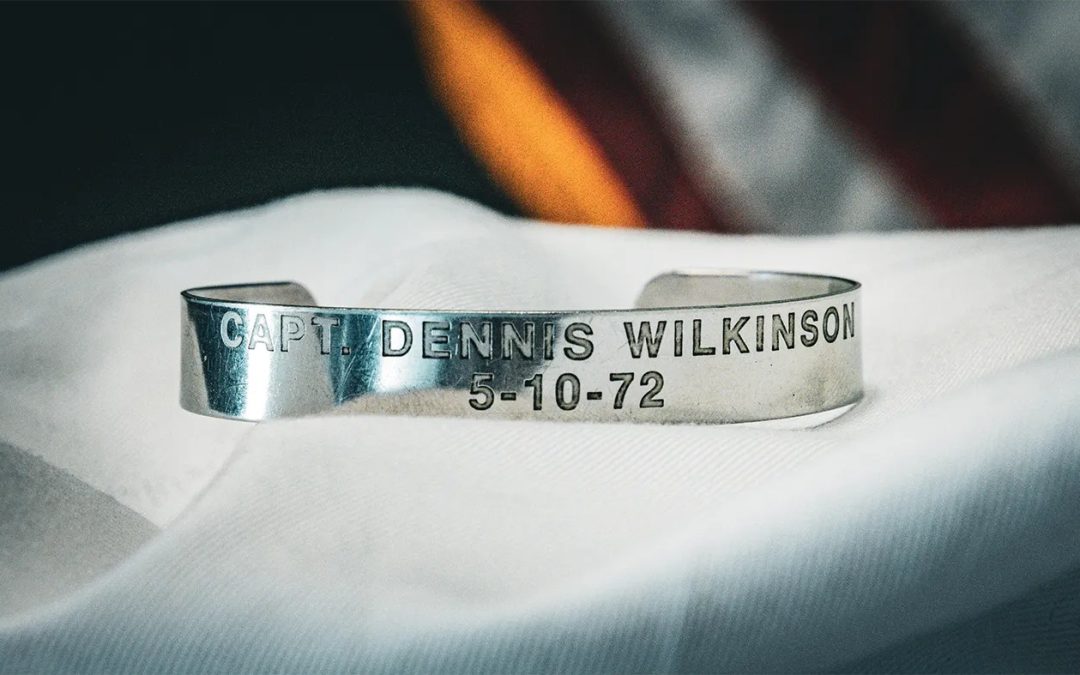
A Vietnam Veteran’s years-long effort returned a POW/MIA bracelet to the son of a fallen Air Force captain
On Sept. 11, 2026, the West Palm Beach VA Healthcare System received an unexpected package in the mail containing a silver bracelet engraved with the name “Dennis Wilkinson” and the date “5-10-72.”
That package arrived exactly 48 years after investigators identified the remains of U.S. Air Force Capt. Dennis Wilkinson, bringing a piece of his story back to where it began.
Wilkinson was born in West Palm Beach, Florida, on July 23, 1944. He married another West Palm Beach native, and they had two children. Wilkinson, who learned to fly during college at the University of Florida, later joined the Air Force from his hometown. He served in Vietnam with the 13th Tactical Fighter Squadron.

On May 10, 1972, he was the weapon systems officer aboard an F-4E Phantom II on a combat mission over North Vietnam when enemy fire hit the aircraft. It crashed in Vinh Phu Province.
His remains couldn’t be recovered at the time and he was declared missing in action. Officials initially believed he might have survived and been held as a Prisoner of War. When American prisoners were released in February 1973, Wilkinson wasn’t among them, and none of the released prisoners had information about him.
In 1978, the Vietnamese government repatriated remains from the war, and on Sept. 11 of that year, U.S. investigators identified Wilkonson’s remains.
Today, Wilkinson is memorialized at the Courts of the Missing at the National Memorial Cemetery of the Pacific. His name, along with those of fallen comrades, is inscribed on the Vietnam Veterans Memorial Wall in Washington, D.C.
A bracelet kept, not forgotten
For years, Wilkinson’s silver bracelet sat in the care of Mark Kramer, an Army Vietnam Veteran and former American Legion post commander in Green Lake, Wisconsin.
Kramer no longer remembers how it arrived at the Legion post he commanded. What he does remember is deciding that it couldn’t simply be discarded or forgotten.
He tried to locate the family, reaching out through military and Veterans organizations and making contacts as far away as Florida. But none turned up a match or lead.
Only recently did Kramer decide to mail the bracelet to West Palm, hoping someone at the VAMC would have better luck finding Wilkinson’s family.
Outreach
After receiving the bracelet, West Palm Beach VA Healthcare System staff from the Privacy, Chaplain and Communications offices got to work. They reviewed records, made phone calls, mailed letters and coordinated outreach until they finally connected with Douglas Wilkinson.
Douglas was very young when he lost his father. Much of what he came to know about him was preserved through photographs and family stories. Those stories describe a man who loved his family, the outdoors and finding adventure. Like the time his parents’ unreliable Dodge Dart broke, so he bought his mother a Pontiac LeMans for Valentine’s Day in 1969.
“That car’s part of the family,” Douglas said. “I got that car from my mom when I was 15 and I still have it.”
As Douglas grew up, others, including his grandfather and uncle, helped fill in his understanding of who his father had been.
“He became that surrogate figure,” Douglas said of his grandfather. “He was basically my granddad and dad.”
Douglas’s uncle recalled a supportive big brother who kept him out of trouble.

Military service was also deeply embedded in the Wilkinson family. One grandfather was an Army Air Corps bomber pilot, the other a Navy submariner, and his mother worked as a civilian for the Department of Defense. Douglas grew up near Eglin Air Force Base, where even his childhood soccer coach had been a military aviator. Douglas eventually served as well.
A piece of his father returns
For Douglas, knowing that someone had carried his father’s name gave the returned bracelet a different meaning.
“There’s some strength in community for other people remembering,” he said.
That sense of community became even more significant when he learned that the man who preserved the bracelet was a Vietnam Veteran.
“He took the time and effort and energy not only to hang on to this, but, as information and technology changed over time, to keep trying to track down where it needed to go,” Douglas said. “It causes you to rethink all of those things and pulls all those memories back to the forefront. You get so caught up in the day-to-day stuff that you forget about some of the things that are important.”
Now, Douglas thinks about how his own children will remember the grandfather they never knew. While living near Washington, D.C., he used to take them to Arlington National Cemetery and other memorial sites twice a year: the anniversary of his father’s loss and his birthday.
The bracelet’s return made him think about gathering his family again, perhaps during Thanksgiving, to share stories and make more memories together.
“Life is about the connections we make,” he said. “And there is a real concern that our memories will fade.”
That philosophy shapes how Douglas approaches his own relationships. He describes himself as the person who makes the call, buys the concert tickets and finds reasons to bring old friends together. Just like how the bracelet brought a piece of his father’s story back into the present.
A tradition forged in legacy

The bracelet’s return to the Wilkinson family is part of a larger tradition of remembrance.
POW/MIA bracelets became one of the most recognizable ways Americans honored prisoners of war and service members missing in action during the Vietnam War. Each bracelet connected its wearer to an individual service member, carrying that person’s name beyond their family and military unit and into communities across the country.
For Douglas, that idea remains important decades later.
He hopes people who learn his father’s story remember that the names engraved on memorials and bracelets belonged to real people who made difficult choices in service to others.
“They’re good people, and they do things that are hard,” he said. “As long as there are people willing to stand up and protect the things that are important to them, I think we still have a pretty bright future.”
More than five decades after Dennis Wilkinson’s final mission, the bracelet bearing his name had completed a journey of its own, from an unknown wearer to the hands of another Vietnam Veteran in Wisconsin, and finally back to his son in West Palm Beach.
VA offers benefits to eligible former prisoners of war and their family members. Learn more about eligibility and services at Benefits for former prisoners of war.
Recent Comments