
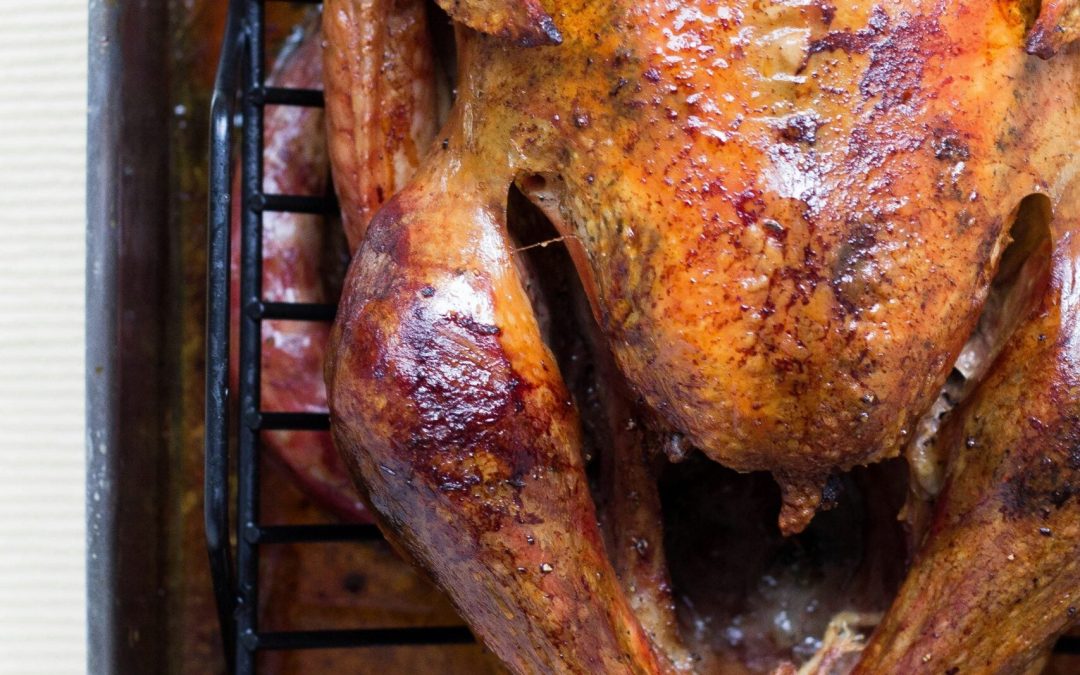
Every Thanksgiving, millions of American home cooks face the same engineering crisis. The dark meat needs more time. The breast meat wants out of the oven now. Somewhere between the two, a perfectly good bird turns into a cautionary tale and a gravy-delivery system.
As it turns out, someone patented a fix.
U.S. Patent No. 9,155,422, “Turkey Flipper and Method for Making and Using,” issued on October 13, 2015, to inventor Susan M. Wohld. Yes, a patent on flipping a turkey. It sounds like a trivia question to break out between slices of pie. But the patent carries a lesson worth more than the wishbone: great inventions often start with a problem everyone else has simply learned to live with.
The Problem: One Bird, Two Schedules
Anyone who has hosted Thanksgiving knows this problem personally. A turkey is not uniform. Different parts of the bird cook on different timelines. The patent also surveys the usual workarounds: brining, basting, deep frying, and rotisserie cooking. Each method has loyal fans. Deep frying also has a loyal following at the local fire department.
The patent points to a popular fix. Roast the bird breast side down, then flip it breast side up for the home stretch so the skin turns brown and crisp. Simple, right? Not quite. The patent itself notes that turkeys are “large and slippery.” Nature, apparently, did not design them with Thanksgiving in mind. Add an extremely hot bird and an extremely hot roasting pan, and you begin to see the problem. Flipping a turkey, in the patent’s own words, “can be dangerous.” Personal injury attorneys, take note!
Now picture the scene. Your mother-in-law stands in the kitchen doorway, arms folded, silently grading your technique. She has roasted forty turkeys and has never once dropped one. Then your Uncle Eddy wanders in, three eggnogs deep, and announces, “I got this.”
He does not got this.
Thirty seconds later, the turkey is on the floor, the dog is having the best Thanksgiving of his life, and your mother-in-law has a new story to tell for the next fifteen years.
The inventor took a different route and reached for engineering.
The Solution: A Turkey Exoskeleton (Sort Of)
The patented apparatus includes a breast rack shaped for the breast side of the bird and a back rack shaped for the other side. Handles and attachment mechanisms let the cook connect the racks in different positions. In plain English, the device secures a large bird and lets the cook reposition the bird mid-roast. No more wrestling a scalding, slippery turkey with two forks, a spatula, and a prayer. No more trusting Uncle Eddy with the hard part. And no more giving your mother-in-law fresh material.
Nobody will mistake this for headline technology. No artificial intelligence. No quantum computing. No self-driving turkey. Just a smarter answer to a familiar headache. And that is exactly what makes the Turkey Flipper such a good example of how invention really works.
Invention Starts with Mild Annoyance
People tend to picture patents as lightning-bolt breakthroughs. Real invention usually begins with something far less cinematic: a mutter over a hot oven. “There has to be a better way to do this.” That mutter shows up everywhere. A product feels awkward to use. A manufacturing step drags on too long. A part fails more often than it should. Two components refuse to play nicely together. Or, in this case, a scalding, slippery bird needs a flip halfway through dinner.
Those everyday frustrations make fertile ground for invention. The key question is not how impressive the problem sounds. The key question is what the inventor did differently to solve it.
The Patent-Drafting Lesson (Pass the Stuffing)
The Turkey Flipper also offers a lesson for anyone preparing a patent application.
A patent attorney’s first question should not just be “What did you build?” The better question is
“What problem were you actually trying to solve?”
That difference matters more than most people expect.
A disclosure that focuses only on the inventor’s current product risks becoming a loving portrait of one particular version. The claims then tend to drift toward the exact collection of parts in the prototype, down to the last screw.
Understanding the problem lets everyone take a step back from the roasting pan.
Here, the bigger story is not simply that someone designed a particular cooking rack. The patent describes an apparatus that secures a large piece of food and lets the cook reposition the food during cooking. With the problem and the solution in hand, good drafting asks a new question: what else would accomplish the same goal?
So, this Thanksgiving, let the Turkey Flipper serve up a surprisingly useful patent lesson alongside the cranberry sauce. Pay attention to the problems people have learned to tolerate. When evaluating an invention, understand the problem before fixating on the product. And when drafting the application, protect the inventive solution, not just the particular gadget sitting on the inventor’s workbench.
Because the next time you find yourself wrestling a Thanksgiving turkey and muttering, “There has to be a better way to do this,” pay attention.
Someone else had that exact thought. And that someone got a patent.
Happy Thanksgiving. Gobble responsibly.
Recent Comments