
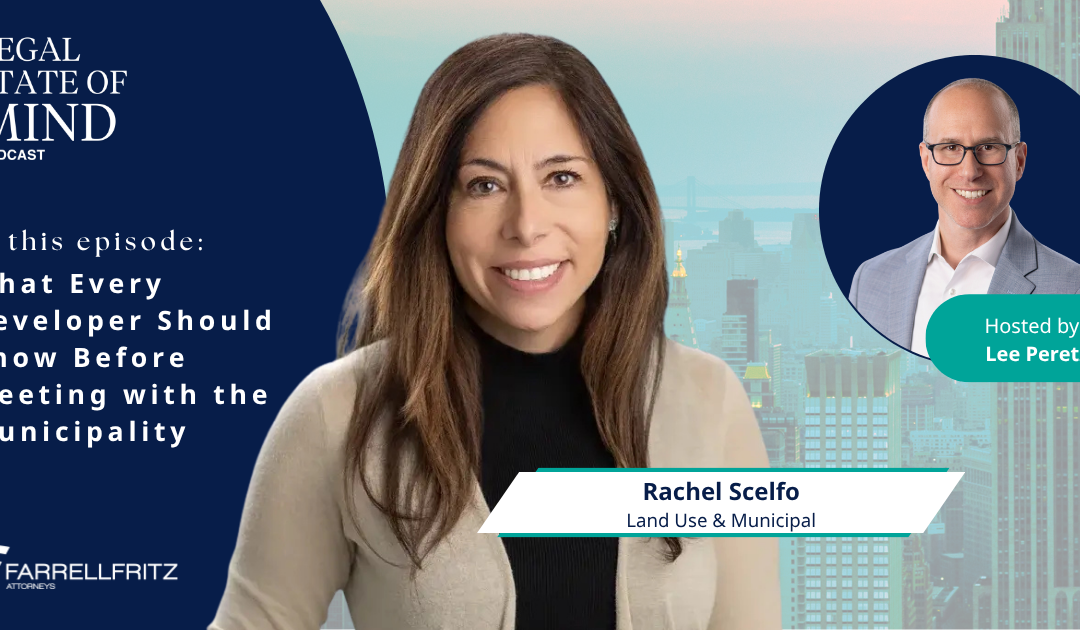
On Farrell Fritz’s Legal State of Mind podcast, land use and zoning partner Rachel Scelfo explained that a project’s success is often decided before that first meeting at Town Hall happens. She has served as counsel to the Town of Babylon Zoning Board and later as its Planning Commissioner, so she knows how towns view these initial project meetings. Here are some of her key takeaways.
The Code is King: Do Your Homework
Before the meeting, work with your land use attorney to understand your zoning district, what is allowed and required for the development of the property, the Town’s comprehensive plan (especially key with a rezoning request) and recent board decisions. Know the property as well as the planners do, if not better: Does the property flood? Does traffic back up in the area? These are practical considerations that the Town will know. You as the developer should be aware of existing conditions as well.
Bring a Plan and the Right Team
A concept plan is the best investment you can make before your initial meeting with the Town. Show up organized with something to put on the table, ideally a concept or sketch plan, along with a rendering or examples of your past work. These will yield the most productive feedback from the town. Also, bring your core team with you – your land use attorney, engineer and/or architect. You should be speaking with this team early on. They will give you their initial take on your project and identify any large concerns. Add in other experts – traffic, environmental and/or a landscape architect as the town’s concerns become clear. Further, ask what experts are required. Some towns require certain types of experts on different projects.
It’s a Conversation, not a Sales Pitch
A meeting with the town supervisor or town board member may be more of a high-level introduction, while a meeting with planning staff is typically more technical. In either one, you want to be conversational and have your “listening ears” on. You have been given valuable time in front of the very experts that will ultimately be reviewing your plan. They can provide you with meaningful feedback including how a similar application went, or which civic association or fire department you should be contacting. You shouldn’t expect a definitive answer, though. The town planners and other staff are not the ultimate decisionmakers on the application. The independent boards (Town Board, Zoning Boards and Planning Boards) decide the applications and outside agencies such as the NYSDOT, the NYSDEC and the Suffolk County Department of Health Services will also have their say.
A Similar Approval or a Permitted Use Doesn’t Necessarily Guarantee Success
Don’t assume a similar project’s approval guarantees yours. The circumstances may not have been the same. Also, having the correct zoning doesn’t mean an approval is automatic either, because site plan review still asks whether the site will work for the proposed use. A long list of variances or very substantial (large) variances may be a red flag. Starting out with a permitted use – one that the district permits, with parking that works, with little or no variance relief would be a green flag: your project has potential.
Set Realistic Timelines and Know the Process
Every developer should ask the town how long approval will take, including its best and worst estimates. Your team’s responsiveness will matter in the overall timeline for the life of a project. In Babylon, the guideline for the Town to issue departmental comments on a site plan was four to six weeks, and slow answers from your design professionals will stretch the entire timeline. Ask which applications can be filed at the same time and which filings and reviews can overlap to avoid delays.
Engage the Community
Neighbors are built into the process through public notice and the public hearing process. If you fail to address their valid concerns, you can derail a project or invite a costly court challenge. The town can provide guidance and contact information for the local civics at your preliminary meeting. Determine the right time to engage civic groups and adjacent residents and present your picture of the overall development along with its benefits: jobs, a larger tax base, much needed housing, for instance. Listen to their concerns and address same wherever possible.
Last, avoid being adversarial. As Rachel put it, you’ll be in a relationship with the town for the life of the project, and you want it to be a positive and productive one.
For more on the Legal State of Mind podcast, go to www.legalstateofmindpodcast.com.
Recent Comments