
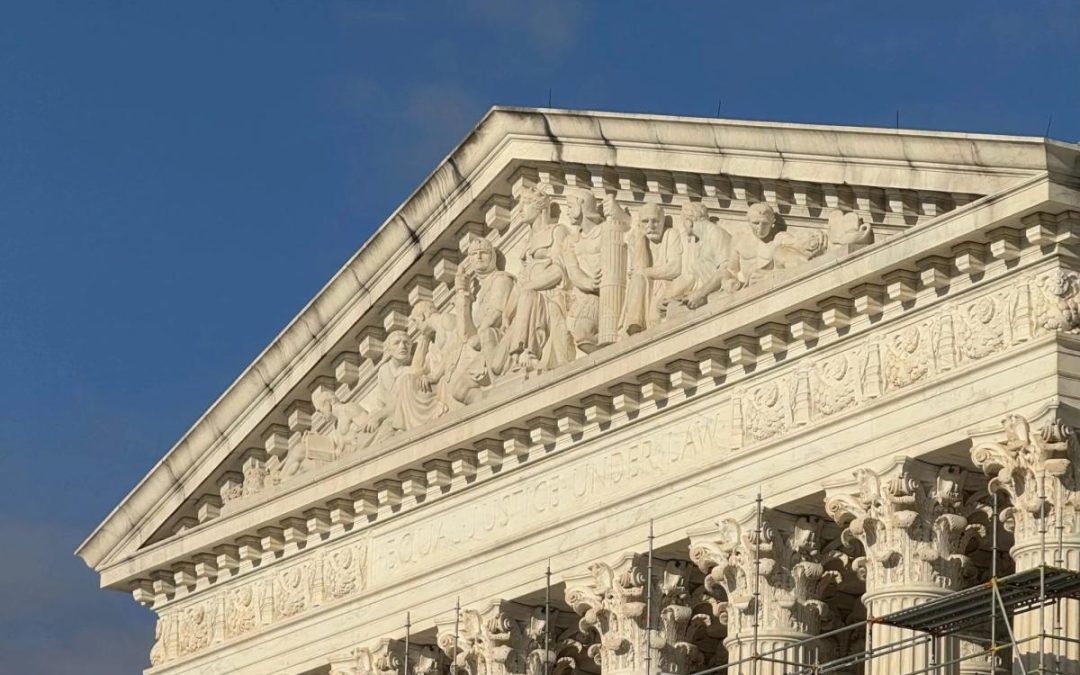
The Supreme Court may be done with oral arguments for the week, but you don’t have to be done listening to people discuss this term’s cases. SCOTUSblog’s Zach Shemtob is part of Pacific Legal Foundation’s virtual term preview event, which will take place today from noon to 1 p.m. EDT. Register here.
At the Court
On Wednesday, the justices heard oral argument in Department of the Air Force v. Prutehi Guåhan, a case on the interaction between two federal environmental laws that arose when the U.S. Air Force applied to renew its permit to dispose of munitions on a beach in northern Guam.
Also on Wednesday, the Supreme Court denied three requests for a stay of execution from Jamaal Howard, who was sentenced to death for the 2000 murder of Vickie Swartout. About an hour later, Howard was executed in Texas.
On Sept. 28, the Trump administration brought a dispute over the Federal Bureau of Prison’s policy on healthcare and accommodations for transgender inmates to the interim docket. The court has asked the challengers to respond to this request by 4 p.m. EDT today.
Morning Reads
Justice Alito 'amused and puzzled' by false retirement report
Maureen Groppe, USA Today
In a written interview with USA Today, Justice Samuel Alito described his reaction to NPR’s publication – and quick retraction – of a report that he would retire just moments “after the Supreme Court had handed down its final decisions for” the 2025-26 term. “I was amused and puzzled,” Alito said. “I wondered what had led to the erroneous report. And when the error was corrected, I wondered how many people were crest-fallen.” Alito also addressed his past criticism of the court’s seeming unwillingness to take up certain hot-button issues – or at least to not address them as often as it could. “Our job is easier and more pleasant when we deal with technical legal issues that do not involve us in heated public controversy,” he said, “but eschewing controversy is not a good reason to duck questions that richly merit our prompt review.”
Capitol agenda: GOP braces for SCOTUS fight that may not come
Calen Razor, Politico
Neither Justice Clarence Thomas nor Justice Samuel Alito is expected to retire later this year, but “Senate Republicans are privately ready” to confirm a replacement if either justice succumbs to the “mountain of pressure to step down” they are expected to face “if Democrats retake the Senate,” according to Politico. “We would proceed quickly with such a vacancy,” said current Senate Majority Leader John Thune. Similarly, Sen. Thom Tillis “said he would ‘absolutely’ support a post-election confirmation.” “You’ve got to use your majority position to take that vote,” he said. Politico noted, however, that other lawmakers “aren’t ready to entertain the thought of a lame-duck confirmation sprint.” “Oh gosh,” said Sen. Lisa Murkowski. “You’re giving me the chills.”
Girl asks Supreme Court to block Wash. state rules allowing trans athletes
Julian Mark, The Washington Post
On Tuesday, a Washington state high schooler “asked the Supreme Court to block rules there allowing transgender athletes to play on female sports teams, signaling the next front in legal battles over trans women in competitive athletics,” according to The Washington Post. The request arrived on the interim docket just over three months after the court “upheld state bans on transgender women playing on women’s sports teams.” In that ruling, the majority “acknowledged that it left unanswered the question of whether officials could set their own policies and allow trans girls and women to participate in female sports.” The girl involved in the present dispute “alleges that Washington’s policies are discriminatory and violate Title IX.”
US Circuit Judge, 99, gets fitness dispute moved to new court
Blake Brittain, Reuters (paywalled)
In an August decision that was made public on Tuesday, “Chief Justice John Roberts … transferred a dispute between the US Court of Appeals for the Federal Circuit and its longest-serving judge Pauline Newman to” the U.S. Court of Appeals for the 11th Circuit, giving “the oldest active federal judge an opportunity to convince a new set of judges that she should be reinstated,” according to Reuters. Newman, 99, has been suspended since 2023, when “she allegedly refused to cooperate with an investigation into her fitness to serve.” In June, the Supreme Court declined “to take up a lawsuit brought by Newman over her suspension. Newman had told the justices that the Federal Circuit had violated her constitutional rights.”
On Site
Argument Analysis
Justices wrestle with procedural dispute over Air Force’s munition detonations in Guam
The Supreme Court on Wednesday grappled with a lawsuit brought against the U.S. Air Force by a group that describes its mission as protecting Guam’s environment and culture. During roughly 75 minutes of oral argument, the justices questioned whether the Air Force’s application to renew a permit to detonate hazardous munitions on a beach in Guam was the kind of final action that the group could challenge now.
Argument Analysis
Justices emphasize comparing apples to apples in assessing investment choices for retirement funds
The argument on Tuesday in Anderson v. Intel Corporation Investment Policy Committee showed a bench skeptical of claims that the investment choices of employee retirement funds should necessarily form an easy basis for litigation in federal court.
Relist Watch
The first relists of the 2026-27 term
In his Relist Watch, John Elwood offered an overview of the 13 petitions for review that will get a second look from the justices at this Friday’s conference, and one summer holdover that will get a fourth look. These petitions cover such issues as the takings clause, qualified immunity, and free speech.
Contributor Corner
Law and politics collide in asylum case
In his Immigration Matters column, César Cuauhtémoc García Hernández highlighted Wassily v. Blanche, a case that will be argued on Nov. 30 on whether noncitizens whose asylum protections were terminated are eligible to obtain a green card. Hernández contended that the outcome of the case may hinge on whether the justices read an old immigration law through the lens of contemporary politics.
SCOTUS Outside Opinions
A textbook 14th Amendment revolution
In the second entry in their series of columns for SCOTUSblog on constitutional change over the past two decades, Josh Blackman and Randy Barnett explored the ongoing revolution affecting “each facet of 14th Amendment law.”
Podcasts
Amarica's Constitution
Delivering Justice – with Judge Patrick Schiltz and Michael Stokes Paulsen
This episode features a discussion between Professor Michael Stokes Paulsen and Judge Patrick Schiltz, a federal judge in Minnesota, about Schiltz’s work amid the dramatic escalation in ICE activity in his area. Before and after this discussion, Akhil Amar weighs in on some of the legal issues involved.
A Closer Look
Boysen v. PeaceHealth
More than six years after the start of the COVID-19 pandemic, the Supreme Court continues to receive petitions for review addressing vaccine mandates, particularly mandates for healthcare workers. On Monday, the justices denied review in two such cases out of Washington state, which involved firefighters and former hospital employees. At least two more vaccine-related petitions are still pending, including Boysen v. PeaceHealth, which is scheduled to be considered by the justices for the first time at their private conference on Friday.
Boysen centers on vaccine mandates imposed in 2021 by the state of Oregon and a healthcare system called PeaceHealth on PeaceHealth employees. Workers were required to be vaccinated against COVID-19, and if they refused – absent being granted a medical or religious exemption – risked termination.
In 2023, a group of former PeaceHealth employees who had been fired after refusing to be vaccinated sued the healthcare system, several individual PeaceHealth leaders, and two Oregon officials, contending that the vaccine mandates violated the Constitution and international treaties addressing human rights, as well as a variety of state and federal laws. Their claims stemmed from their belief that the COVID-19 shots were “investigational new drugs” that had been approved on an emergency basis – not fully vetted vaccines proven to be safe and effective. Such “investigational products” must be offered “under conditions of voluntary informed consent without coercion or punishment,” they argued, and, therefore, PeaceHealth and the state did not have a right to require vaccination.
Before the U.S. District Court for the District of Oregon, the respondents filed a motion to dismiss the healthcare workers’ case, which U.S. District Judge Ann Aiken granted. Aiken rejected the workers’ characterization of the shots, concluding that “[t]he record flatly contradicts and renders implausible Plaintiffs theory that the Pfizer vaccine was investigational only, and not really a vaccine.” As a result, Aiken continued, none “of the federal statutes, regulations, reports or international treaties they cite” apply. She further concluded that the mandates did not violate the 14th Amendment’s equal protection or due process clauses because “unvaccinated individuals do not constitute a suspect class” and “the Covid-19 vaccine mandates do not implicate a fundamental right.” The U.S. Cout of Appeals for the 9th Circuit affirmed the dismissal in December.
In May, the former PeaceHealth employees asked the Supreme Court to allow their case to move forward. Their petition for review focuses on their claim “that there is a Fourteenth Amendment due process right to refuse unwanted investigational drugs” that the lower courts failed to properly consider. “This is not a right created by a single statute or regulation,” they assert. “It is a right that reflects the American people’s enduring commitment to individual autonomy, bodily integrity, and the principle that no person should be forced to serve as a subject in medical experimentation without their free and informed consent.”
Initially, PeaceHealth and the PeaceHealth leaders who were named in the suit, as well as the former state officials named in it, waived their right to respond to the petition. In June, however, the court called for a response. In their briefs, the PeaceHealth respondents and state respondents both assert that the dispute is not significant enough to merit the Supreme Court’s attention, in large part because there is not a disagreement between the federal courts of appeals over states’ authority to impose vaccine mandates amid a public health crisis. “Petitioners identify no decision of this Court or any court of appeals that conflicts with the decision below,” the PeaceHealth respondents contend. “To the contrary, this Court held long ago that the liberty interests protected by the Constitution do not defeat a vaccination requirement necessary to protect public health.”
As noted above, Boysen v. PeaceHealth is scheduled to be considered by the justices at their next private conference.
SCOTUS Quote
JUSTICE GORSUCH: “… [W]e'd have a federal common law question for some court to resolve, right?”
MS. HARRIS: “You would have a federal common law question, again, underpinning any constitutional issues.”
JUSTICE GORSUCH: “Okay. All right. All right. Let me stop you there. That –”
MS. HARRIS: “Sure.”
JUSTICE GORSUCH: “I'll take ‘yes’ every day of the week.”
— Suncor Energy Inc. v. County Commissioners of Boulder County (2026)
Recent Comments