
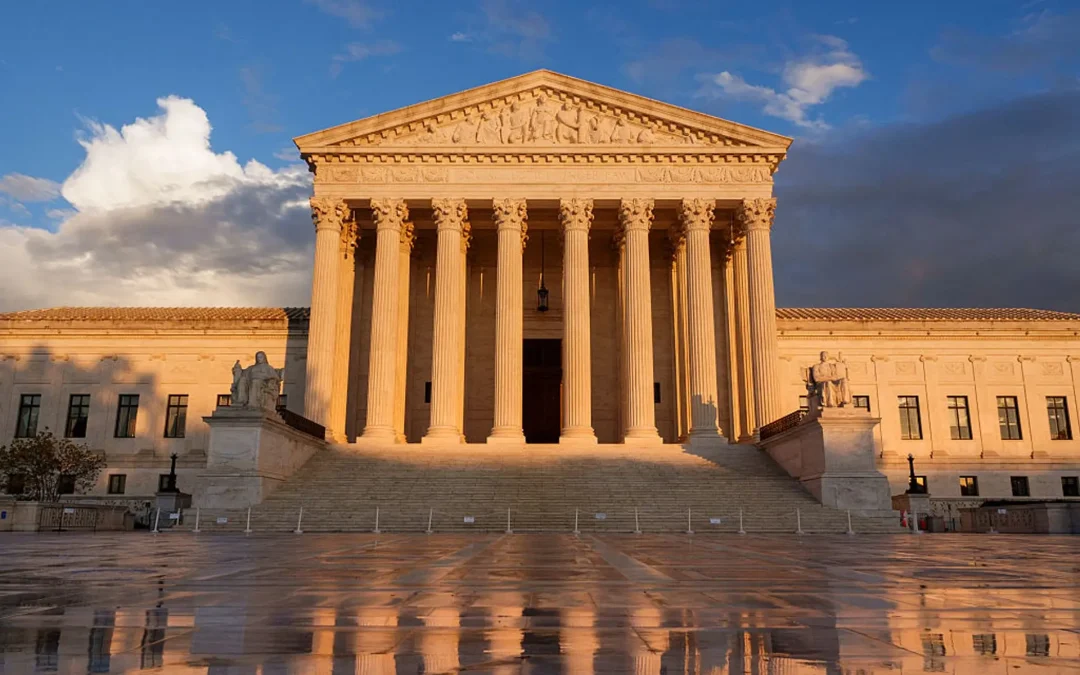
On Oct. 1, the Supreme Court took up a question of considerable importance: whether the Trump administration may continue to detain noncitizens without a bond hearing. This question now sits at the court in two pieces: a statutory question the justices have agreed to answer, and a constitutional one still waiting for the right case. Together, the answers will decide whether people who have lived here for years, even decades, can ask a judge to release them while they fight deportation.
***
Until July 2025, following passage of the Illegal Immigration Reform and Immigrant Responsibility Act in 1996, every administration had detained noncitizens who entered without inspection (that is, without being inspected and admitted by an immigration officer) and were later arrested in the interior of the country under Section 1226(a). According to this provision, ICE may release a detainee on bond subject to an immigration judge’s review (unless Section 1226(c)’s criminal- and terrorism-related provisions apply). In July 2025, Immigration and Customs Enforcement began requiring – for the first time – that anyone who had entered the United States without inspection, whether last year or decades ago, be detained instead under Section 1225(b)(2)(A) for the length of removal proceedings. Unlike Section 1226(a), this provision holds that immigration judges have no power to grant such detainees bond. Two months later, the Board of Immigration Appeals agreed with ICE in Matter of Yajure Hurtado.
Under this policy, the only way one may leave the country before his or her removal proceedings end is discretionary, case-by-case parole, granted only for urgent humanitarian reasons or a significant public benefit. Partly due to this policy, ICE’s overall detained population, which also includes people held on other grounds, hit a reported record of roughly 73,000 in mid-January 2026.
Section 1225(a)(1) deems any noncitizen “present in the United States who has not been admitted [to the country]” to be an “applicant for admission.” The detention command then provides: “in the case of an alien who is an applicant for admission, if the examining immigration officer determines that an alien seeking admission is not clearly and beyond a doubt entitled to be admitted, the alien shall be detained.” The courts of appeals agree that long-term residents who entered the U.S. unlawfully are deemed “applicant[s] for admission.” The dispute is whether that deemed status also means they are “seeking admission,” and would thus fall within Section 1225 and be detainable without bond.
Eleven of the 12 federal circuit courts (all but the U.S. Court of Appeals for the D.C. Circuit) have now answered. Nine hold that Section 1226, not Section 1225(b)(2)(A), governs people arrested in the interior: the U.S. Courts of Appeals for the 1st, 2nd, 3rd, 4th, 6th, 7th, 9th, 10th and 11th Circuits. Two read Section 1225(b)(2)(A) as the government does: the U.S. Court of Appeal for the 5th Circuit and the U.S. Court of Appeal for the 8th Circuit.
For the majority of circuits, “seeking admission” is an ordinary phrase Congress left undefined, and as the 1st Circuit put it, “means seeking lawful entry.” A person who crossed the border years ago is not seeking entry; he already entered. The deeming clause in Section 1225(a)(1) may make a long-term resident an applicant for admission, Judge Joshua Kolar wrote for the 7th Circuit, but it does not “conjure a fictional intent to seek admission.” Structure points the same way: in the Laken Riley Act of January 2025, Congress expanded Section 1226(c)’s mandatory detention categories to reach certain unlawful entrants accused or convicted of specified offenses, a needless step if Section 1225 had always reached them. The majority of circuits add that five administrations over three decades read the statute their way, and that Congress would not silently have required detaining some two million people.
For the 5th and 8th Circuits, however, ordinary meaning cuts differently. To apply for something is to seek it, Judge Edith Jones wrote for the 5th Circuit; for example, a college applicant does not stop seeking admission once the application is filed. Several dissenters elsewhere go further and rest on the deeming clause itself, arguing that a legal fiction carries the attributes of the thing it deems. As 11th Circuit Judge Barbara Lagoa wrote in dissent, in a line later adopted by a 1st Circuit dissenter: “If a person whom Congress has deemed an applicant for admission is not seeking admission, it is hard to know what Congress thought it was deeming him to be.”
As for the government’s long contrary practice: “Years of consistent practice,” Jones wrote, “cannot vindicate an interpretation that is inconsistent with a statute’s plain text.” Government-side judges answer the Laken Riley point, too: Section 1226(c) also reaches admitted noncitizens and bars parole, and in January 2025 DHS still treated unlawful entrants as bond-eligible. Both sides now also cite the justices’ own June decision in Mullin v. Al Otro Lado, which read “arrives in the United States” to mean crossing the border, said fears of encouraging illegal entry “cannot defeat the best reading of the text,” and called the rule that every word must do work “not an iron rule.”
The Supreme Court will soon have its say. On Oct. 1, the justices agreed to hear Rhoney v. Barbosa da Cunha, the government’s challenge to a unanimous 2nd Circuit panel ruling for a Brazilian man who has lived here more than 20 years, was detained in 2025 under Section 1225(b)(2)(A), and which that circuit court found to be inapplicable. No argument date is set yet; proposed merits briefing runs into February, pointing to argument in late winter or spring and a decision by term’s end.
But a related constitutional question is also pending at the court. This is whether, even if under Section 1225(b)(2)(A) detainees do not have a statutory right to a bond hearing, they have a right to one under the due process clause. On Oct. 23, the full U.S. Court of Appeals for the 5th Circuit held in the case of Sosnava Rodriguez v. Vergara that noncitizens subject to the government’s mandatory detention policy have no such right.
Judge Cory Wilson wrote for the majority: “Because Petitioners have never been admitted to the United States, due process does not entitle them to additional proceedings beyond what Congress has provided before they may be detained pending removal.” Seven judges dissented. Judge Leslie Southwick countered that the court “has constructed an impenetrable wall between the Constitution and these long-term residents,” who by the record had each lived here for more than a decade.
For now, in Texas, Louisiana, and Mississippi, noncitizens who entered without inspection thus have no ordinary path to a bond hearing; discretionary parole and a few claims the majority reserved remain, but those are narrow exits. The 8th Circuit’s ruling closes the statutory route across its seven states as well.
The 3rd and 6th Circuits, on the other hand, have held that detaining long-present noncitizens under Section 1225(b)(2)(A) without a bond hearing does indeed violate due process. In these circuits, which cover Delaware, New Jersey, Pennsylvania, and the U.S. Virgin Islands (the 3rd Circuit), and Kentucky, Michigan, Ohio, and Tennessee (the 6th Circuit), long-term residents can point to circuit precedent recognizing a due process right to a bond hearing. One’s geographical location thus makes all the difference.
***
If the court affirms in Rhoney, subject to specific exceptions, noncitizens who entered without inspection and are later arrested in the interior could again ask for bond everywhere, as they could before July 2025. A hearing does not guarantee release, and the burden is generally on the detainee, but the right to ask for bond would be the same in every circuit. If the court reverses in Rhoney, mandatory detention becomes the statutory rule everywhere, yet geography, as noted, would still matter: the 3rd and 6th Circuits have held that a constitutional right to due process requires bond hearings for long-resident detainees like those before them, and the 5th has held it does not.
That is where the case of Putra v. Lopez-Campos comes in. The government’s petition from its loss in the 6th Circuit in that case raises both the statutory and constitutional questions, and the solicitor general urged the justices to take it for that reason. The court only agreed to hear Rhoney, which raises the statutory question, and thus appears to be holding Putra until Rhoney is decided. If the government wins in Rhoney, the split between the 3rd and 6th Circuits, which found a due process right to a bond hearing, and the 5th, which did not, would matter far more, and the justices would likely have to take up Putra to settle the due process issue. But if the detainees win in Rhoney, that constitutional question may never need an answer.
Rhoney should be decided before the term ends next summer. Based on this decision, we will see if the constitutional dispute follows. In the meantime, tens of thousands of people remain detained.
Recent Comments