
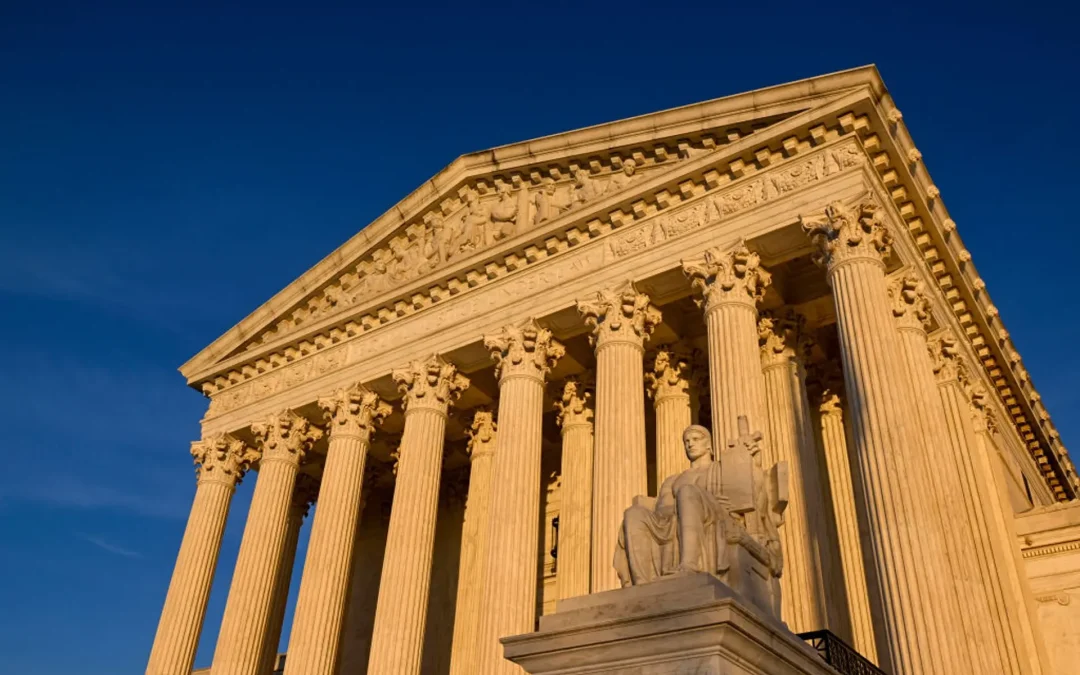
Two of the most enduring rights in the Constitution are the First Amendment’s protections of the free exercise of religion and the 14th Amendment’s equal protection clause. Should the court’s approach to these rights vary? Specifically, should it be easier to prove discrimination under the free exercise clause than under equal protection?
At the oral argument in St. Mary Catholic Parish v. Roy, on Nov. 3, several of the conservative justices in their questions suggested that a law’s discriminatory effect against a religion should be a basis for striking it down. That is in sharp contrast with a half century of law under equal protection holding that disparate impact (seemingly neutral policies that result in negative effects on a particular group) is not enough to prove discrimination. I would not be surprised to see such “free exercise exceptionalism” from the Roberts court. But it seems to me unjustified.
St. Mary Catholic Parish v. Roy
Colorado, in 2024, adopted a universal preschool program where it will provide funds for children to attend public, secular private, or faith-based preschools. The condition for receiving funds is that the school must consent to “provide eligible children an equal opportunity to enroll and receive preschool services regardless of race, ethnicity, religious affiliation, sexual orientation, gender identity, lack of housing, income level, or disability.”
St. Mary Catholic Parish in Littleton, Colorado, which has a Catholic preschool, and two parents brought a challenge arguing that this restriction on funding violates their free exercise of religion as it requires them to accept students whose families do not adhere to the Catholic Church’s teachings, including LGBTQ children and children with LGBTQ parents. The federal district court and the U.S. Court of Appeals for the 10th Circuit upheld the Colorado law.
The 10th Circuit stressed that the Colorado law did not discriminate on the basis of religion. The court applied the Supreme Court’s 1990 decision in Employment Division v. Smith, which held that the free exercise clause cannot be used to challenge a neutral law of general applicability. This means that the free exercise clause is not a basis for an exception to a law unless it can be shown either that it was motivated by a desire to interfere with religion, that it discriminates against religion, or even that it just creates discretion to treat religions differently from secular actions. The 10th Circuit found that the Colorado law met the requirements for a neutral law of general applicability, as, among other things, it did not treat any one religion differently than others.
The court of appeals also found no discrimination against religious schools in government funding. In 2017’s Trinity Lutheran v. Comer, the court declared unconstitutional a Missouri law that provided public and secular private schools funds for surfacing playgrounds that did not provide the same funds to religious schools. In 2022’s Carson v. Makin, the court applied this to invalidate a Maine law that provided funds to parents to send their children to secular private schools in areas without public schools, but not “sectarian” schools. The 10th Circuit distinguished these cases, explaining that the Colorado law did not exclude religious schools as it allowed them to receive state money on the same terms as all other preschools.
At the oral argument on Nov. 3, there was more focus on the latter issue, perhaps because it would avoid the court needing to decide whether to overrule Employment Division v. Smith. In 2021’s Fulton v. City of Philadelphia, Justice Samuel Alito wrote an opinion concurring in the judgment, joined by Justices Clarence Thomas and Neil Gorsuch, urging the overruling of Smith. Justice Amy Coney Barrett, joined by Justice Brett Kavanaugh, wrote a concurring opinion, expressing support for that view, but finding it unnecessary to decide the issue to resolve that case. The court likely remains divided over whether to overrule Smith and what would replace it.
In the arguments in St. Mary Catholic Parish, there were many questions from the conservative justices that suggested that they saw the Colorado law as discriminatory because of its effects on religious schools. For example, Chief Justice John Roberts asked the attorney for Colorado how this was different from the program in Carson v. Makin and said that the effect of the Maine law was “pretty much the same as the effect of the law here,” as it disadvantaged religious schools. Barrett asked Colorado’s attorney why, if Colorado cannot expressly exclude religious schools from its program, it can nevertheless “impose a condition” – the nondiscrimination requirement – that it knows such “schools will be unable to agree to.”
In other words, these justices suggested that a discriminatory effect of Colorado’s law would be sufficient to find the law violated the free exercise of religion even though the law said nothing about religion and was not motivated by a desire to interfere with religion. The questions suggested that Colorado adopting the non-discrimination requirement knowing that some religious schools would not comply should be sufficient to prove discrimination under the free exercise clause.
Equal protection analysis
Such an approach would be dramatically different from analysis under the equal protection clause. Although I personally think such cases were incorrectly decided, the Supreme Court long has held that proof of a discriminatory effect alone is not sufficient to establish race or sex discrimination. And it has expressly held that discrimination cannot be proven by showing that government officials took an action with knowledge that it would have discriminatory consequences.
Washington v. Davis, decided 50 years ago, was a key case holding that a racially discriminatory effect is not sufficient to establish an equal protection violation. Applicants for the police force in Washington, D.C., were required to take a test, and statistics revealed that Black individuals failed the examination much more often than Whites. The Supreme Court, however, held that proof of a discriminatory impact is insufficient, by itself, to show the existence of a racial classification. Justice Byron White, writing for the majority, said that the court never had held that “a law or other official act, without regard to whether it reflects a racially discriminatory purpose, is unconstitutional solely because it has a racially disproportionate impact.” The court explained that discriminatory impact, “[s]tanding alone, . . . does not trigger the rule that racial classifications are to be subjected to the strictest scrutiny and are justifiable only by the weightiest of considerations.”
The court has even held that discriminatory purpose cannot be proven by showing that government officials adopted a policy with knowledge that it would have a discriminatory effect. Rather, the court has made it clear that showing such a purpose requires proof that the government desired to discriminate. In 1979’s Personnel Administrator of Massachusetts v. Feeney, the court declared: “‘Discriminatory purpose,’ … implies more than intent as volition or intent as awareness of consequences. It implies that the decisionmaker . . . selected or reaffirmed a particular course of action at least in part ‘because of,’ not merely ‘in spite of,’ its adverse effects upon an identifiable group.”
Feeney involved a challenge to a Massachusetts law that gave preference in hiring for state jobs to veterans. At the time of the litigation, more than 98% of the veterans in the state were male, and only 1.8% were female. The result was a substantial discriminatory effect against women in hiring for state jobs. Nonetheless, based on the principles articulated above, the Supreme Court held that there was not a sex classification because the law creating a preference for veterans was facially sex neutral and there was not proof that the state’s purpose in adopting the law was to disadvantage women. The fact that the legislature knew there would be an discriminatory effect against women was thus irrelevant.
The tension
There is no way to reconcile this equal protection jurisprudence with the approach several conservative justices suggested in St. Mary Catholic Parish. The question then becomes whether there is any reason to treat discrimination under the free exercise clause differently from under the equal protection clause.
Several justices suggested in their questions at oral argument that Sherbet v. Verner, a 1963 case, justifies concluding that discriminatory impact is alone sufficient for a free exercise violation. That case involved a state having denied unemployment benefits to a woman, a member of the Seventh-day Adventist Church, who quit her job rather than work on her Saturday Sabbath. The court concluded that the denial of benefits imposed a substantial burden on religion; the woman had to choose between an income and her faith. The court thus said that the issue was “whether some compelling state interest enforced in the eligibility provisions of the . . . statute justifies the substantial infringement of appellant’s First Amendment right.” The court found no such compelling interest and ruled that the denial of benefits constituted a violation of the free exercise clause.
Sherbert found a violation of the free exercise of religion based on the impact on her religion despite the law at issue being facially neutral. As a precedent for striking down the Colorado law, however, that is unpersuasive. Sherbert was decided a decade before the Supreme Court held that proof of discriminatory impact was not sufficient for an equal protection violation. And although the court has not overruled Sherbert, it has never explained how it can be reconciled with Employment Division v. Smith. But most importantly, invoking Sherbert begs the crucial question: Should a different standard be used for discrimination under the free exercise clause compared to the equal protection clause?
Conceptually, I cannot understand any reason why discrimination on the basis of religion should be treated dissimilarly from discrimination based on race or sex. Why should two such critical rights be treated differently? Indeed, it is just a doctrinal accident that religious discrimination is litigated under the free exercise clause (or the establishment clause) rather than the equal protection clause.
Applying equal protection principles, the Colorado law does not discriminate against religion in its terms or in its purpose. Many commentators, including me, have argued that – despite court precedent – discriminatory impact should be enough for a claim under equal protection. But there has been no suggestion from the court that it is moving in that direction.
Finally, it is important to stress that even if the law is deemed discriminatory, that does not mean that it is automatically unconstitutional. It means that strict scrutiny should be applied, in which the government action can be upheld if there is a compelling purpose for it. I was disappointed that the conservative justices did not focus on the government’s compelling interest in preventing children from being discriminated against on account of their gender identity or for having LGBTQ parents. Without explicitly saying so, the justices appear poised to carve out a special place for the free exercise clause over that of equal protection.
Recent Comments