
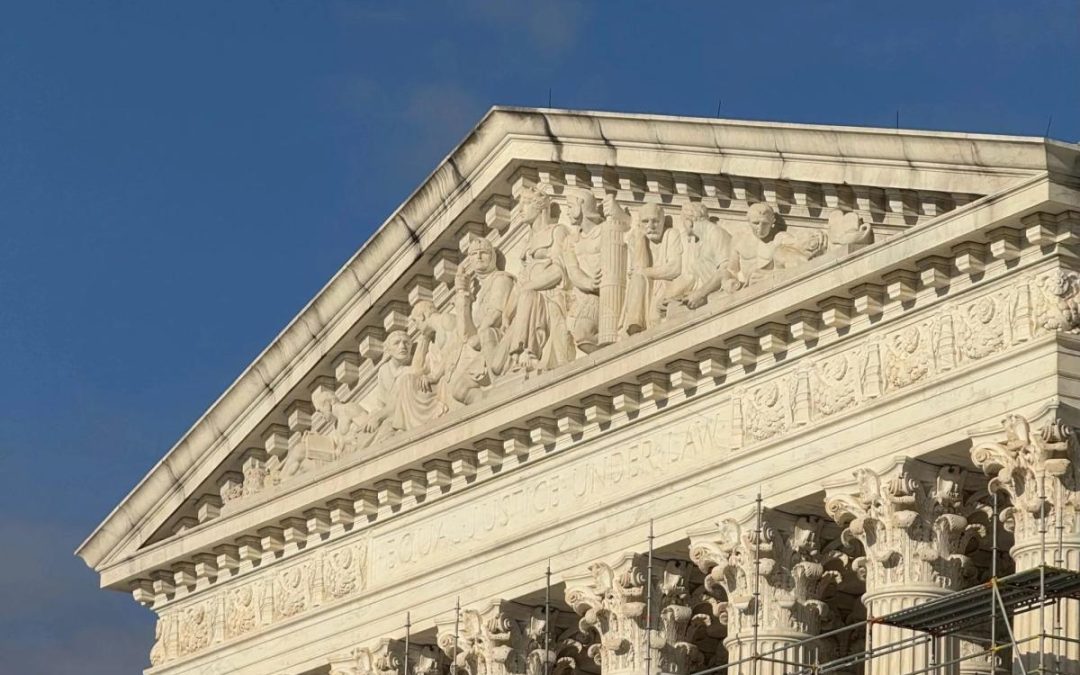
Justices Elena Kagan and Amy Coney Barrett will appear before House and Senate subcommittees today to address the Supreme Court’s budget request. Keep reading to learn more about that request and the history of such congressional testimonies.
Plus, don’t forget to register for Thursday’s LinkedIn Live event on the 2025-26 term’s most consequential cases, featuring SCOTUSblog’s Amy Howe and Briefly’s Adam Stofsky. The event is scheduled to start at noon EDT.
Morning Reads
With Threats Rising, Supreme Court Asks Congress to Increase Security Funds
Ann E. Marimow, The New York Times (paywalled)
During their appearance on Tuesday before House and Senate subcommittees, Justices Elena Kagan and Amy Coney Barrett will discuss the court’s “$228 million request for the budget year that begins Oct. 1, an increase of about $20 million,” according to The New York Times. Part of the increase stems from the goal of creating “a new facility to screen visitors outside the court’s home on Capitol Hill, as security threats against the justices mount.” The court has also asked for “an increase of $14.6 million to continue the expansion of the court’s in-house police force and for security when the justices travel outside the Washington area.”
‘Colorblind Constitution’ concept underlies key Supreme Court rulings
Julian Mark, The Washington Post
As a young attorney serving in the Justice Department during the Reagan administration, John Roberts “repeatedly invoked the view that the Constitution is ‘color-blind’ and forbids the government to make decisions based on race, even to combat the effects of discrimination,” according to The Washington Post. “More than four decades later, the ‘color-blind principle’ is rapidly becoming a pillar of the law, ushered in by the Roberts-led Supreme Court, particularly over the past few months.” “Legal analysts say the Supreme Court’s growing embrace of the phrase could hasten the end of race-conscious policies in education, housing, employment, redistricting and other areas.”
Conservative groups say Justice Kagan cannot be impartial in upcoming Supreme Court climate litigation
Elaine Mallon, Fox News
On Monday, “a coalition of conservative legal organizations” urged the Senate Judiciary Committee to investigate whether Justice Elena Kagan must recuse herself from Suncor Energy v. Boulder County, “a major climate change case expected to be argued before the high court next term,” according to Fox News. The groups contend that “Kagan compromised her impartiality by writing the foreword to the Reference Manual on Scientific Evidence, which included a climate science chapter that was later criticized by Congress and Republican attorneys general as biased and was eventually removed.” Suncor Energy “asks whether Colorado local governments can use state law to hold oil and gas companies financially liable for their alleged contributions to climate change.”
Conservatives urge Congress to pass constitutional amendment keeping Supreme Court at nine justices
Jack Birle, Washington Examiner
In a Monday letter to Congress, “conservatives and legal groups” asked “lawmakers to pass the ‘Keep 9’ constitutional amendment to curb Democrats’ threats of adding additional justices to the Supreme Court,” according to the Washington Examiner. “For over 150 years, the Supreme Court has consisted of one chief justice and eight associate justices. Although a nine-justice Court is not constitutionally required, adding justices now would serve no purpose but to politicize, and thus undermine the legitimacy of, the Court and its rulings,” the letter said.
Let the Cameras Roll at the Supreme Court
Gabe Roth, The Wall Street Journal (paywalled)
In a letter to the editor published by The Wall Street Journal, Gabe Roth, the executive director of Fix the Court, contended that cameras in the Supreme Court would not affect the justices in the same way that cameras in Congress have affected lawmakers. “Supreme Court justices and their lower-court colleagues serve for life. Unlike members of Congress, who run for office every two or six years, federal jurists have no professional incentive to play to the cameras and trawl for clicks,” Roth wrote. He noted that a former judge once told him “he was concerned about cameras for the first 30 seconds after they were turned on, but then he became engrossed in the case and forgot about being recorded.”
On Site
Contributor Corner
A dissent worthy of a World Cup
In her In Dissent column, Anastasia Boden revisited a petition for review from 1982 addressing a dispute between the National Football League and the North American Soccer League. In it, the NFL asked the court to consider whether it could bar “team owners from holding controlling interests in teams in any other professional sports league.” The court denied the petition, but Justice William Rehnquist wrote a lone dissent from the denial, supporting the NFL’s position and which had a lasting impact.
Contributor Corner
The Supreme Court and the opinion-assignment guessing game
In his Empirical SCOTUS column, Adam Feldman explored how consistently the court has distributed signed majority opinions within each argument sitting over the past approximately 80 years, seeking to determine, among other things, how this practice has shifted on the current court.
Podcasts
Divided Argument
Norway-Sweden Worshippers
Will Baude and Dan Epps discussed Mullin v. Doe and Mullin v. Al Otro Lado, immigration decisions on the Temporary Protected Status Program and asylum metering at the U.S.-Mexico border, respectively.
A Closer Look
Justices Testifying Before Congress
For the first time since 2019, sitting Supreme Court justices will appear before Congress regarding their annual budget. Specifically, Justices Elena Kagan and Amy Coney Barrett will testify before the House Appropriations Subcommittee on Financial Services and General Government in defense of the court’s fiscal year 2027 budget request and are expected to also appear before a Senate Appropriations subcommittee. The combination of Kagan (appointed by President Barack Obama in 2010) and Barrett (appointed by President Donald Trump in 2020), “may reflect the Court’s effort to present a cross-ideological front on budget matters,” per one account.
The occasion is the court’s fiscal year 2027 budget request, in which the justices are asking for more than $200 million for salaries and expenses, a roughly 7% increase from current funding. Security accounts for much of that growth: of the $20.6 million overall increase the court is seeking, $14.6 million would go toward protecting the justices at work and another $2 million toward security at their homes. More specifically, the court wants to grow the Supreme Court Police so that it (rather than the U.S. Marshals Service) handles the justices’ residential protection going forward. (The Marshals have guarded the justices’ homes around the clock since 2022, when there was an assassination attempt against Justice Brett Kavanaugh.) The request also covers 12 new cybersecurity positions and “[o]ne off-site residential security office.” House appropriators have already advanced a bill funding the court at $207 million.
Per Politico, senior appropriators have said they are looking to keep questions trained on the court’s operations (rather than cases). Some lawmakers and court watchers see the hearing as long overdue; House Appropriations Committee Ranking Member Rosa DeLauro, noting that almost a decade has passed since a justice appeared before the House, said in a press release that the justices “have a duty, just as cabinet secretaries and agency heads, to answer our questions and provide information to the American people relevant to their budget requests.”
If history is any guide, the questioning may range beyond funding – as anyone who has watched a congressional hearing knows, lawmakers are free to wander off topic. At the last appearance of justices before a House subcommittee in March 2019, Kagan and Justice Samuel Alito faced questions about a possible ethics code and whether the court’s proceedings should be televised. And as Steve Vladeck noted, at a March 2001 House budget subcommittee hearing Rep. Jose Serrano “grilled” Justice Anthony Kennedy about Bush v. Gore.
The Congressional Research Service identified 93 committee or subcommittee hearings between 1960 and 2022 featuring at least one sitting justice and 175 appearances in all. A justice appeared before Congress every year from 1960 through 2011. The vast majority of those appearances (92%) came before the House or Senate Appropriations Committees. Justice Byron White holds the record at 24 appearances, followed by Kennedy at 23 and Justice Sandra Day O’Connor at 21; among the current justices, Justice Clarence Thomas has appeared 13 times, most recently in 2010.
Chief Justice John Roberts declined a 2023 request for his appearance before the Senate Judiciary Committee to testify on ethics, writing that “[t]estimony before the Senate Judiciary Committee by the Chief Justice of the United States is exceedingly rare, as one might expect in light of separation of powers concerns and the importance of preserving judicial independence.” Vladeck, for his part, has said that more frequent Congressional appearances by the justices would be “a relatively low-cost means of restoring some of the interbranch dialogue that used to be common—and the accountability that could indirectly come with it.” With Barrett and Kagan’s appearance today, we may see some of that dialogue.
SCOTUS Quote
MR. DREEBEN: “So if you have an iPhone, Justice Breyer, and I don't know what kind of phone that you have –”
JUSTICE BREYER: “I don't either because I can never get into it because of the password.”
— United States v. Wurie (2014)
Recent Comments