
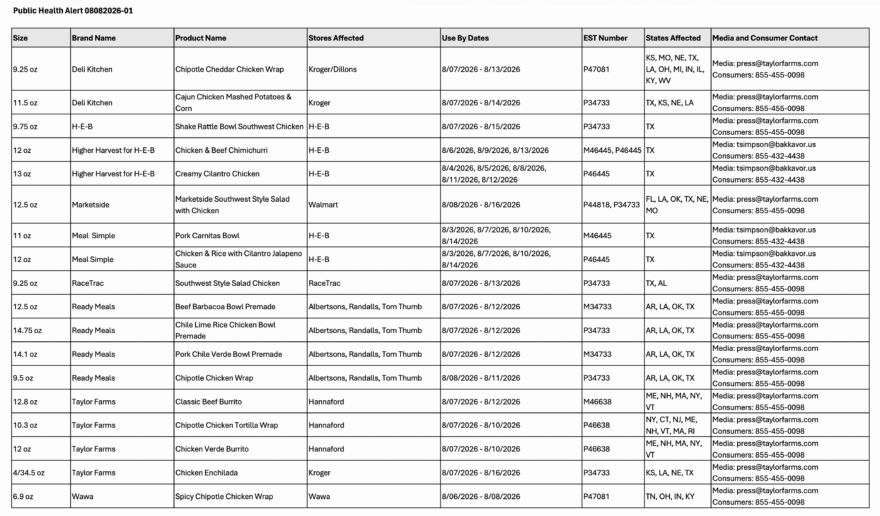
The U.S. Department of Agriculture’s Food Safety and Inspection Service issued Public Health Alert 08082026-01 this morning, covering meat and poultry products made with the FDA-regulated jalapeños recalled in the Salmonella Javiana outbreak. The product list runs to eighteen items sold at Kroger, Dillons, H-E-B, Walmart, Albertsons, Randalls, Tom Thumb, Hannaford, RaceTrac and Wawa, in at least twenty-three states — Alabama, Arkansas, Connecticut, Florida, Indiana, Kansas, Kentucky, Louisiana, Maine, Massachusetts, Michigan, Missouri, Nebraska, New Hampshire, New Jersey, New York, Ohio, Oklahoma, Rhode Island, Tennessee, Texas, Vermont and West Virginia. Use-by dates run through August 16. FSIS says it expects more products to be identified as the ingredient recall works its way downstream, and tells consumers to check back frequently.
The outbreak underneath this alert began in restaurants, not in grocery stores. CDC and FDA have counted 345 people infected with Salmonella Javiana across twenty-seven states, 36 of them hospitalized, with illness onsets running from June 19 to July 20. Of 191 people interviewed, 177 had eaten at a Mexican-style restaurant before they got sick, and CDC named Chipotle Mexican Grill and QDOBA. Minnesota epidemiologists and Chipotle’s own supply chain people got to the jalapeño before the federal government did — the company switched suppliers for affected stores on July 20 and QDOBA stopped serving jalapeños on July 28, while FDA did not open its traceback until July 22. That traceback landed on a single grower in Sinaloa, Mexico, whose peppers entered the country through Coast Citrus Distributors of San Diego, a seventy-five-year-old importer bought by the food e-commerce roll-up GrubMarket last summer. FDA recommended a recall, Coast Citrus agreed to pull the remaining implicated product, and the company stopped buying from that grower. FDA has never named the grower.
It is worth saying plainly how rare and how familiar this is. The recognized record of Salmonella outbreaks traced to fresh peppers in this country runs to exactly three, and all three trace to Mexico. In 2008 it was Salmonella Saintpaul in jalapeños and serranos — 1,442 people sick in forty-three states, the District of Columbia and Canada, after FDA spent most of the summer telling the public the problem was tomatoes. The strain turned up in a jalapeño at a Texas importer, in a pepper in one of my client’s refrigerators in Montezuma County, Colorado, and in irrigation water and a serrano on a farm in Mexico. In 2016 it was Salmonella Anatum in imported hot peppers, 32 sick in nine states, and FDA had already isolated the outbreak strain from a pepper it sampled that April, before the first person got sick. Now it is Javiana in 2026. Three outbreaks, three decades, one country of origin, and each time the public learned the source only after the peppers had already moved through the chain.
Read the establishment numbers in the far-right column and the alert says something FSIS did not put in its press release. P34733 and M34733 belong to Taylor Farms TX, Inc. on North Cockrell Hill Road in Dallas. M46638 and P46638 belong to Taylor Farms New England in North Kingstown, Rhode Island. P47081 belongs to Taylor Farms Tennessee North in Covington, Kentucky, doing business as Taylor Fresh Foods. P44818 belongs to Taylor Farms Florida in Orlando. Fourteen of the eighteen products on the federal list came out of those four plants. The other four — two Higher Harvest items and two Meal Simple items, all sold at H-E-B — came from Bakkavor US in San Antonio.
Only four of the fourteen say Taylor Farms anywhere on the package. The rest go out as Deli Kitchen at Kroger and Dillons, as the H-E-B Shake Rattle Bowl, as Marketside at Walmart, as Ready Meals at Albertsons and Randalls and Tom Thumb, as RaceTrac, as Wawa. Somebody standing in a Walmart holding a 12.5-ounce Marketside Southwest Style Salad with Chicken has no way of knowing who made it, and therefore no way of connecting it to anything else they may have read this summer.
Which is the part worth sitting with. Taylor Farms is the company at the center of the other federal produce outbreak running right now — the Cyclospora outbreak in shredded iceberg lettuce grown in central Mexico, 6,358 sick across fifteen states with two dead. Now the same company’s plants account for fourteen of eighteen products on a federal alert built around a different pathogen in a different Mexican-grown ingredient. Same month. Two open federal outbreak files. To be fair to Taylor Farms on this one, the jalapeño is not its pepper — it bought a contaminated ingredient like everyone else on the list. But when a single fresh-cut converter is the funnel through which a bad lot reaches ten grocery chains in half the country, the size of that funnel is itself the food safety problem.
Now put the USDA list next to what FDA is telling the public. FDA’s jalapeño outbreak advisory, content current as of August 6, says under Stores affected that distribution went to distributors, wholesalers, restaurants and food service companies, and that at this time Coast Citrus Distributors does not appear to supply jalapeños directly to grocery stores. Two days later USDA published a list of eighteen refrigerated grocery store items. Yesterday Phyllis Entis had already found the peppers themselves at retail — five-pound Costco bags under one item number, and a second brand out of Orlando carrying the same item number. FDA is not wrong so much as behind, and being behind on the question of whether a recalled food reached grocery stores is not a small place to be behind.
Here is everyone who has recalled or pulled a pepper in this outbreak to date, gathered in one place, because no federal agency has done it. Coast Citrus Distributors agreed at FDA’s recommendation to recall the remaining implicated product and stopped buying from the Sinaloa grower — but the company has published no recall notice, no lot codes and no consignee list, so that recall exists as a sentence on a government web page and nowhere else. Chipotle switched suppliers for affected restaurants on July 20 and then removed jalapeños across the country. QDOBA stopped serving jalapeños in every location on July 28. Costco pulled five-pound bags of Coast Tropical jalapeños, item #514606, sold out of its Dallas and Stafford business centers between July 13 and August 5, and the identical item number under a second label, Todd’s Quality Tomatoes, sold out of Orlando between July 23 and August 5 — Coast Tropical being one of Coast Citrus’s own house brands. Brookshire’s, Fresh by Brookshire’s, Spring Market and Super 1 Foods pulled Nature’s Best pico de gallo in medium and mild, in four-ounce and fourteen-ounce cups and sold by the pound, every date code, along with BGC guacamole sold by the pound. Stop & Shop pulled a seven-ounce pico de gallo and an eleven-ounce chicken tortilla wrap. Now add this morning’s eighteen items from four Taylor Farms plants and one Bakkavor plant.
Now notice what is missing from that list. Not one of those actions is a recall an ordinary person can look up. The importer has announced nothing publicly. This morning’s USDA action is a public health alert, not a recall — FSIS telling the country not to eat eighteen products that no company has formally recalled, which is the tool the agency reaches for when the firm holding the finished goods is not the firm that broke the food. The retailer pulls surfaced on shelf tags and store bulletin boards and had to be assembled by a blogger working on a Saturday. Seven weeks after the first person got sick, there is still not one public recall notice in this outbreak with a lot code on it.
FSIS says there have been no confirmed reports of illness from the FSIS-regulated products, and that is true, and it means almost nothing today. The last illness onset in this outbreak was July 20. The case count has been frozen at 345 since August 5. Product with an August 16 use-by date is in refrigerators as I write this. Salmonellosis takes six hours to six days to make somebody sick, days more before anyone cultures it, and weeks after that before the isolate is sequenced, matched and the patient interviewed. A wrap eaten this weekend does not become a federal case count until September. Ask the question again then.
There is also a precedent here that ought to embarrass somebody. On August 5, 2020, FSIS issued a public health alert for ready-to-eat meat and poultry products containing recalled Thomson International onions in a Salmonella Newport outbreak. The establishment was M34733 and P34733 — the same Dallas plant. The product list included an H-E-B Shake Rattle Bowl southwest salad with chicken and a Marketside Southwest Style Salad with chicken. Six years later, the same plant, the same two product lines, the same structure: an FDA-regulated produce ingredient recalled upstream, USDA chasing the finished goods downstream, no illnesses attributed to the USDA products, consumers told to check back frequently.
That structure is the whole story of modern fresh-cut. One grower in Sinaloa sells to one importer in San Diego. The importer sells into a commissary system. The commissary chops the pepper into wraps, bowls, burritos and salads under seven different brand names and ships them to ten retail chains across twenty-three states. Nobody downstream of the importer knows whose pepper they have, which is why the discovery comes out one public health alert at a time instead of all at once.
Congress passed a fix for exactly this in 2011. The FSMA Section 204 food traceability rule — recordkeeping that would let FDA pull a lot backward and forward through that chain in hours instead of weeks — was finalized, then pushed to 2028. Fresh-cut leafy greens and fresh peppers are both on the Food Traceability List. Had the rule been in force in June, the list USDA published this morning could have been generated on day one instead of week seven, and it would have been complete.
Meanwhile the grower in Sinaloa that FDA’s traceback identified is still not named. And the federal product list itself went out with Kentucky rendered as IKY and a state abbreviation in the Walmart row truncated to a single letter, which is a small thing, and also the kind of small thing that tells you how fast this was assembled.
Eighteen products today. There will be more. The people who will be counted in this outbreak in September are, some of them, eating one of these wraps tonight — because the alert went out on a Saturday in August, because the package says Marketside, and because nothing on the label has ever been required to tell them where the pepper came from.
Recent Comments