

Family business disputes can turn on a deceptively simple question: Can an owner exercise a contractual or statutory right in one capacity while allegedly violating obligations owed in another?
In Corporate Woods 15, LLC v. West Bradford Corp., 2026 NY Slip Op 51642(U) (Sup Ct, Albany County Sept. 23, 2026), Justice Richard Platkin confronted that question in a dispute involving a century old, family-owned commercial real estate enterprise, multiple affiliated limited liability companies, and a proposed dissolution of a holding company that threatened to trigger a “flow down” liquidation of the underlying realty businesses in which the holding company was a member.
The decision is noteworthy for a number of reasons. Among them, it illustrates the challenge judges face in predicting the likelihood of success on the merits in arbitration under its more flexible evidentiary and remedial standards, when a party seeks a preliminary injunction in aid of arbitration under CPLR 7502(c). It also demonstrates how the language of operating agreements—and the distinction between an owner’s different legal capacities in affiliated companies—can determine whether a proposed voluntary dissolution may proceed while the parties litigate their competing rights.
The Companies
The dispute arose out of a family’s commercial real estate business founded in 1933 by Bernard Picotte and his brother. Over time the enterprise acquired major commercial properties in the Albany area.
Bernard formed West Bradford Corporation (WBC) in 1957 to provide an opportunity for his two sons and two daughters to be involved in, and financially benefit from, the family business. WBC does not own any real estate but, rather, serves as a holding company that owns minority interests along with the four siblings in a series of single-asset companies that own and operate commercial properties.
The four siblings are both shareholders and directors of WBC. As relevant to the litigation, Michael Picotte on the one side of the dispute holds a 22.73% voting interest in WBC and his three siblings on the other side collectively hold the remaining 77.27% voting interest.
Between 1994 — the first year in which New York enabled LLCs — and 1997, each of the six properties involved in the litigation (the “Picotte LLCs”) was transferred into a separate LLC. The LLCs have cookie cutter operating agreements naming the two brothers, Michael and John, as co-managers. The two brothers, two sisters and WBC each holds a membership interest in each LLC along with a number of related family trusts.
The operating agreements in Article V (“Management of the Company”) generally require the co-managers to manage the companies jointly, preserve their property, and take appropriate action to maintain their continued existence. The critical provision at the heart of the case is found in Section 10.1.1 captioned “Events Causing Dissolution.” One such event in subpart “(iv)” is “Upon the death, Disability, termination, dissolution or bankruptcy of a Member.” If any of those happen, dissolution follows automatically unless a majority in interest of the remaining members vote to continue the business. (More about the genesis of that provision later.)
Ninety Years In, A Successful Family-Owned Business Meets Dissension
I don’t know the siblings’ ages, but it’s safe to say they’re all senior citizens. In 2024, John and his two sisters — but not Michael — embarked on a plan to divest and cash out their interests in the Picotte LLCs. To that end, as WBC shareholders they entered into a formal Voting Agreement under which each of them “irrevocably and unconditionally” agreed to vote (a) in favor of WBC’s dissolution and winding up and (b) against the continuation of the Picotte LLCs whose dissolution thereby would follow under Section 10.1.1.
Following the Voting Agreement and a WBC resolution adopted by his siblings authorizing WBC to investigate its possible dissolution and the effect on the Picotte LLCs, Michael in his own name and that of the Picotte LLCs filed an arbitration demand (as required by Section 11.1 of the operating agreements) against his siblings. Michael basically alleged that the WBC resolutions effectively allowed it to exercise management prerogatives in derogation of Michael’s and John’s exclusive rights and duties as co-managers of the Picotte LLCs, and in particular their co-equal authority to decide upon the dissolution of the LLCs.
The Arbitrator’s Ruling Acknowledges John’s Dual Roles
The arbitrator’s ruling in May 2025 acknowledged that dissolution of WBC would trigger the dissolution of the LLCs under Section 10.1.1(iv) of the operating agreements. It further acknowledged that under the Voting Agreement, dissolution of WBC “may result” in dissolution of the Picotte LLCs. The arbitrator declared that WBC may explore the question of its dissolution and to conduct related due diligence, so long as doing so does not “intrude on the affairs and management” of the Picotte LLCs co-managed by Michael and John. The ruling rejected Michael’s contention that John’s execution of the Voting Agreement created a conflict with his LLC co-manager role “that cannot be expunged,” and noted that it is possible for John “to properly perform each such role.”
Michael’s Second Arbitration Demand Shifts the Fight to Supreme Court
Post arbitration WBC continued its due diligence under the conditions specified in the award. In August 2026, WBC’s board of directors by majority vote adopted a resolution directing John, as president, to call a special meeting of the shareholders to vote on voluntary dissolution. Michael immediately filed a second arbitration challenging the legality of his siblings’ efforts leading to the LLCs’ dissolution via dissolution of WBC.
Shortly afterward each side filed suit against the other in Albany County Supreme Court. Michael’s suit (brought in his and the LLCs’ names) sought a preliminary injunction in aid of arbitration under CPLR 7502(c). The petition alleged breach of John’s fiduciary duties and sought to restrain WBC and his siblings from causing WBC to dissolve during the pendency of the arbitration.
The WBC shareholders agreement, unlike the Picotte LLCs’ operating agreements, did not include an arbitration clause. Shortly after Michael filed his injunction application, WBC and the three siblings filed a declaratory judgment action seeking to prevent Michael from taking any action to prevent or interfere with WBC’s dissolution.
Both sides filed orders to show cause seeking interim relief. Justice Platkin set an expedited briefing schedule in both cases and held oral argument on August 28, 2026. The parties consented to Michael’s request for a temporary restraining order pending briefing and the court’s 29-page decision issued a little over three weeks later, on September 23, 2026.
Justice Platkin’s Decision
After initially dealing with arbitrability issues that won’t be discussed here, Justice Platkin’s decision addresses Michael’s motion for a preliminary injunction in aid of arbitration under CPLR 7502(c) upon the ground the arbitration award sought may be rendered ineffectual absent provisional relief. The applicant also must satisfy the familiar tri-partite test for preliminary injunctive relief, i.e., a danger of irreparable injury, likelihood of success on the merits, and the balance of equities in its favor.
Irreparable Injury. Justice Platkin finds that Michael and the Picotte LLCs made a substantial showing on irreparable harm insofar as the proposed dissolution of WBC threatened to trigger the dissolution and liquidation of the Picotte LLCs under the operating agreements. Because the arbitration could take a year or more, the court observes, the companies might be liquidated before an arbitrator could determine whether the dissolution strategy violated contractual or fiduciary obligations. The court rejected the contention that monetary damages would necessarily provide an adequate remedy. The loss of ownership and governance rights in operating businesses that had existed for decades could not readily be reduced to a damages award. Nor would a later arbitral ruling necessarily restore companies already dissolved and liquidated.
Likelihood of Success in Arbitration. This is where Michael’s position ran aground. For me, the high point of Justice Platkin’s decision is his analysis of Michael’s claim that John’s “spearheading” the dissolution of WBC for the purpose of dissolving the Picotte LLCs without Michael’s consent as co-manager violates John’s fiduciary duties to the LLCs and violates Michael’s right to participate jointly in the LLCs’ management. “The problem for Michael,” Justice Platkin writes, is that while the operating agreements govern John’s responsibilities as a manager of the LLCs,
[Michael] has not identified any action that John has taken, or threatens to take, as a manager of the LLCs that contravenes the Operating Agreements or his fiduciary duties. John executed the Voting Agreement as a shareholder of WBC and member of the [Picotte] LLCs; the proposed WBC dissolution vote is an exercise of shareholder rights; John’s implementation of WBC’s dissolution would be undertaken in his role as a WBC officer; and any subsequent vote against continuation of the LLCs would be undertaken as an LLC member. There simply is no record basis to find that John exercised his authority as manager of the LLCs in any way connected with the WBC dissolution or the potential flow-down dissolutions. . . . ⁋ Nor does the Court see a likelihood of success in Michael’s argument that the [Picotte] LLCs can only be dissolved with his consent as co-manager. Dissolution by agreement of the co-managers is one path (see Operating Agreements, § 10.1.1 [iii]); dissolution under Section 10.1.1 (iv), following the loss of a member, is a separate and independent path. ⁋ As to the Voting Agreement itself, Michael correctly notes the omission of “manager” from its savings clause (see Voting Agreement, § 9), but the preceding sentence makes clear that John is not entering into the agreement in his capacity as a manager of the LLCs. And the Voting Agreement neither amends the Operating Agreements nor releases John from his fiduciary duties.
“Thus,” Justice Platkin concludes “while Michael has shown conduct on John’s part intended to cause the flow-down dissolutions of the [Picotte] LLCs, Michael has not shown a fair likelihood that the arbitrator will treat John’s conduct as a breach of the contractual and fiduciary duties that John owes to the [Picotte] LLCs and their members as manager.”
Justice Platkin’s analysis also looks at Michael’s arbitration claim that John is acting under a disabling conflict of interest, and that WBC’s voluntary dissolution will not trigger the Picotte LLCs’ dissolution absent Michael’s consent as co-manager. Justice Platkin concludes that Michael is not likely to prevail in the arbitration on either ground. In a section of the decision with the heading “Overall Decision” Justice Platkin sums up his analysis:
The critical issue is whether Petitioners have shown a fair probability of obtaining arbitral relief that makes the WBC dissolution process wrongful or insulates the [Picotte] LLCs from a flow-down dissolution. The Court finds that an arbitrator is not likely to accept the notion that John’s duties as a manager of the [Picotte] LLCs extend to an all-capacities obligation to refrain from causing an event of dissolution. Further, the prior Award rejected Michael’s claim of an inexpungeable conflict arising from John’s multiple roles, and the present record does not disclose any misuse of LLC managerial power, misappropriation, unequal treatment, a non-pro rata benefit or other specific conduct amounting to a breach of John’s fiduciary and/or contractual duties. And Michael’s arguments concerning Section 10.1.1 run counter to the prior Award and lack textual support.
Balancing of the Equities. Michael argued that the equities balance in his favor because the dissolution plan has been under development for two years, the Picotte LLCs have operated for decades and maintaining the status quo during expedited arbitration would cause less harm to his siblings than the harm dissolution and liquidation would cause him. In response John and his sisters cited their advanced ages, prolonged intra-familial dysfunction, lack of an acceptable succession plan, and potential financial obligations upon the death of a shareholder. Justice Platkin found that the equities do not tip in favor of Michael’s requested injunction which, if granted, “would grant Michael a prolonged veto, despite the lack of persuasive evidence that he is likely to obtain relief from the arbitrator” and because “given the age of the parties there is a real prospect of intervening events altering the status quo.”
Outdated Operating Agreements
Any self-respecting drafter of an LLC operating agreement today likely would want to check their malpractice policy before including a provision calling for dissolution upon the death or dissolution of a member unless the surviving members voted to continue the business. So why was this provision included in the Picotte LLCs’ operating agreements?
Each of the Picotte LLCs was formed and their operating agreements prepared in the period 1994 to 1997 under the provisions of New York’s LLC Law as it was originally enacted and became effective in 1994. As I explained in an article I published in 2002, in those years pre-dating the IRS’s check-the-box regulations, LLCs remained at risk of not qualifying for partnership tax treatment if they failed the test for continuity of life. Which is why LLC Law § 701’s default rule as originally enacted provided for LLC dissolution upon the death, dissolution, etc. of a member unless the remaining members within 180 days voted to continue the business.
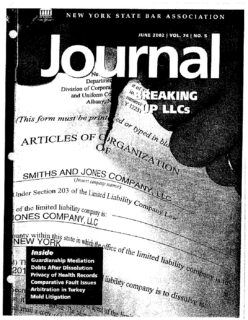
I would make a very large wager that the state of the law and tax treatment uncertainty at the time explains why Section 10.1.1 of the Picotte LLCs’ operating agreements was written to track LLC Law § 701 as it was then written.
The IRS’s check-the-box regulations went into effect in 1997. In 1999, the New York legislature amended § 701 to authorize LLCs to exist in perpetuity. It also flipped the default rule to provide that the death, dissolution, etc. of a member does not trigger dissolution unless a majority in interest of the remaining members votes to discontinue the business.
Putting aside the Picotte siblings’ apparent failure to adopt a succession plan when they were younger and before antagonisms arose, I can’t understand their failure at least to amend their operating agreements in the wake of the 1999 amendment to the statute as did many, many New York LLCs at the time.
Recent Comments