
On Sunday, the Trump administration’s plot to derail the Alaska Senate election got unceremoniously yeeted into the sun. Chief Judge Sharon Gleason dismissed the trollsuit without leave to amend, finding that the requested relief is not something any court could grant. She also made time to ding the government for shoddy lawyering.
The DOJ was so embarrassed that it immediately ran to the Ninth Circuit to get its ass kicked again.
The debacle started October 22, just 12 days before the election, when the Justice Department sauntered into the District Court of Alaska demanding that the it block certification of the election if Democrat Mary Peltola wins. Mumbling vaguely about the purpose clause of the National Voter Registration Act, the DOJ asserted that the federal government “suffers an injury when the certification of the election for a federal office is tainted by a frivolous candidacy because that undermines confidence in the make-up and workings of the federal government.”
Yes, of course, this dumb turkey was signed by Associate Attorney General Stan Woodward, who is currently trying to get himself sanctioned in Judge Ana Reyes’s courtroom in DC so that Trump can steal a municipal golf course. There is no filing too outrageous or unethical for Woodward to attach his name to, and his entry of appearance is a surefire omen that crazy shit is about to go down.
(Side note: On Friday, Woodward popped into the “Broadview 6” case in Chicago to inform Judge Perry that the government regards discovery orders as entirely optional, and thus the DOJ won’t be complying, TYVM.)
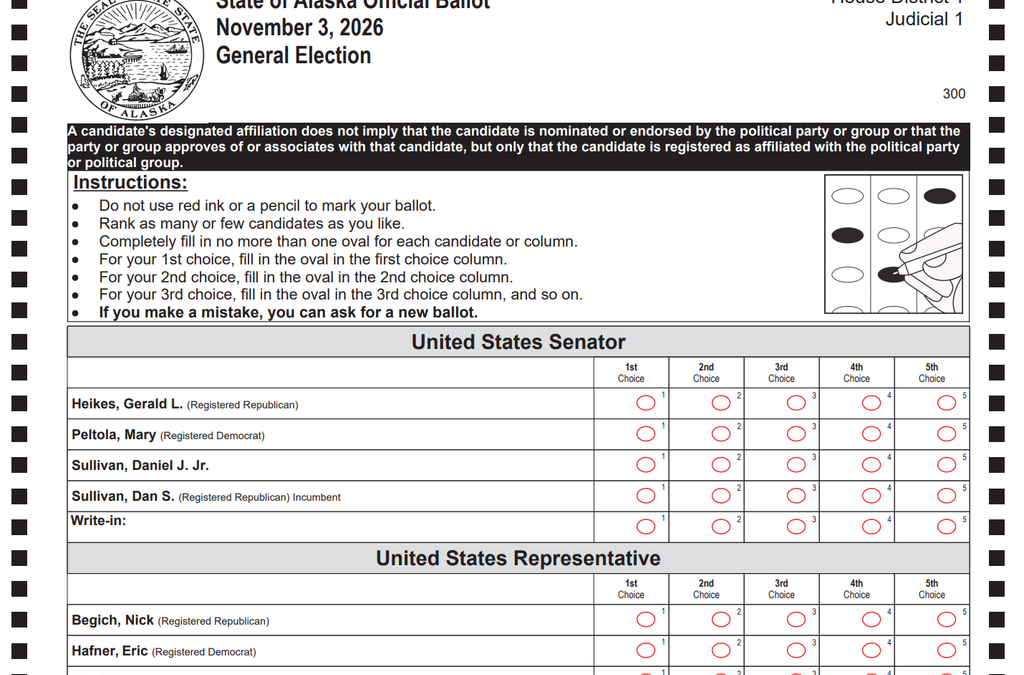
The government insists that a soundalike candidate on the ballot constitutes a fraud on the voters. But the Alaska Supreme Court ruled in June that Republican election officials couldn’t boot Daniel J. Sullivan off the ballot for having the same name as incumbent Senator Dan S. Sullivan. And so state officials ran the primary with a ballot that conspicuously tagged Senator Dan Sullivan as “(Registered Republican) Incumbent,” with no party affiliation listed for Daniel J. Sullivan, Jr.
Arguably, confusion helped “Decoy Dan” in August, when he took 2.5 percent of the vote and advanced to the general as one of the top four finishers. But that same confusion would almost certainly help Senator Sullivan in the general, since Alaska uses ranked choice voting, and any combination of Dan Sullivans in the top two spots ensures that all votes will pour into the incumbent’s pile.
But Vice President Vance has an answer for that, though, and it is that Alaskans are idiots.
According to the Trump administration, “some supporters of Senator Sullivan likely will inadvertently vote for Daniel J. Sullivan,” while others “likely will be confused as to how to rank the three Republican candidates.” Which would be a neat trick, since Daniel J. Sullivan isn’t labeled as a Republican on the ballot.
The New York Times was happy to play along, though, first publishing a pearl-clutching feature connecting “Decoy Dan” to the Peltola campaign, and then breathlessly wondering if Peltola’s shenanigans would spell the end of ranked choice voting.
After which the DOJ filed an amended complaint, accusing the Peltola campaign of fraud, while snarking that “what the New York Times reports is not always true.” Woodward added darkly that “This subversive ‘scheme’ ‘involved the party’s Senate committee and its top law firm’ — the Elias Law Group (the firm representing Alaskans For Mary and the DSCC in this matter).”
On Friday, he also docketed a “Memorandum of Points and Authorities in Support of United States’ Motion for Expedited Discovery and Preliminary Injunction,” without bothering to docket either a motion for discovery or a motion for preliminary injunction. Ooopsie! In a motion to expedite, he spelled out what he actually wanted: an order forcing Alaska to “preserve and segregate all ballots ranking Daniel J. Sullivan for the purposes of investigating whether such ranking was the product of voter confusion.”
That same day, Alaska’s U.S. Attorney Michael Heyman held a press conference, flanked by the FBI and the Alaska State Troopers, promising that law enforcement was “working to make sure that your vote counts in a way that you meant and intended it to count.”
Neither Heyman nor Woodward is keen to explain how the government intends to suss out voters’ true intentions — probably because it would involve hovering over them at the ballot box shouting “WERE YOU CONFUSED WHEN YOU FILLED IN THAT BUBBLE?” Reading between the lines, it appears that the FBI intends to “segregate” mail-in ballots for Daniel J. Sullivan, along with the envelopes they came in, and then go to voters’ homes to shout at them there. But that’s not better, which is probably why the government has been so cagey
As for the state defendants, who originally tried to kick Dan J. off the ballot, they are extremely not down for a federal takeover of their election.
“The United States’ opposition provides no reason for this Court to entertain this meritless lawsuit any longer,” they fumed on Saturday, adding that “the relief demanded is inappropriate and not even possible given Alaskan voters’ vital right to ballot secrecy.”
Yesterday, Judge Gleason agreed.
“The Court cannot grant the United States the relief it seeks because the United States has failed to establish the redressability prerequisite for Article III standing,” she wrote, noting that the only way to “investigate” is to compromise the secrecy of the ballot for mail-in voters.
The judge is also ticked at the quality of lawyering by the government. As she points out, the request to segregate ballots “is nowhere in the Amended Complaint; rather, it appears in the United States’ separate filing seeking a preliminary injunction.” This drops to a footnote noting that the DOJ failed to filed either an actual motion for a preliminary injunction or a proposed order as required under District of Alaska’s Local Civil Rule 7.1(b)(2).
Civil procedure is hard! And, in fairness, Woodward was a little busy lighting himself on fire in open court on Friday when the motions were filed.
The government immediately noticed an appeal to the Ninth Circuit, no doubt hoping to score a friendly panel. But even the friendliest panel will have a hard time crafting meaningful relief in the next 48 hours, particularly since tens of thousands of voters already voted early in-person or by absentee ballot, which will be processed for tabulation on election night. And if Senator Sullivan wins on Tuesday, or Peltola beats him by more than “Decoy Dan’s” vote total, the whole issue is moot anyway.
But even if this thing flames out on impact at the Court of Appeals, the Justice Department will have left it all on the field trying to muddy up a Democrat in the run-up to the election. Peltola will have been forced to spend the last week of her campaign fending off charges of fraud and skullduggery. And if the race is tight, Republican Governor Mike Dunleavy can use the lawsuit as justification to delay certification of the result.
And isn’t that what the DOJ and federal courts are for?
US v. Alaska [Docket via Court Listener]
Liz Dye produces the Law and Chaos Substack and podcast. You can subscribe by clicking the logo:
The post Stan Woodward’s Brainwave Shorts Out In Alaska appeared first on Above the Law.
Recent Comments